
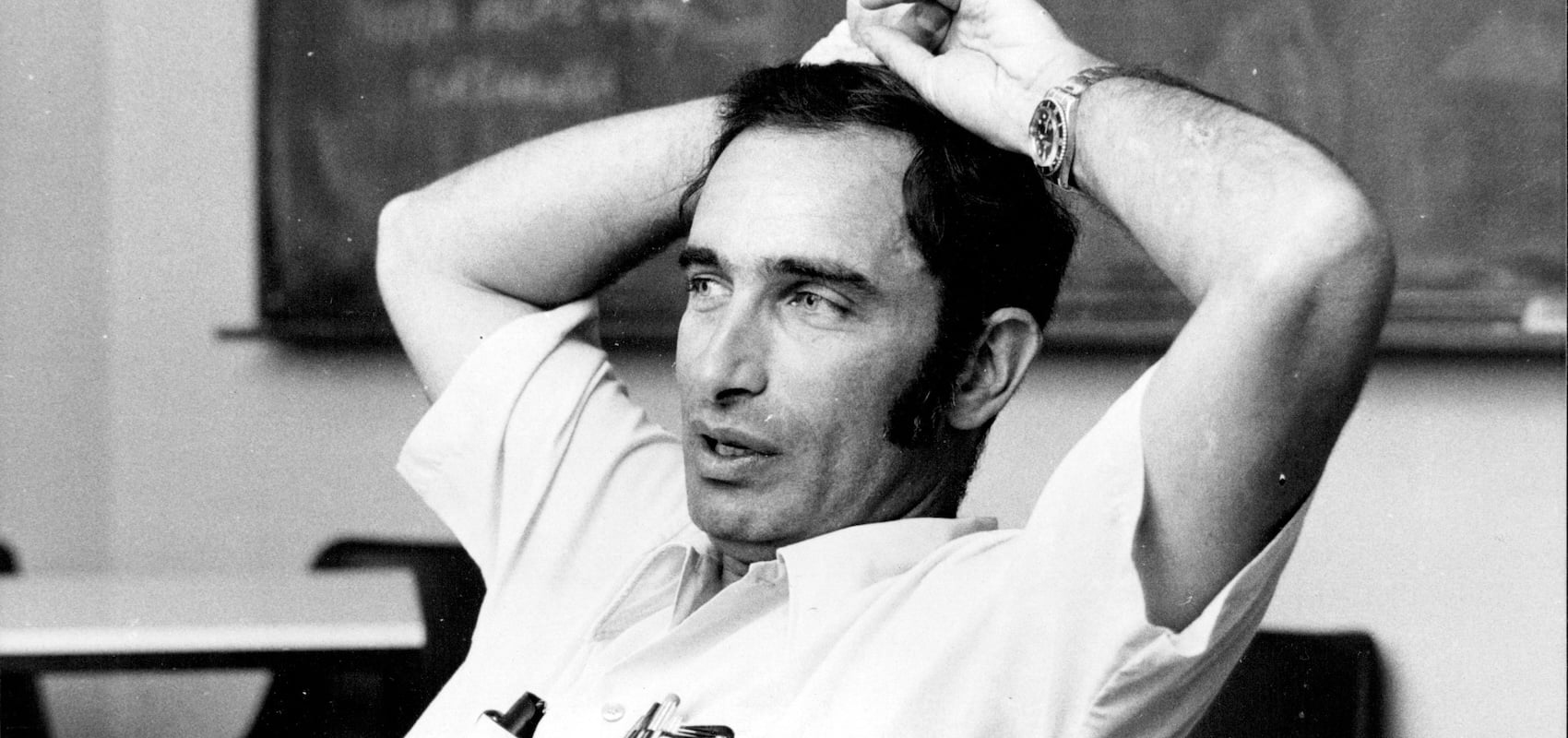
Paul Ehrlich, noted author of The Population Bomb, died last week. Few people have been so consequentially wrong as Ehrlich. Ironically, his name, translated from the German, means “honest, truthful, sincere.” It is remarkable how this PhD in butterflies and Stanford professor rose to such prominence, capitalizing on a wave of popular pessimism to attack civilization from the left.
Ehrlich’s Population Bomb begins with an arresting line: “The battle to feed all of humanity is over. In the 1970s and 1980s hundreds of millions of people will starve to death in spite of any crash programs embarked upon now. At this late date nothing can prevent a substantial increase in the world death rate . . .” Indeed, in the late 1960s, American society seemed to be coming apart. The threat of nuclear war loomed. Mass migration wore away borders. Disease spread. Ehrlich’s Population Bomb more caught the wave of alarmism than created it. The Rockefeller and Ford Foundations were already promoting population control across the world, especially in India and East Asia, in the early 1960s.
Many ears heard Ehrlich’s prophecies. He appeared more than twenty times on Johnny Carson’s Tonight Show. During his 1980 appearance, Ehrlich praised Eastern European countries for reaching Zero Population Growth. Imitators arose too, most notably the Club of Rome’s Limits to Growth, a book published in 1972. Limits, a cultural marker of sorts, saw several MIT professors use computer models to prove that coming population explosion would lead to resource depletion and declines in agricultural and industrial output. The only bright spot would be the rebirth of humanity after its impending collapse.
Ehrlich was an effective propagandist. In 1965, only about 30 percent of Americans were worried about population increases around the world. By 1971, 87 percent were worried that it was a problem in America, and almost half thought population control required “immediate action.” Roe arrived a short time later. In 1992, 68 percent were still worried. Those numbers have since cratered, according to Population Connection, the ambiguously titled successor organization to Ehrlich’s more direct Zero Population Growth organization. Concerns about overpopulation have the aura of a temporary madness, running hot in one generation and then cooling to the point of disappearance.
Skeptics always dogged Ehrlich. Most famous was his bet with Julian Simon, the free-market economist and techno-enthusiast. I read Simon’s The Ultimate Resource as a young man. Like others at the time, he was more worried about the world’s impending labor shortage. Fewer laborers would mean less creativity. With more people, Simon thought, human ingenuity would flourish. There would be no worries about running out of commodities like copper or tungsten. Simon allowed Ehrlich to pick five commodities that he thought would increase in price during the next decade. Each ended up decreasing in price, consistent with Simon’s prediction.
Ehrlich’s predictions cannot be taken seriously today. Life expectancy climbed in most of the world after 1970. Mass famines didn’t materialize. Yet he felt no shame for being so wrong. So maybe “starvation has been less extensive than I (or rather the agriculturalists I consulted) expected,” he said in 2004. But many are still “very hungry.”
Ehrlich thought it was necessary to pretend that it wasn’t too late to fix these civilizational threats. He recommended precisely what the big foundations were already recommending in the 1960s and ’70s: more birth control; sterilization; publicly-financed abortion; a system of incentives to discourage more children; environmental controls. He also put his money where his mouth was, having a vasectomy immediately after his only child was born in the mid-1960s when he was in his early thirties.
As populations crater, Ehrlich’s propaganda about the population bomb looks particularly ill-timed—or, as the New York Times would say, “premature.” Some bombs don’t go off. What motivates a man like that? How could someone so wrong be lauded for so long?
Strangely, as confidence in civilization craters, many like Ehrlich surrender all hope in the future. The kids call it “blackpilling.” His disposition of despair comes in many shapes and sizes.
Ehrlich’s despair is consistent with both his predictions of overpopulation and today’s reality of depopulation. His predictions about the depletion of resources, the impending nuclear war, and mass starvation were misanthropic. Human beings, he believed, could never live together rationally, scientifically, and without conflict—not unless they were willing to undertake a total revolution under the guidance of experts. Strangely enough, turning to experts to determine who should be sterilized is something people resist. So—the world must end.
Much the same attitude lies at the heart of not having children at all today. Lost in fleeting ambitions and pleasures, people cease betting on the future by having children. Having children is a mark of hope not without political implications. Less worried about starvation, today’s childless still hate the civilization that produces plenty. The childless are Ehrlich’s epigones, without his predictions of doom and gloom but carrying its strange “promise” of hopelessness.
The road to wisdom, wrote Hegel in the introduction to his Phenomenology of Spirit, is “a highway of despair.” Intellectuals are fundamentally negative, suffering as they seek what is missing in the goods of today. But such negative wisdom is simply part of growing up and reaching greater understanding. Ehrlich never achieved that. Greater thinkers find the “rational in the actual,” as Hegel always sought to do, which grounds the human penchant for hope.
When I was young, I thought Simon’s bet showed the importance of human ingenuity. It does. But human ingenuity itself shows how crucial hope is to a life well lived. Ehrlich was caught on the highway of despair, without an off-ramp to a deeper wisdom.
Photo by Kevin John Berry/Fairfax Media via Getty Images
