
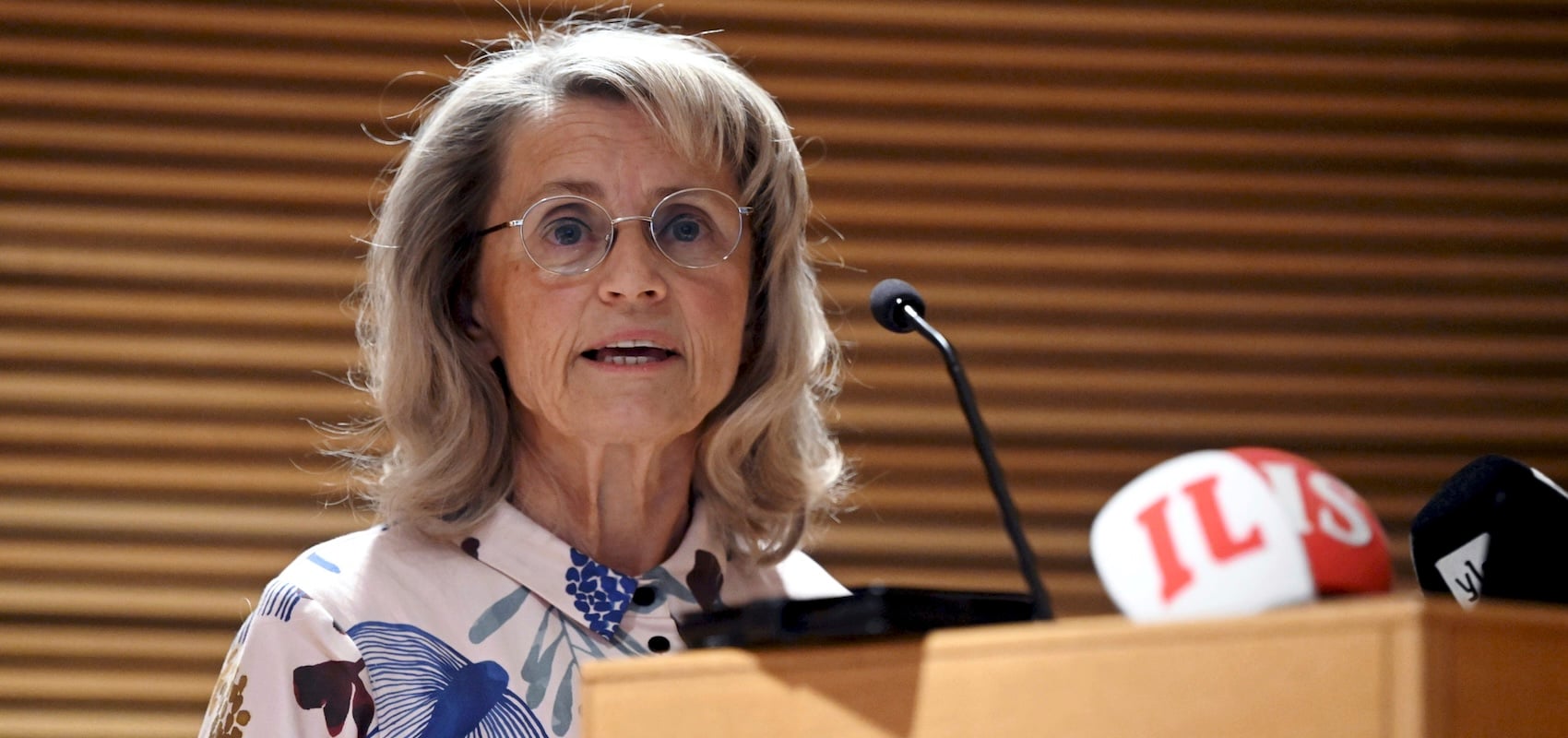
On March 26, the Supreme Court of Finland handed down its verdict in the case of Päivi Räsänen, a doctor, grandmother, and long-serving member of the Finnish parliament. The court found her guilty of “insult” for a church pamphlet she wrote in 2004, in which she expressed her views on sexual morality. On the basis of the decades-old pamphlet, she has been criminally convicted for “making available to the public a text that insults a group.”
Finland’s highest court fined her €1,800—giving her a criminal record—and ordered the offending passages destroyed and removed from the internet. Fortunately, the court unanimously acquitted Räsänen for a 2019 tweet in which she criticized her church’s sponsorship of a Pride event and quoted Romans—the impetus for her whole ordeal. The case has wound its way through the Finnish courts for nearly seven years since police first launched their investigation into Räsänen following her tweet.
The Christian parliamentarian was subjected to police investigation, three criminal charges, three trials, and now a conviction for “hate speech” under the “War Crimes and Crimes against Humanity” section of Finland’s criminal code. All of this for peacefully expressing her beliefs in the public square.
The central, implicit promise of “hate speech” laws is that there exists a manageable boundary between speech that is permitted and speech that is criminal. The Räsänen case demolishes that promise.
Eleven judges across three levels of the Finnish judiciary spent over six years trying to locate the line. They could not agree. The Helsinki District Court acquitted Räsänen unanimously on all charges in 2022. So did the Court of Appeal in 2023. Then the Supreme Court split 3–2. Its own rapporteur, the senior lawyer who delivers a formal recommendation to the justices, concluded that all charges should be dismissed. Two of the five justices agreed; three did not.
Consider what the court decided. Räsänen’s tweet was deemed unanimously lawful. The court reasoned that she was using religious language to speak out on a topical issue as a member of parliament and church council member. But while the same reasoning could presumably apply to the pamphlet, the majority reached the opposite conclusion. The reasoning turns on contextual distinctions so fine it’s difficult to extrapolate any broad principles.
This is not a sign that the law needs fine-tuning. It is evidence that the enterprise is misconceived. If eleven trained judges cannot agree—after years of argument and hundreds of pages of legal briefs—where the boundary between lawful opinion and criminal insult lies, then no ordinary citizen can be expected to know either. A criminal law that is unclear about what it prohibits is not a law anyone can fairly be expected to obey. Instead, it becomes a tool to be wielded to suppress disfavored speech.
When Räsänen first came under investigation in 2019, she was asked to explain what she meant by citing Romans. The state prosecutor, Anu Mantila, told the Court of Appeal that, “You can cite the Bible, but it is Räsänen’s interpretation and opinion about the Bible verses that are criminal.”
Räsänen stood firm. So did Bishop Juhana Pohjola, who was dragged into the case for his role in publishing the pamphlet through his church foundation. But seven years of investigation and trial exact a cost that no acquittal, partial or otherwise, can repay.
Most people are not former cabinet ministers with an international legal team behind them. Many, faced with a police interrogation about a blog post or a pamphlet or a social media comment, would, perhaps understandably, fold. They would delete the post, issue an apology, and resolve never to speak on the subject again. You do not need a conviction to silence people. You just need to make the process painful enough that only the exceptionally courageous will endure it.
Meanwhile, the Supreme Court’s own judgment acknowledged that Räsänen’s pamphlet “did not contain incitement to violence or comparable threat-like fomenting of hatred.” It found that her conduct was “not particularly serious in terms of the nature of the offense.” And yet, here we are: a criminal conviction, a fine, and a criminal record for a sitting parliamentarian. A European democracy has ordered the destruction of text from a church pamphlet written over twenty years ago, under a provision of the criminal code that did not even exist in its current form when the pamphlet was first published.
This is not a matter of one panel of judges getting the balance slightly off. The problem is the framework itself. Hate speech laws vest in the state a power to decide which opinions may be expressed and which must be suppressed. Once that power exists, it will be exercised. Across Europe, we see that it is most routinely exercised against anyone whose views the prevailing consensus finds uncomfortable. Many will look at this case and rightly ask whether laws of this kind reflect the society they want to live in.
Even after two unanimous acquittals, the state kept pursuing Räsänen. The uncertainty this creates, the chilling effect on ordinary citizens who might think twice before expressing their beliefs, the sheer weight of the process itself: these are costs that fall on everyone, not just the victims. Only structural reform can address it. Hate speech laws do not need better judges or clearer guidelines. They need to be taken off the books.
Photo by EMMI KORHONEN/LEHTIKUVA/Sipa USA
