
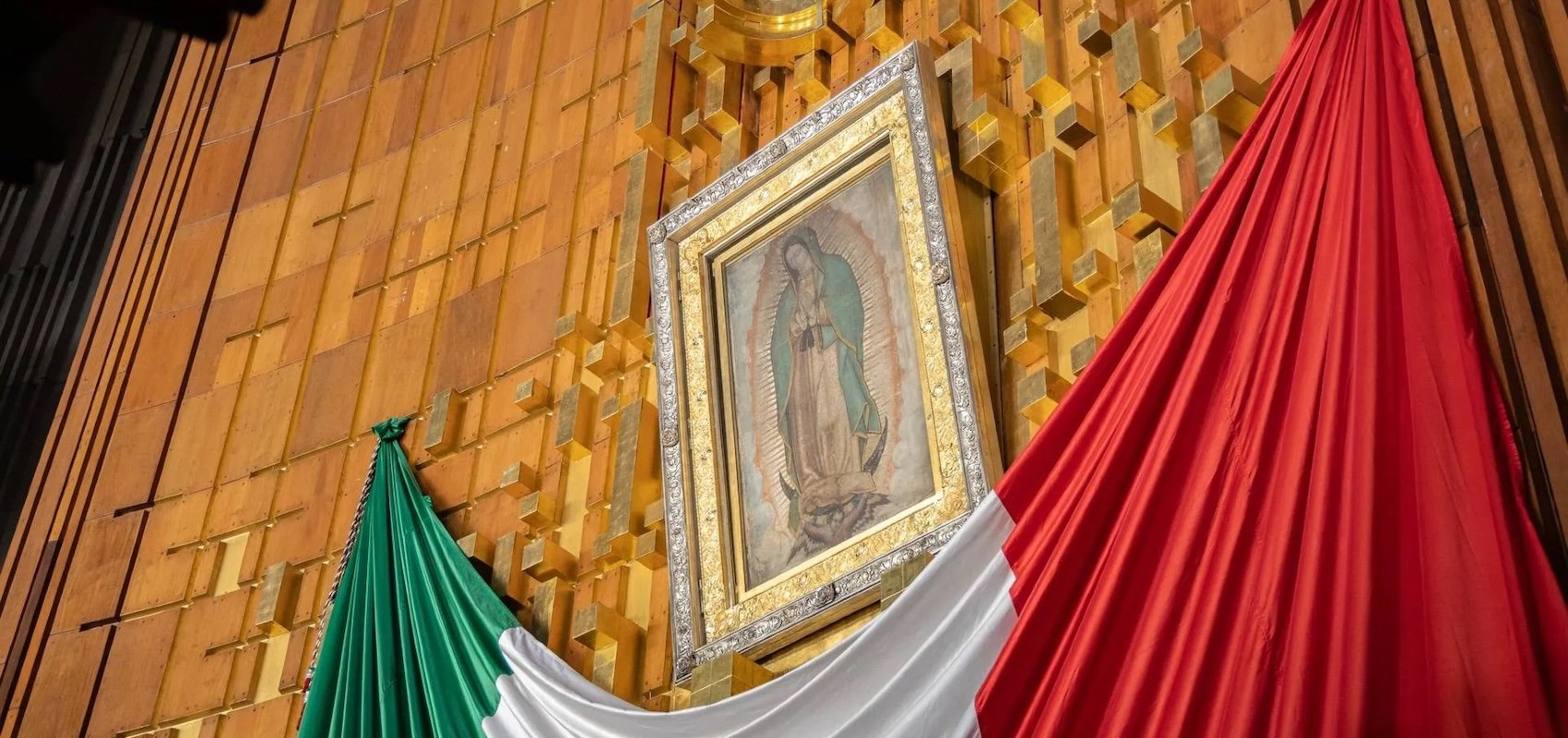
It’s a Marian week on the Catholic calendar, with three feasts observed in five days: Immaculate Conception (December 8), Our Lady of Loreto (December 10), and Our Lady of Guadalupe (December 12). Move on nine months from Mary’s conception, and there is another Marian week in September: Nativity of Mary (September 8), Holy Name of Mary (September 12), and Our Lady of Sorrows (September 15).
Catholic piety is most accommodating of feasts, shrines, patronages, and titles for the Blessed Virgin Mary—especially titles. Litanies—a collection of titles under which to invoke the intercession of this or that saint—can be baroque in their formulations. St. Francis Xavier, for example, is invoked in his litany as the “scourge of demons and destroyer of idols.”
The best-known litany is the Marian “Litany of Loreto”—it will be prayed far and wide today—which addresses the Blessed Mother as “Tower of David” and “Tower of Ivory.” Many of the pious who have prayed it for decades have no idea what those titles mean. Titles can be like family nicknames, or terms of endearment, the use of which does not depend on knowing the original meaning.
So it was a bit unusual when the Vatican’s Dicastery for the Doctrine of the Faith issued a “doctrinal note” last month on Marian titles, warning against the use of “Co-redemptrix” and “Mediatrix of All Graces” as suitable titles for Mary. The document, Mater Populi Fidelis (Mother of the Faithful People) stated that “given the necessity of explaining Mary’s subordinate role to Christ in the work of Redemption, it is always inappropriate to use the title ‘Co-redemptrix’ to define Mary’s cooperation.” Regarding “Mediatrix,” the document does not teach that the title is “inappropriate” but that it should only be used with “special prudence.”
Msgr. Thomas Guarino in these pages outlined the history of debate over Marian titles at Vatican II, and saw echoes of it in the latest doctrinal note. This week, the theological commission of the International Marian Association issued a “scathing critique” of the doctrinal note, calling for its “re-evaluation.” The association includes ecclesiastics and theologians of high caliber and reliable orthodoxy. It supports “the solemn papal definition of Our Lady’s role as Spiritual Mother of all humanity, inclusive of her maternal roles as Co-redemptrix, Mediatrix of all graces, and Advocate.”
I do not wish to enter the debate over the titles themselves. It is an oversimplification to be sure, but once the Church declares Mary to be Mother of God (at Ephesus in 431), it seems that almost all other titles are defensible—and perhaps unnecessary.
I would argue a different point about “Co-redemptrix” and “Mediatrix,” namely that Marian piety tends toward the particular, not the general. For Christ, his titles speak of what is accomplished on a cosmic dimension: Messiah, Savior, Redeemer—”God from God, Light from Light, true God from true God,” “through him all things were made.”
Marian devotion is different. Marian devotion is particular, associating Mary’s presence with various places, conditions, or states of life. Jesus works on the largest imaginable scale; Mary works beside me. That’s a matter of feeling, not theology, but feelings are important.
The Litany of Loreto invokes Mary as “health of the sick” and “comfort of the afflicted.” Pope Francis added “solace of migrants.” While she is Queen of Heaven and Earth (the fifth glorious mystery of the rosary), the litany gives her more particular titles: queen of angels, patriarchs, martyrs, confessors, virgins. St. John Paul the Great added “Queen of Families.”
This week’s feasts invoke Mary as associated with particular places—Loreto and Guadalupe. It is a moment of illumination when a Catholic child learns that Our Lady of Lourdes and Our Lady of Fatima are not different women. How particular can Mary’s patronage be? Near the airport in Toronto is the parish of Our Lady of the Airways. St. Philip Neri’s church in Rome—still the Chiesa Nuova after nearly five centuries—is officially Santa Maria in Vallicella, St. Mary’s in the Little Valley. The principal Marian church in Rome, Santa Maria Maggiore, the favorite of Pope Francis and his final resting place, marks its feast day on August 5, Our Lady of the Snows. (A miraculous summer snowfall in Rome indicated where it was to be built.)
There is a theological case to be made for the more expansive titles. After all, what is more expansive than Mother of God? But even if the International Marian Association were to succeed in its efforts to add another Marian dogma about co-redemption, I doubt it would be taken up by popular piety. There are images in Catholic churches and homes of the Immaculate Conception and the Assumption—two Marian dogmas—but they are outnumbered a thousand to one by images of Our Lady of Guadalupe, Lourdes, Fatima, Częstochowa. St. Patrick’s Cathedral just this year added a massive mural including Our Lady of Knock, Ireland.
When Pope Leo XIV was elected, his first words from the balcony noted that it was the feast of Our Lady of Pompeii. Soon after he visited Santa Maria Maggiore to venerate the image of Our Lady, Salus Populi Romani, which Pope Francis visited over a hundred times. “Salvation of the Roman People” is not local patriotism, much less chauvinism. It is the maternal dimension of salvation history. God so loved “the world” that he sent his Son, but that Son had to have a particular home, the home of Joseph and Mary. Our homes are local, not universal. The maternal heart makes a home, which is why the Catholic parish in Gaza is dedicated to the Holy Family. Even seeking refuge in Egypt, Mary made for Joseph and Jesus a home.
Bruce Springsteen was not consulted by the International Marian Association, but his song about Mary this year reached more people than the association’s commission report. The song was not called the “Mediatrix of All Graces,” but “Our Lady of Monroe.” It tells of a retired Newark detective who worked twenty-five years “on the streets where the Lord does not intervene.” His faith is weak, but he hangs his rosary on the rearview mirror as he heads south on the New Jersey Turnpike through Monroe township. He asks Our Lady of Monroe to “give me peace, peace I’ve never known.” The detective may not recognize the Lord in the streets but he knows his Mother is out there on the turnpike.
In the places where Jesus is hard to find, in those places where it appears he does not intervene, Our Lady of This Particular Place is present—in Loreto, in Guadalupe, and in Monroe.
