
Sixty-four percent of American Catholics say the Church should allow women to be ordained as priests, according to Pew Research. In several Latin American countries, women’s ordination is even more popular (in Brazil, a staggering 83 percent of Catholics are in favor). The survey was released just a few months after the late Pope Francis rejected the possibility of female deacons during an interview with 60 Minutes, a rejection all the more relevant after the question was raised in the Synod on Synodality. James Keating, in a 2025 article for First Things, elaborated the theological reasons why female ordination to the diaconate, let alone the priesthood, is impossible. And as a recent report has it, all sources indicate the official collapse of the conversation.
I am genuinely baffled by the question of female ordination. Journalists are eager to highlight fringe groups like the Association of Roman Catholic Women Priests and the Women’s Ordination Conference when they’re on the march, and surely there exist some women who want to be priests. But I have never met one in the wild. And by now I should have.
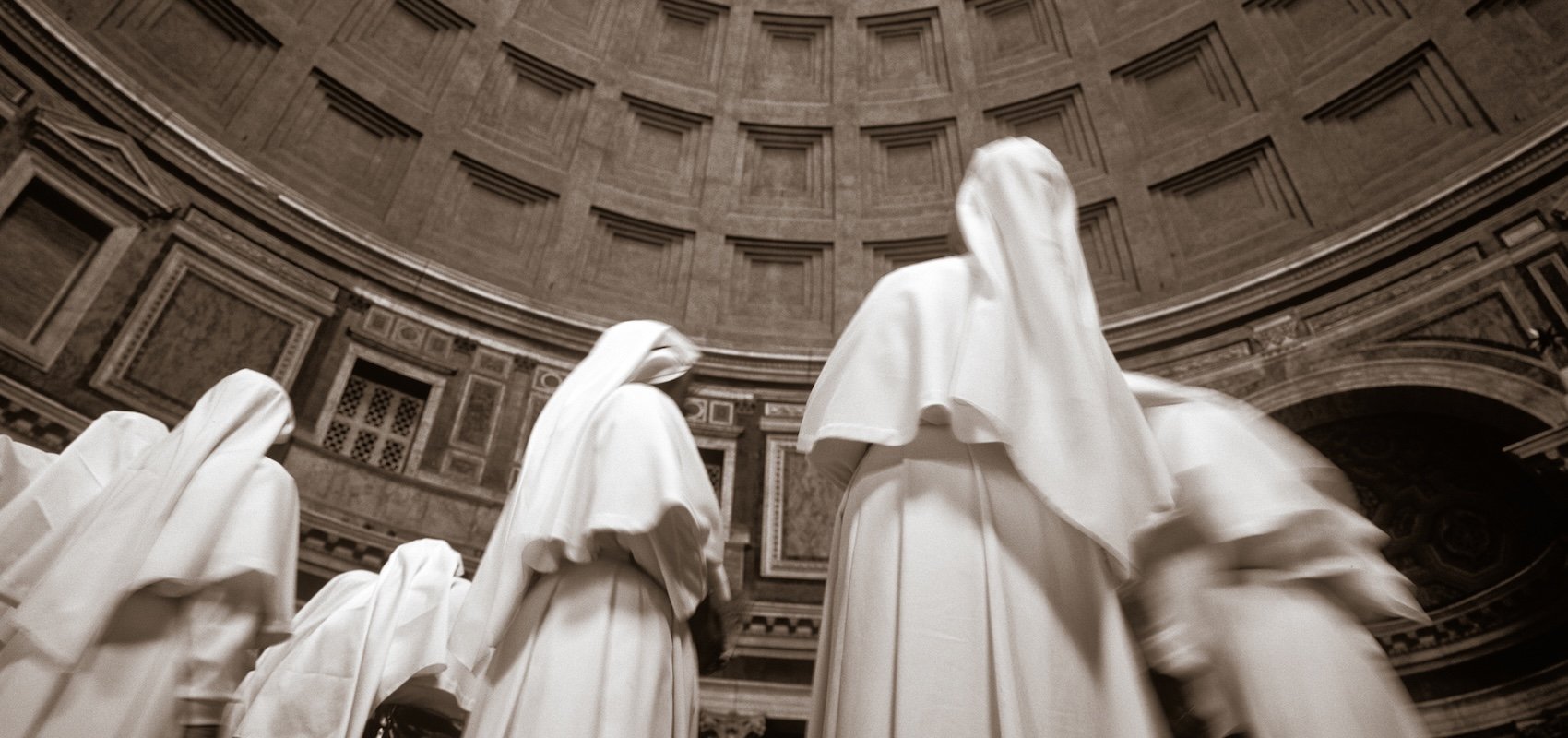
When I was twenty-one, I joined the Ann Arbor Dominicans, one of the few communities in the world to countervail the trend of demographic collapse. My novitiate of forty included women of every age, from across the country, and even from Melbourne, British Columbia, and Jakarta. We had an Air Force vet, an astronautical engineer, and a scientist, as well as teachers and plenty of women who, like myself, had left school to join. For all our differences, what we shared was the white martyrdom, the hunger to be perfectly poured out, that had drawn us to the consecrated life.
Oprah came to the motherhouse in the early 2000s to document life in the chapel and cloister. She interviewed some women to learn why they had entered and also toured the house. As you walk through the halls you see impeccably kept cells, larger than you would imagine, with a window, a rocker, and a desk in addition to the bed. Dominicans live a joyful, studious, balanced life, and care for souls primarily through teaching. The expansive charism that marries monastic practice to the apostolate is derived from Christ’s model, whose daily ministry was complemented by contemplative union with his Father.
Not one of my sisters wanted to be a priest.
As a first-year novice I read almost exclusively Carmelite authors. Once, my novice mistress told me that every Dominican has a Carmelite heart. During our canonical (first) year, novices spent no more than two weeks outside the cloister. We did not read current events or fiction; instead, we invested our time in meditation, practicing silence, and reading spiritual literature. We were building the interior cloister that would be the foundation of our apostolate. And that’s where I found the nun who wanted to be a priest.
In a nineteenth-century French Carmel, the now-famous Thérèse of Lisieux wrote: “The vocation of a Priest! With what love, my Jesus, would I hold Thee in my hand, when my words brought Thee down from Heaven! With what love I would give Thee to souls! . . . Like the Prophets and Doctors, I would be a light unto souls . . . I do not sigh for one torment; I need them all to slake my thirst. . .”
She describes the torment of her lack—a sickly, uneducated, highly sensitive woman with no opportunity for worldly advancement. Carmelite nuns are not teachers or scholars or doctors. They do not run soup kitchens or minister to the addicted, the lonely, the sick, the suffering. Her limitations are distressingly proximate, having vowed never to leave the small convent property even to go to a grocery store. Starving for the apostolate, she is consoled by the teaching of Paul:
“Be zealous for the better gifts. And I show unto you a yet more excellent way.” The Apostle then explains how all perfect gifts are nothing without Love, that Charity is the most excellent way of going surely to God.
I knew that the Church has a heart, that this heart burns with love, and that it is love alone which gives life to its members.
She discovered that the starving of her soul could not be satisfied by her own work, not even by performing the glorious role of the priest. Thérèse had joined the convent because she had a supernatural appetite to love perfectly. And in the infinity of perfect love, the apparent limitations of her body, status, and education became irrelevant. Shedding a desire to mean anything in a worldly sense, she could instead serve perfectly, with undivided heart, the work of her heavenly spouse. His work is love.
Every Dominican has a Carmelite heart because every Christian is called to love perfectly. That is why St. Thérèse is patroness of the missions—her teaching has truly universal character. But there is also something uniquely feminine about her insight, which is that women are perfect recipients of love. The best way to receive is to have the most room to receive, the most emptiness.
The Bible is full of examples of women whose strength came precisely from their littleness: Ruth, the penniless widow, begs for the protection of Boaz; Esther’s fainting is the pinnacle of her strength; Abigail, supremely vulnerable, runs after David to implore his mercy; Mary rejoices that she is seen in her lowliness. This theme is seen in the traditionally barren: Hannah, Rachel, Elizabeth, and Anne are the empty vessels through whom God saves his people. Thérèse, worldly dross, is enthroned in heaven. Women embody the weakness in which God’s power is made perfect.
This paradox is precisely why none of my sisters envied priests. We were building the interior cloister, like Teresa of Ávila instructs us. The cloister is a place whose only law is the principle that God’s action is not limited by space or time. In it, women, by plenty of worldly metrics weaker than men, are transfigured. Nuns are proof of the prodigality of God’s love.
When people ask me why I left the convent, I point them to the life of another woman Doctor of the Church. God instructed Catherine of Siena, all of seven years old, to move into a room of her parents’ house, where for several years she prayed and fasted like an anchorite. She eventually was mystically married to his Son, and she expected to enjoy that unitive love in seclusion for the rest of her earthly life. Much to her surprise, God told her that, taking the cloister with her, it was time to minister to souls. Raymond of Capua’s biography of Catherine details the many miracles God went on to perform through her, miracles that might never have occurred had she stayed in her cell. Dwelling in her cell for a period of formation, she carried her cloister with her for the rest of her life.
I left the novitiate two months before I would have professed first vows, on the feast of Catherine of Siena. My leaving was not entirely of my own choosing; the Lord worked through painful circumstances to set me on the path he had chosen for me. I’ll never fully understand the mystery, torture, and ecstasy that followed. Should I have derailed my educational and professional trajectory to live in a convent for a few years? Should I have risked my relationship with my family by leaving them the way I did? Should I have then braved the loneliness of leaving the community, horrified that I was abandoning God? To all of these I must respond with a resounding “Yes,” recognizing with St. Catherine that, sometimes, the contemplative life is meant to shape our understanding of the active life. (It certainly prepared me for marriage, among other things.)
I have often said that if there is one thing religious life taught me it was that I had to be able to say to God: You are enough for me. This is the refrain of detached love. I could limit conversation with my family because I know God loves them more than I do; I could feel perfectly loved by sisters I barely know because God informs our friendship; I could obey even when I do not understand because I know God works through superiors. Detached love is perfect love because it is selfless.
As I reflect on this period now, I see that when I offered God everything, he really received everything. You are enough for me, he said, when I entered, and every day thereafter. Your youth, your failings, your ill-kept silence are enough for me. With them I want to make myself known. He set me at heaven’s banquet, even though my stay in the cloister would be temporary. He taught me to take it with me, and that through it he could draw souls to himself.
My experience taught me not only that God’s power is sufficient for us but also that women are naturally suited to living this truth. God offers authority in the role of the priesthood, and he offers trust in the role of the contemplative. He will not be outdone in generosity to those that open their hearts to the secrets of the King.
