
One of the most striking aspects of our therapeutic age is the increasing inability of many to sustain a sane and coherent moral hierarchy. Perhaps this stems from the omnipresence of social media. Everything, everywhere always demands our attention and yet, with nowhere solid to stand, we have no way of judging what is important and what is trivial. Or perhaps it’s because the label of “victim” has become the most coveted title. Now many seek the “prize” without having been subjected to real abuse—abuse that no one would wish upon himself.
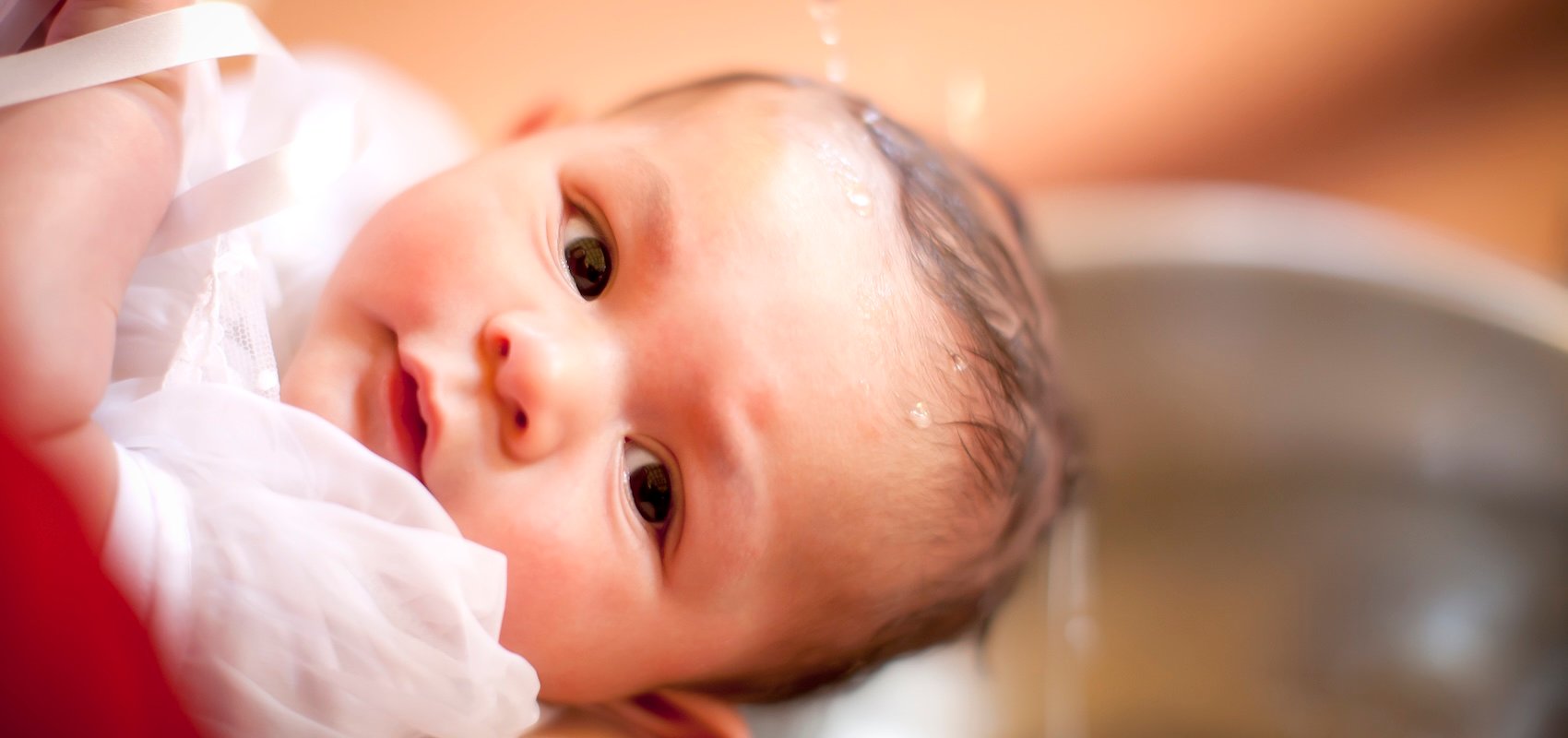
A prominent Catholic recently argued in the Irish Times for a new category of victim: those subjected to infant baptism, especially as practiced by the Catholic Church. Former president of Ireland and canon lawyer Mary McAleese declared it to be “a long-standing, systemic and overlooked severe restriction on children’s rights with regard to religion.” Really? At the very moment when thousands are being slain in Iran for protesting the brutal religious regime, McAleese apparently lies awake at night worrying about infant baptism. This is an eloquent testimony to the moral disorientation that marks our present age.
Several comments are in order. First, McAleese does not deny that baptism brings certain “spiritual” benefits, such as “expunging original sin” and “opening up . . . the flow of God’s grace.” But she objects to the lifelong membership of the Church that baptism claims to involve. Of course, her fear of the objective responsibilities that baptism entails only has force if she accepts that what the Church teaches about baptism is true. Yet, like a good therapeutic consumer of spirituality, she embraces what comforts her and discards what causes discomfort or demands too much.
Second, McAleese’s hyperbolic language is ridiculous. Reflecting on her own baptism, she laments that “nothing else was to shape my life so powerfully or impose such formidable restrictions on my inalienable intellectual human rights as that brief Sunday baptism ceremony 7½ decades ago.” Really? Nothing else had such a powerful impact on her life? None of her years pursuing an education? Her marriage? None of the children to whom she gave birth? None of the relationships she had with friends and mentors, intellectual and spiritual? Not one of those shaped her in a more profound way than a ceremony that she sees as deeply problematic in part because she has no recollection of it? That is very hard to believe.
Third, she clearly does not understand that we live in a secular age. As Charles Taylor commented, we today can believe in the same things that people did in the fifteenth century—but unlike them, we choose to believe, whereas they had no choice. In that sense, we might provocatively claim that even Catholics are now Protestants. We are creatures of religious choice. Catholics today may be baptized as infants, but if they are still practicing as Catholics by age twenty, it is because they have chosen to do so. The Church might still claim the apostates as members, but it makes no practical difference. Yes, the Church can excommunicate, as McAleese points out—but that power only has weight if the Church’s teaching about herself is true. Since McAleese rejects church teaching, excommunication should, in her view, amount to little more than an empty gesture.
And that leads to another significant point. McAleese herself has spent much of her public life attacking the Church’s teaching on male ordination, abortion, sexuality, and gender. She was a signatory, for example, to the 2021 document “A Home for All.” That she remains a Catholic would indicate that the Church, far from using baptism as a means to corral and crush her members, is rather lackadaisical or even impotent in that regard. As a Protestant, I am always puzzled by Catholics who so clearly despise their Church’s teachings not only on what it means to be Catholic but even to be human. Why such people continue to use the label “Catholic” even while treating it in the most un-Catholic way—making it mean whatever they want—is a mystery to those of us on the outside. I would argue that the Roman Church hierarchy, far from being a despotic bully, is far too gracious and patient with the McAleeses within her fold. The Church would have far more credibility if she showed that she does make the kind of demands on her members that McAleese bemoans by taking firm action against those who have made careers out of mocking her teaching.
As to McAleese herself, her concern for the victims of infant baptism is quite a contrast to her lack of concern for the unborn. It is odd that baptism of an infant is so abusive whereas the killing of the same child in the womb is a human right.
I might conclude by saying that nothing else was to shape my life so powerfully or impose such formidable restrictions on my inalienable human rights as that act of love between my mother and my father that led to my conception fifty-nine years ago. I suspect McAleese would agree that life was something imposed upon me without my consent. It’s therefore just a pity that she does not extend the logic of her objections to infant baptism back to the moment when egg collides with sperm.

YOU MIGHT ALSO LIKE
Turned Away on Palm Sunday
In politics, diplomacy, war, or pretty much any field of human interaction, one must contend not only…
Timothée Chalamet Is Right About Art (ft. Suzy Weiss)
In this episode, co-founder and reporter for the Free Press, Suzy Weiss, joins Virginia and Germán to…
Via Crucis, 2026
The Way of the Cross—and the third, seventh, and ninth stations in particular—has been an especially appropriate…
