
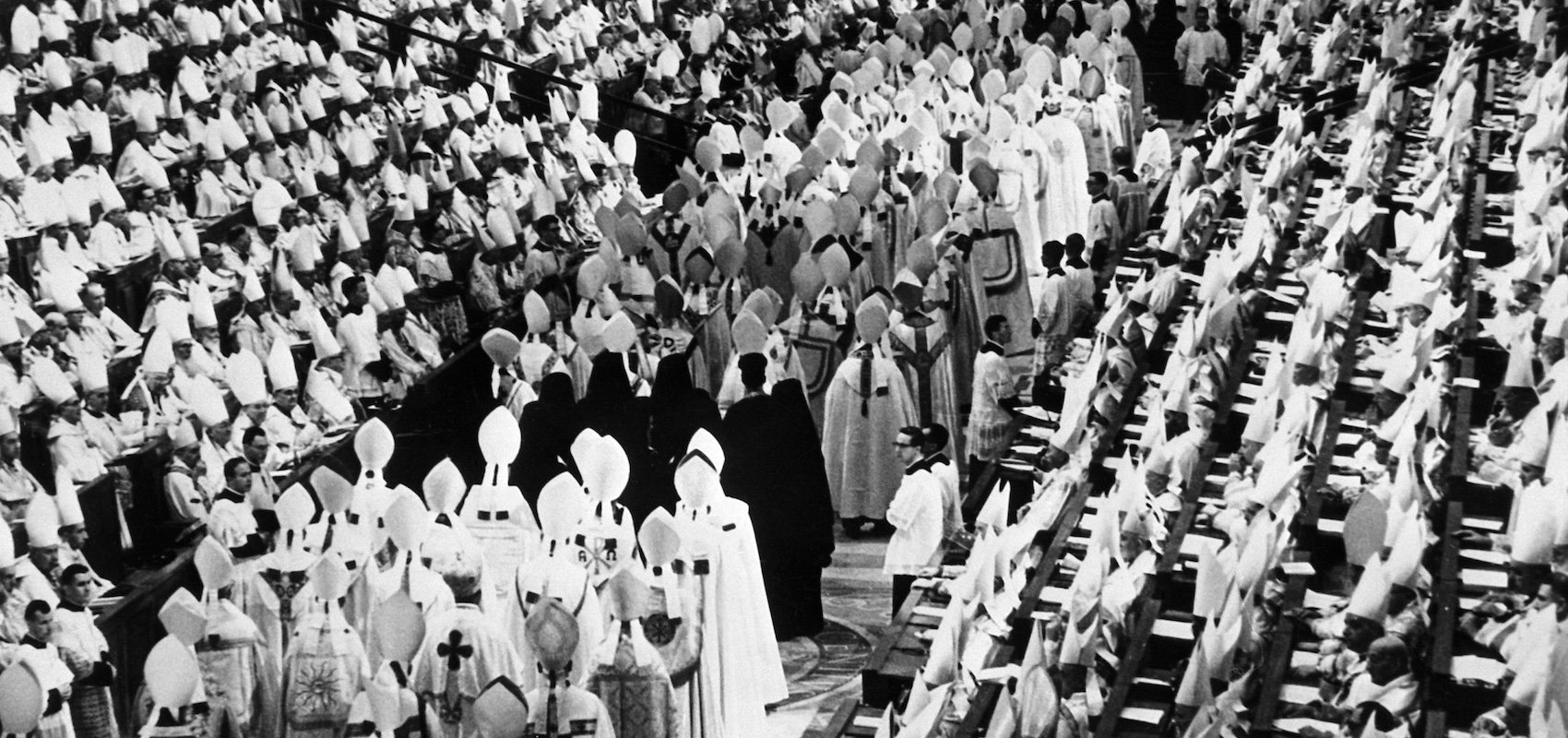
Before I went to university, Vatican II seemed to be a settled issue. By 1990, however, disagreements and different interpretations of its documents had emerged, stirring controversy. The operation of taking them back from the hijackers was in full swing, led at the highest level by John Paul II and Joseph Ratzinger. A key aspect of this operation was to let Vatican II be Vatican II, liberating it from those who merely considered it a starting point for more radical changes in the Church. Increasingly, the sharp opposition between pre- and post-conciliar factions was becoming problematic—practically, theologically, and liturgically.
The liturgy wars that have emerged post-Vatican II are as lamentable as they are understandable: lamentable, because they allowed for politicizing tensions to enter a sacred space; understandable, because the liturgy is so important, so close to priests and the people, and has been so deeply reformed in the decades after Sacrosanctum Concilium was released in 1963. When you ask people what changed at Vatican II, they often say: Latin was abolished, the altars were moved, and Communion looks different. But curiously, none of these changes has a solid basis in what the council actually said. No wonder, therefore, that people, in the face of such liturgical changes, tried to hold onto the unreformed rites. First came small-scale accommodations under Paul VI and the traditionalist movement championed by Archbishop Marcel Lefebvre, followed by the provisions under John Paul II (Ecclesia Dei), culminating in the high point of openness and inclusion with Benedict XVI (Summorum Pontificum), which was later scaled back by Francis (Traditionis Custodes). Leo XIV has inherited a confusing situation that has yet to be resolved.
To make any progress, we need to put aside two predominant approaches. First, our problem is not how to accommodate, satisfy, or somehow placate the more ardent “traditionalists” who are “attached” to the older form of the liturgy. This allegedly pastoral attitude often comes across as paternalistic, and as long as we act and sound like that, we only reinforce the suspicion that some form of manipulation is at work. Behind the paternalism lies the flawed conviction that some people just need a bit more time to catch up while history moves invariably in one direction.
Second, we need to let go of liturgical obsessions. As Paul VI stated in 1963: “In liturgical matters, therefore, no real opposition should occur between the present age and previous ages; but all should be done so that, whatever be the innovation, it be made to cohere and to concord with the sound tradition that precedes it, and so that from existing forms new forms grow, as through spontaneously blossoming from it.” Neither those who reject all modifications, nor those who see the post-conciliar reforms as a complete reinvention of the liturgy, can be trusted. We should learn from our Orthodox brethren that schisms based on liturgical changes are very hard to heal.
Questions about Vatican II and about liturgical changes in its wake are first and foremost theological questions, not pastoral or liturgical. Because they relate to continuity and tradition, they are questions about revelation, and therefore God: theological in the strict sense. Vatican II itself prioritizes the topic of revelation (Dei Verbum) and the Christocentric vision of the Church (Lumen Gentium).
The post-conciliar debate about “Church as communion” vs. “Church as perpetual council” (as in, a “conciliar Church”) is also illuminating in this regard. It is a debate about the role and mission of the Church. Today’s emphasis on a “synodal Church” needs to be grounded in a eucharistic ecclesiology, so that synodal concepts and conversations are rooted in the sacraments, and through them in the divine communion of the Holy Trinity. In a eucharistic ecclesiology, the primacy of God shines brightly as the priority of grace is evident in how the sacraments build up the Church. Communion theology avoids the trap of never-ending self-reflection, distracting the Church from her mission to evangelize, teach, and sanctify—a distraction that often ends up in self-secularization, as highlighted, in different ways, by Popes Francis and Benedict XVI, especially with regard to the church in Germany.
Within the framework of communion ecclesiology, synodality cannot be considered a defining mark of the Church (like apostolicity or catholicity). Synodal methods need serious development and correction if they want to avoid devolving into a form of Catholic Pentecostalism, immunizing allegedly inspired insights against doctrinal evaluation. Catholic spirituality, theology, and church governance need to live in a space deeply permeated by the logos, by sacred tradition and Holy Scripture; any spirit that would compromise or contradict them is not the Paraclete.
We have to make sure that evangelization means sharing the “faith of the Church,” even if—precisely because—we are sinners. Christ’s liberating truth comes to us in the broad and deep river of living tradition. It is within tradition that Scripture came into being, was codified, and continues to be interpreted as the supreme condensation of God’s word. In particular, Scripture is proclaimed, received, and celebrated within the liturgy, which is the most powerful expression of sacred tradition. For this reason, we need to shed all fear of older forms of tradition. For the sake of evangelization, all Catholics need a “sincere reflection concerning their own fidelity to the Church’s Tradition,” as John Paul II puts it in Ecclesia Dei, including a “new awareness, not only of the lawfulness but also of the richness for the Church of a diversity of charisms, traditions of spirituality and apostolate, which also constitutes the beauty of unity in variety,” with respect and generosity toward those preserving older “spiritual and liturgical traditions.”
On all fronts, we have to soften hearts and minds, tone down liturgical hysteria, and embrace humility—all of which an Augustinian pope may be perfectly suited to foster. We need bridge-building, not condescension, as if the poor traditionalists just need a bit more time to get with the program. In fact, those confused about “the Council’s continuity with Tradition, especially in points of doctrine” (Ecclesia Dei), need to be corrected and called to deeper study.
Instead of pastoral concern, which can descend into paternalism, and liturgical anxiety, which can become obsessive, what we need is, in the words of Leo the Great, “the peace and truth of apostolic doctrine to reign everywhere.” The project of keeping traditional liturgy on the reserve is failing. It is necessary for everyone to understand Vatican II as part of the Church’s tradition; it is even more important to acknowledge that what we have done with that council is not good enough, including the post-conciliar liturgical reforms themselves. This will be a humbling, demanding process, another purification the Church has to undergo: So be it. And it will be challenging both for those leaving their traditionalist echo chambers as they encounter the real existing Church in all its complexity, and for all the people, priests, and even bishops as they embrace the traditionalist thorn in the side of their parishes and dioceses. To move forward together, we need real communion, real synodality—affective, theological, and liturgical. And if we avoid deep self-examination regarding liturgical renewal, we make the liturgical reform the blueprint of all kinds of tendentious interpretations of Vatican II. If, as Augustine writes, “in the One, we are one,” we can be unafraid of self-examination, set aside pride and suspicion, make progress together, and, in the words of Leo the Great, become “sharers in holy love.”
Image licensed via Getty Images.

YOU MIGHT ALSO LIKE
Retrieving the Modern Self
Contempt for modernity has become a familiar posture among intellectuals, preachers, and cultural critics. Modern individualism is…
Lou Holtz and Our Lady on the Dome
Lou Holtz hated to lose at football. Texas A&M’s 35–10 victory over his Notre Dame team in…
Antoni Gaudí’s Icon of the Universe
This year marks the hundredth anniversary of the death of Antoni Gaudí, the great medievalist-modernist architect from…
