
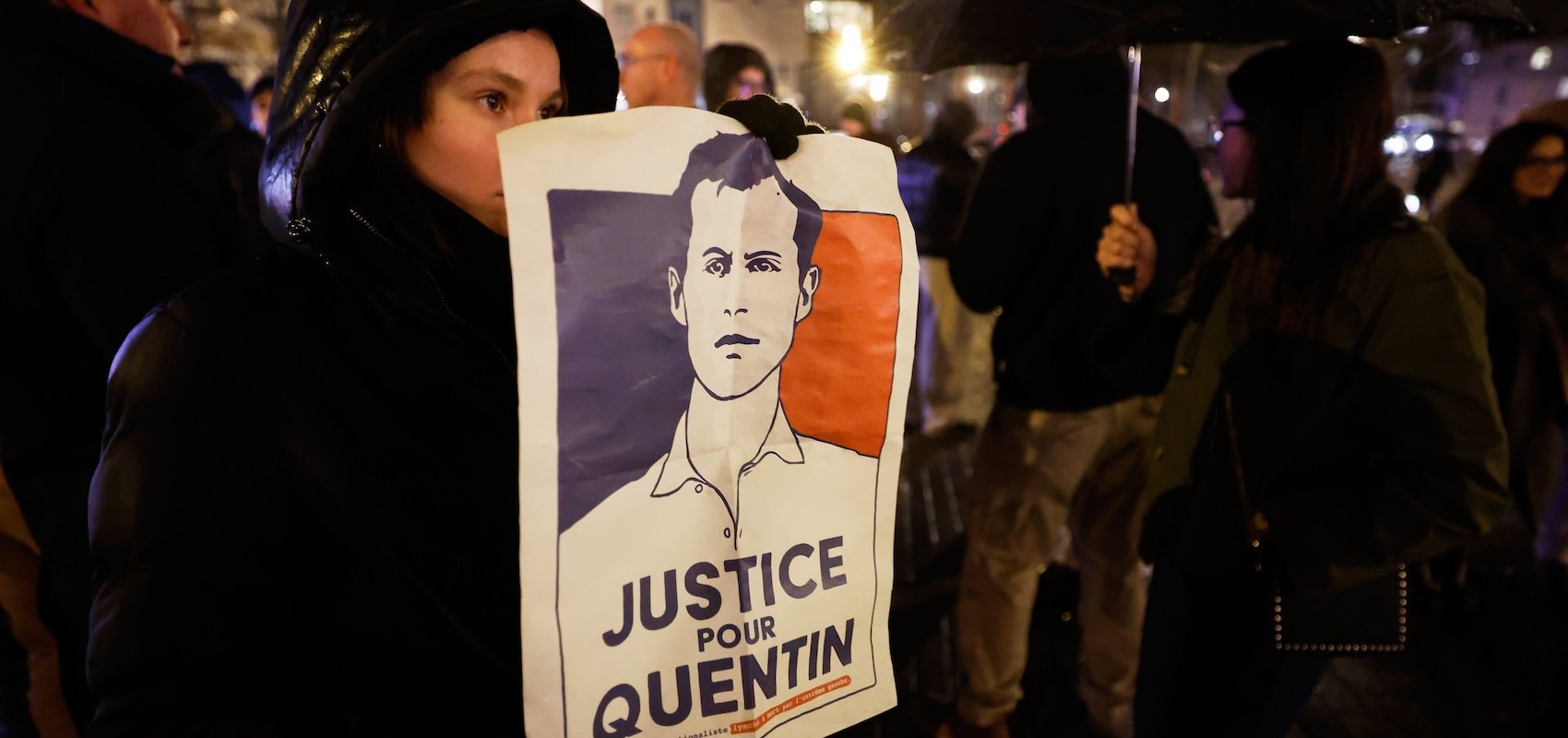
Quentin Deranque was twenty-three years old and a student in mathematics at the University of Lyon, France. A recent convert to Catholicism, he attended Saint-Georges, a church of the diocese of Lyon where Mass is usually said in the traditional Latin rite. Family, friends, and acquaintances described Quentin as devout and studious, someone whose day-to-day life centered on faith, reading, and doing well in school. One friend, “Vincent,” speaking on Radio Courtoisie, praised his “moral and spiritual virtues” and described him as a “bookworm” widely read in classical Christian theology, with a special interest in Thomas Aquinas and Augustine. Another friend, “Baptiste,” quoted by Le Monde, described him as deeply devout, intelligent, and curious, with a strong sense of justice.
On February 12, 2026, Quentin and two other men accompanied female activists from Collectif Némésis as they protested outside of Sciences Po Lyon, a far-left university. Collectif Némésis is a right-wing NGO comprised of young women opposed to the negative impact of mass immigration, Islamism, and left-wing ideology on the lives and rights of young women in France and Europe. The women of Némésis were there to unfurl a banner protesting an appearance on campus by Rima Hassan, a member of the European Parliament for the far-left party La France Insoumise (LFI). Hassan, who claims to be of Palestinian descent, is chiefly known for her full-throated support for Hamas in the wake of October 7.
An unremarkable set-piece of political theater should have ensued: A far-left figure speaks at a far-left university; right-wing activists protest peacefully outside. Instead, a horror unfolded.
Thanks to mobile phone video, an official autopsy report, and a preliminary report by Thierry Dran, chief prosecutor of the Judicial Tribunal of Lyon, we know what happened in detail. Contrary to initial media reports that described a “street brawl” between far-right and far-left activists, implying shared responsibility, it is now undeniable that a group of about twenty masked, hooded men encircled Quentin and the two other men and threw them to the ground and beat them. Quentin became isolated from his companions, and six men hurled him to the pavement and struck him repeatedly before dispersing.
The autopsy report shows that the assailants landed multiple blows to Quentin’s head, even after he was incapacitated. A breakdown of the video evidence counted at least eleven distinct blows. One man straddled Quentin and hit him repeatedly. Another appeared to strike him with a metal object.
According to the autopsy report, the damage to Quentin’s skull and brain was so deep and pervasive, including “major cranioencephalic trauma” and a “right temporal fracture,” that he had no chance of survival. This last fact is important, because minutes later Quentin regained consciousness, being described as visibly confused, and initially refused medical attention. The left-wing noise machine latched onto this fact to claim that Quentin had not been mortally wounded and that he only died as a result of his initial refusal to seek medical help. The autopsy report made it clear that even if Quentin had been immediately rushed to the hospital, he would still have died of his injuries.
It is important to get the facts right, which, again, are attested by multiple mobile phone videos, an official autopsy report, and an official report by the chief prosecutor of Lyon. There can be no reasonable doubt: Quentin was attacked and murdered by an organized, violent group. He did not seek, provoke, or initiate violence, and his attackers deliberately beat him and left him for dead.
The import of the event is clear. A French center-right commentator, Kevin Bossuet, put it simply in a television interview yesterday: “He is our Charlie Kirk.”
Quentin had nowhere near Charlie’s public profile, but he was a virtuous, talented, young Christian man who was gratuitously murdered by far-left extremists for doing nothing other than peacefully exercising his right to free speech.
France, famously, has a longstanding tradition of street-level political violence (whether protests that turn violent, or violence by immigrants or Islamists). But organized violent political groups, far-left and far-right, were crushed by French police in the 1980s after a wave of terrorist attacks by the communist group Action Directe, which culminated in the murder of Georges Besse, chief executive of Renault. Since 2020, however, France has seen the rise of new organized violent Antifa groups that use terroristic intimidation tactics similar to the post–George Floyd American left.
At first, everyone on the right in Paris expected a familiar pattern to emerge: The incident would be minimized, the facts muddied, and far-left judges would give the culprits a light or even suspended sentences. And, indeed, that is what at first seemed to happen. Original press headlines referred to a “street brawl” without clear moral responsibility. Rumors circulated that the prosecutor would only indict for “assault having led to death without intent of giving it,” a much lesser charge. For a dismal forty-eight hours, there were no arrests at all.
Legal experts have told me that police often wait until the last minute to perform arrests. Defense attorneys have access to their evidence roster as soon as the arrest is made, so police wait until their evidence is rock solid before acting.
Meanwhile, the autopsy report and the mobile phone video that propagated first online and then on mainstream television made the original stories—of a street brawl with mixed responsibilities, or of a tragic medical error stemming from Quentin’s initial refusal to seek care—untenable.
Though delayed, the reaction, from President Macron on down, has been everything one may have hoped for. President Macron condemned the assault without equivocation on X, calling for the arrest and trial of all those involved. The French National Assembly held a minute’s silence. The prosecutor of Lyon produced an indictment for “intentional homicide,” with “aggravating factors” including “group violence, concealed faces and improvised weapons,” as well as for “association de malfaiteurs” (literally, “conspiracy of evildoers”), a legal term of art that defines the act as a criminal conspiracy and allows the prosecution of the offenders’ associates. Police arrested eleven people in connection with the incident, seven of them being held on counts of intentional homicide and criminal conspiracy, and a further four on counts of helping one or more suspects avoid arrest. Law enforcement authorities appear intent to use the event to crack down on the broader sphere of violent left-wing extremist groups.
Much as in the United States, you don’t have to play Six Degrees of Kevin Bacon to find links between these violent left-wing extremist groups and the established political left. The key nexus is a man named Raphaël Arnault, who founded the violent “Jeune Garde Antifasciste” (“Antifascist Young Guard”) before his election to Parliament under the banner of LFI. One of the men arrested, Jacques-Elie Favrot, was a parliamentary assistant to Arnault on the day of his arrest. Another, whose name has not been released, has been described as also working as a parliamentary assistant. A third was a former intern in the Parliament. All worked for LFI.
As of this writing, it seems that the French government has decided to pursue the widespread crackdown on the violent far-left fringe that many conservatives expected to see in the wake of Charlie Kirk’s assassination.
There are several reasons why. First, as a matter of course, French law enforcement keeps tabs on all extremist groups, so that to effectuate a crackdown, authorities just have to give the go-ahead. This has not been the case with the FBI, which for decades has only seen right-wing groups as a threat; mobilizing the machinery of federal law enforcement against leftist groups thus takes more time.
Second, in the wake of October 7, when the LFI dropped its facade of internationalist leftism and fully embraced an Islamo-Arab identitarian political line straight out of a Houellebecq novel, many centrist elites have grown to fear the far-left more than the far-right. Privately, many such people will tell you that, while they have misgivings about the National Rally’s competence or populist economics, they agree with them on substantive law-and-order issues and on the need for immigration restriction. Meanwhile, they view LFI’s noxious mix of Islamism, anti-white identitarianism, and quasi-communist economics as an existential threat to the republic.
To this writer’s surprise, France’s power elite still includes men who will, as good republicans, say that while they disagreed with Quentin’s views, they believed in his right to peaceful expression, and believe that it is urgently necessary for the state to punish those who violently silenced him.
Quentin’s death was a horrifying murder. But he, his family, his friends, and the movement he belonged to may yet see justice. This is cause for hope.
Image by ASSOCIATED PRESS
