
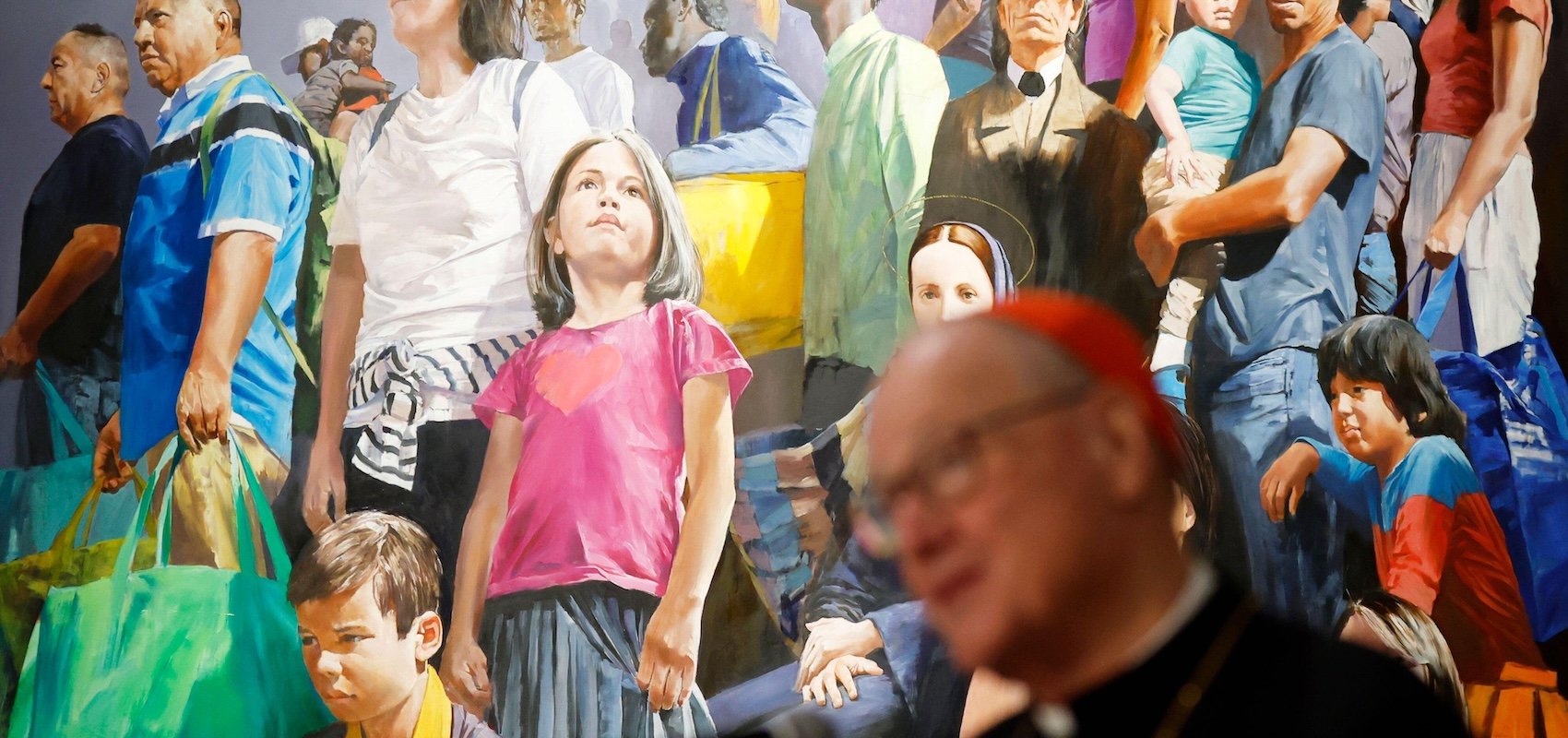
Last month, New York archbishop Timothy Cardinal Dolan unveiled a new painting for St. Patrick’s—the largest work of art commissioned in the cathedral’s 146-year history. Journalists celebrated the work as a daring salvo against Trump and his anti-immigration policy. The painting’s title—What’s So Funny About Peace, Love and Understanding (yes, the sixty-four-year-old painter Adam Cvijanovic is a Boomer)—seemed to announce the enthronement of 1960s counterculture in the gloriously gothic heart of Gotham City. Art curator Suzanne Geiss, promoting the work on Cvijanovic’s own website, compared it to Francis Bacon’s truly ghastly reimagined papal portraits.
The reality has little to do with the press sensationalism. Yes, What’s So Funny About Peace, Love and Understanding is large. But it occupies the entrance wall beneath the organ loft. If you turned off the spotlights trained on it, you would hardly know it’s there. It’s twenty-five feet tall—but the nave of St. Patrick’s is a hundred. Most of the figures represented are immigrants, but there is nothing inflammatory: crowds, not cages. Above the crowds are representations of the apparitions at Knock, Ireland: the Blessed Virgin Mary with St. Joseph and St. John the Evangelist, two angels, and the Lamb on the altar. The depictions are not entirely traditional but appear visually reverent. A panel featuring New York firemen and police officers, with an angel bearing their branded FDNY and NYPD headgear up to (presumably) heaven, is the closest it comes to sacrilege. Yet overall, the effect is more Norman Rockwell’s U.N. work than Francis Bacon—a visual celebration of the diversity of the human exterior as you might see it in normal life.
Such a celebration hardly feels unusual in our society. Yet it is uncommon in our religious art. Of the two angels Cvijanovic paints, one is black and the other white. You would expect nothing less in a television show today, but I’m not sure I’ve ever seen different races of angels in a church. There are two groups of immigrants depicted: On the right is a boatload of nineteenth-century Irish immigrants, while on the left a contemporary group, from every region of the globe, descends a generic hillside. Their racial diversity is comparable to what can be seen daily on the F train. Yet our art rarely asserts the Church’s truly global nature in this way. This is a welcome update, and it feels particularly appropriate at the narthex—the entrance—of a cathedral. Cardinal Dolan said, “Some have asked me, ‘Are you trying to make a statement about immigration?’ Well, sure we are. Namely, that immigrants are children of God.” This is a truth that admits no dispute; it is also the general effect of the painting. The painting is beautiful, too, with pleasant human figures, anodyne skyscapes, and floating gold bars that nod, albeit oddly, toward the gold backgrounds of icons.
This is not to say Cvijanovic’s work is beyond criticism. It is human, humane, and humanistic—that is its virtue. It is not effective at suggesting any other religious values. The Lamb upon the altar, which a religious artist would have given prominence in some way, is off in a corner. No one in the crowd shows any interest in the apparitions above, which are functionally paste-ins with no relation to any other figures. The artist is unable to suggest how the religious vision has anything to do with the immigrants, and perhaps he doesn’t think there is any relationship at all. The squared edges of the gold bars in the background suggest a similar problem: It is a gesture toward religion, but it looks fake, blocky, and ultimately irrelevant. The lack of relation to the divine is replicated by a lack of relationship to each other: The immigrants appear solitary, perhaps caring for one or two children—but for the most part, they are isolated individuals.
The paintings are brightly lit and do not look like the other art in the building, but they are not particularly dissonant, in part because they are the final piece in a much larger decades-long renovation of St. Patrick’s. In the not-so-distant past, the church was a different place: quiet, dark, stony, gray. It felt cave-like and natural, lit only by the dark blue of the stained-glass windows and flickering banks of yellow candles. Joseph Campbell put it well in his PBS series The Power of Myth in the mid-1980s: “I walk off Fifty-First Street and Fifth Avenue into St. Patrick’s Cathedral. I’ve left a very busy city and one of the most economically inspired cities on the planet. I walk into that cathedral, and everything around me speaks of spiritual mysteries.”
Now that feeling of otherness—of having left the city and gone somewhere else—has been almost completely overthrown, the casualty of the renovation that glitzed and glammed every surface in the building. Be careful where you set your feet, for the place whereon thou standest is expensive ground: more than a thousand dollars for every single square foot, the renovators boasted. It looks like it. The floors look expensive. The pews look expensive. The lighting—everything a soft luminous gleam—looks expensive. Every stone has been treated with microabraders to remove the oil left by the greasy hands of the faithful. Dirt has vanished from window and from stone. Everything broken, dented, or stained has been repaired or removed. White paint has been applied to give the place a fresh, clean look and banish the darkness. Your eyes no longer have to adjust when entering. Entering isn’t so big a deal anymore anyway: Big glass doors now allow passersby to see inside from the street, collapsing the distinction between inner and outer. You can stand inside the cathedral and still count the buses and taxis going by.
The polished stone and the toned wood and the perfect lighting and the clean surfaces make the cathedral feel a lot more like its neighbors, Tiffany’s and Saks Fifth Avenue and NBC Studios. The atmosphere feels less reverent—the silence is diminished by the open doors, the darkness is quite gone—and so people talk more, and no longer in hushed voices. They take more pictures and pose for more selfies, which look great in the new light. Cathedral workers pipe in Gregorian chant to try to suggest what has been lost. Now you have to talk over the music.
In this corporate cathedral, art has no choice but to feel like a form of branding. The most cynical reading of the installation is that Adam Cvijanovic has merely offered us the 2025 version of the New York Catholic brand: diversity, immigrants, first responders, Marian apparitions, nostalgia for nineteenth-century Ireland, and money—lots of it, with a generous helping of well-formed taste.
I do not mean to suggest that Cardinal Dolan has done poorly in all this. I am merely ambivalent. If you want a taste of old St. Patrick’s, you can head up Fifth Avenue to the Episcopalian church of St. Thomas, which is the dark and stony prayer-cave it always was. It is also empty, while St. Patrick’s is brimming with smiling tourists. Cardinal Dolan has built valuable partnerships, renovated a beautiful space, and invited the world in. And the world has come. Purists have long complained of the deals the Church continues to make to keep its doors open—in this case literally.
What’s So Funny About Peace, Love and Understanding fits in the new St. Patrick’s. It might, with a change or two, have been made to fit in Abercrombie & Fitch or 30 Rockefeller Plaza or the United Nations building. It is in a democratic Midtown style, which seems appropriate for a Midtown cathedral. It gives tourists something to talk about and take pictures with. It has a chance to inspire some people to look compassionately on immigrants or learn something about the apparitions at Knock. It is a welcome mirror to our truly universal Church. It also shows to future ages something of our modern predicament: We of the world wish to see a strong and beautiful Church, a rich Church, a worldwide Church with a place for all: the poor and the civil servants and the artists and the visionaries and the patrons of art. Yet we also fear the day when a sign over the door will proclaim St. Patrick’s “the Official Prayer Partner of Restoration Hardware.” We feel that, somehow, we are being drawn into a secularism that renders all our religious visions disembodied and irrelevant, that turns our art to self-centered branding, that makes it harder, not easier, for us to pray in our churches.
