

The Dignity of Dependence: A Feminist Manifesto
by leah libresco sargeant
university of notre dame, 232 pages, $2
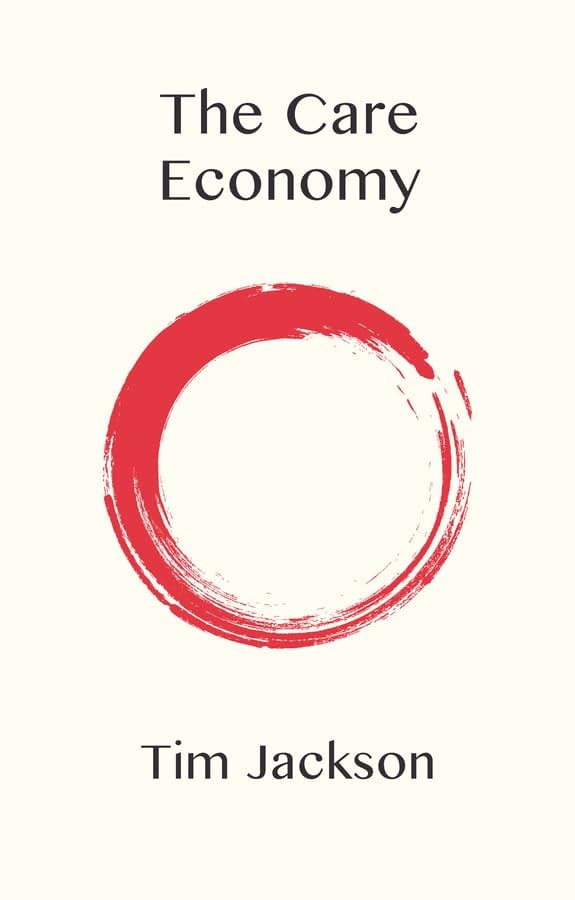
The Care Economy
by tim jackson
polity, 336 pages, $26.95
Shortly after I had a baby, I realized that what I had long understood by “feminism” had little to say about my new reality. Mothering appears in liberal feminism, if it appears at all, mostly as a problem to be solved. For the most part mothering, especially of very little children, comprises routine and repetitive small-scale activities ordered not to individual achievement or some grand project but to the sustenance of everyday life, for those too young to manage such things for themselves. Against this, the operative assumption of contemporary culture is that the “real” business of individual living is everything that happens with such routine labors as a backdrop: agency, ambition, achievement, consumer leisure. It follows that unless women can be freed from the everyday work of care, or those duties more “equally” distributed, our access to “real” life will always be unfairly curtailed.
My baby is now nine years old. The intensity of her need has lessened. But these days I find myself wryly echoing my own mother’s words. Who does my daughter imagine picks up socks from the bedroom floor or cups from the table—the fairies? Patterns of care change over time, and children learn to contribute, but the invisible substrate of routine work will remain a political problem as long as “real” life is understood to be whatever happens against its backdrop. Even outsourcing it to domestic helpers just displaces the central question. As long as our scale of value weighs routine care and individual agency so asymmetrically, there seems no way to make the fruits of “real” life on these terms available to everyone. Someone will end up with the secondary role: clearing cups, picking up socks, and the mundane rest of it.
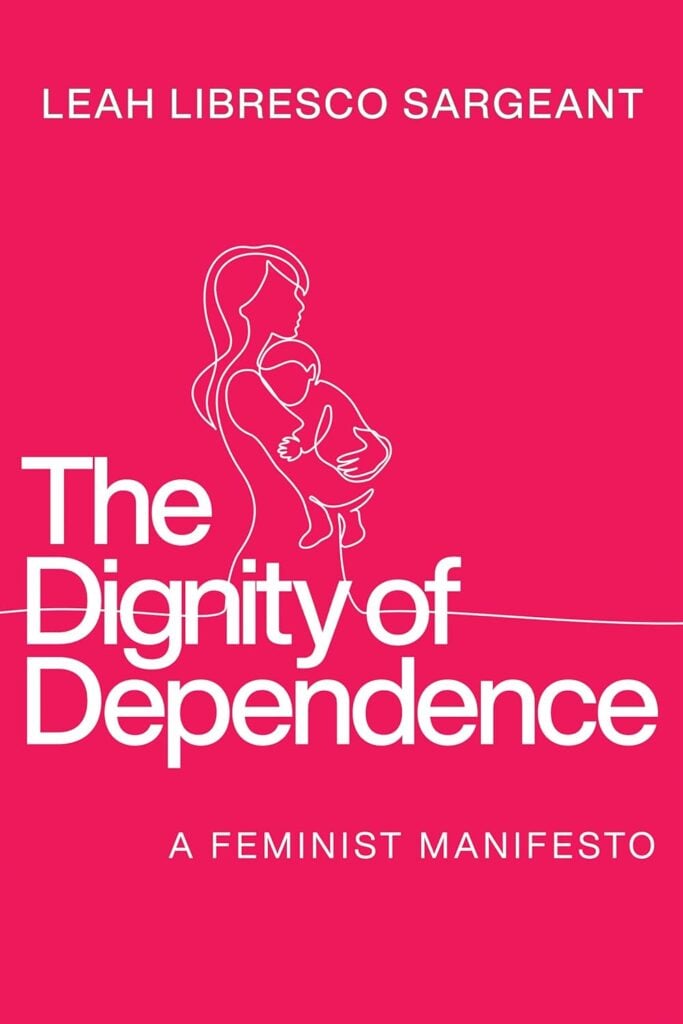
But why does this asymmetry of value exist at all? Why are the fairies invisible? Two recent books, by authors worlds apart, seek to address the “Cinderella” domain. The Dignity of Dependence comes from Catholic writer and policy analyst Leah Libresco Sargeant, and The Care Economy from ecological economist and “degrowth” proponent Tim Jackson.
From these different vantage points, both writers set out to make a case for the importance of dependence and care to human flourishing. Sargeant’s book, subtitled A Feminist Manifesto, tackles this question in the context of women, mothering, and our universal dependence on one another. The Care Economy explores the same question at the level of our larger economies. Both make valuable contributions in the face of an epistemological challenge whose roots lie deep in the past: How can we resolve a crisis that resists naming? But both stop short, for different reasons, of the metaphysics that dare not speak its name.
Sargeant takes an intimate approach to this elusive subject. The Dignity of Dependence skips any attempt to contextualize either “dignity” or “dependence” in a historical, cultural, or theological sense. Her argument is human-scale, and her tone conversational. Reading her feels like being drawn into discussion among a circle of warm and thoughtful friends, for whom the broader context is taken for granted. Sargeant blends personal anecdote with policy discussion and cultural commentary. She aims to free “dignity” from its thin modern sense of proud self-reliance, and “dependence” from its connotation of shame (a connotation especially strong in the culture that celebrates the Fourth of July). The resulting book is something akin to a phenomenology of everyday vulnerability and love.
Jackson’s project is more ambitious: wrestling with the question of “care” at scale. The Care Economy is a sequel to the influential Prosperity Without Growth (2009), which argued that we can resolve the ecological crisis only by reorienting our economies away from the mirage of never-ending growth and toward care and creativity. The Care Economy is Jackson’s attempt to go deeper into what such an economy might look like, but it documents Jackson’s own surprise at the difficulty of this conceptual challenge. What even is care? His solution—one I was not expecting in a book with “economy” in the title—is to exit the dry register of the “dismal science” entirely, for a dizzying array of personal stories, historical reference, literature, feminism, political theory, and analogies from cold-water swimming to cholera. One chapter even takes the form of a dream-sequence.
This surprisingly effective if impressionistic method converges on a definition of “care” as comprising all those repeating and homeostatic patterns that sustain normal health, either within an organism or in its relation to its ecological niche. Such patterns can be difficult to apprehend directly; their shaping power is discernible mainly in the traces they leave. Jackson’s allusive approach recalled my own love, as a long-distance runner, of England’s many unpaved and sometimes ancient byways. This landmass has been continuously inhabited for twelve thousand years. Some of its paths are trodden so well that they are known as “hollow ways”: roads of such ancient provenance and use that they are worn yards deep into the surrounding landscape. It is easier to measure the height of their banks than to apprehend the millennia of human and animal footfall, and associated life-patterns, that carved them. In English folklore they are often associated with fairies, a detail that captures at the level of landscape both the invisibility and the elusive magic that (like laundry fairies) hides in the realm of routine.
Jackson’s attempt to evoke this realm resonates with my own experience of mothering’s iterative quality and its fundamentally relational nature. So it is no surprise to find that Sargeant’s book seeks to surface all those ordinary ways in which, as we meet the needs of dependents, we are patterned in relation to others’ needs, never existing only “for” ourselves. In pregnancy, a woman’s very body is essential for her baby’s survival. The baby experiences the most complete dependence, and the mother confronts the ambiguity of her physical boundedness. Set against these realities, Sargeant shows, the “lonely individual,” the protagonist of contemporary “real” life, is a lie. Each of us begins and ends life vulnerable and dependent. Adults, too, track the hollow ways carved by dependence and need.
And yet, as I discovered as a new mom, our social world is ordered to obscure this reality. Women become mothers in a world structurally blind to interdependence, pattern, and ordinary need. As Sargeant shows, the result is a mismatch between what we believe reality is and what reality is for women. This mismatch extends all the way from individual efforts to reconcile the embodied relations of pregnancy and breastfeeding with an employment environment that only grudgingly accommodates this ordinary feature of human life to the struggles faced by policymakers in responding to the kaleidoscopic range of social care needs across areas such as health, housing, and welfare.
And for those feminists who otherwise believe in the supposed interchangeability of men and women, the result has often been, in Sargeant’s words, “helping women be better men”—that is, directing the full force of economic and technological innovation at flattening every last trace of our difference. The Dignity of Dependence is a persuasive tour of all those ways in which the contemporary world relies on our continued willingness to respond to one another’s need, all while treating this (like the sock fairy) as mere backdrop to, or fuel for, “real” (which is to say economic) life. Sargeant is at her most gently polemical, and rhetorically moving, in the chapter that shows how the price is ultimately paid by those most dependent of all: unborn babies.
But the price of our lack of care is also, Jackson argues, visible in the ecological crisis now unfolding across our planet. It isn’t merely a matter of economic theory. Our difficulty in thinking through the dimension of care seems bound up in our deepest values, and especially in relations between the sexes. It is thus, as Jackson notes, principally feminists who have sought to theorize care. Those feminist authors, though, oppose care to violence and link violence with men. This framing of violence as the antonym of care, whether in “patriarchal” hierarchies or in extractive relations to the planet, is the most conceptually underdeveloped aspect of the book, for reasons I will return to. But it accurately sketches the association between our blindness to care and the forces that are disordering sex relations and ecologies.
The Care Economy ultimately fails to name this force beyond the (for progressives) conventional villain “capitalism,” a framing that, to my mind, puts the cart before the horse. But it is a reasonable enough inference when efforts to recoup care so often end up re-ordered to profit. There exist whole libraries of academic work devoted to naming and understanding the forces of nature and the ecological crisis. Care is likewise abundantly theorized, especially by feminists. And yet every time such theories appear, they somehow end up either ignored or turned against their original spirit. My own feminist inquiry, as a new mom, began with puzzlement at the way every feminist challenge to the erasure of dependence somehow seemed to end in policy solutions that promised to “solve” dependence in the name of freedom. Similarly, as Jackson observes, in the field of ecology the result of every warning about the long-term consequences of our extractive technological paradigm, and our pursuit of never-ending growth, ends up as another burst of extractive technological development, which is then hailed as offering both “green” improvements and more economic growth.
Why? As we have seen, the discursive space of care is riddled with blind spots and omertàs. And we find a path leading into this territory through a topic that is conspicuous in both texts chiefly by its absence: Christianity. It is almost impossible to make sense of two millennia worth of care without acknowledging the role of the Christian Church, and especially Catholicism. But though this path is trodden so deep that it forms a hollow way in our civilization, today its tracks are overgrown with nettles, its signposts torn down or painted over.
Even so, its patterns shape both books. Jackson formally disavows Christian faith, asserting in his chapter on the spiritual dimension of care both that we need a “sacred canopy” to hold communities of care together and that religion has “failed” to supply this good. We can infer from the fact of his having written The Care Economy that secular liberalism and market society have done little better, and it is not clear what secret third thing might provide an alternative to “religion” and “not religion.” Be that as it may, Christianity merits only a handful of references. The only positive one is a passing observation that our concern for the sanctity of human life is about 2,000 years old. No reason for this oddly specific number is supplied. Otherwise the principal context in which the Church appears is a reference to that gender-studies cliché, Heinrich Kramer’s Malleus Maleficarum, a witch-hunting manual that Jackson presents as evidence of how Christian doctrine has been deployed to oppress women. Christians might protest that relative to the Roman mores it displaced, the Church has done more to accord women personhood than to withhold it from them—though there is no denying that Christian doctrine is sometimes misused in this way. Regardless, it is difficult even to frame this debate without acknowledging its debt to the Christian doctrine of personhood.
This in turn produces a deep confusion in Jackson’s definition of violence as the antonym of care, where care is understood as the totality of homeostatic, patterned relationality across human and natural worlds. There are, after all, many examples of interactions in the natural world that both fit this description of homeostatic patterns and are inescapably violent. The most obvious example is, of course, predation for food. Is this not care, in the context of a mother tiger feeding her young? What is different about human violence, or indeed male violence against women? Jackson cannot easily unpack this without drawing a distinction between the nature of animals and that of humans, thus inviting further questions about what we mean by “human” and by “nature.” And by this point he would find himself already walking the overgrown and much-maligned Christian hollow way.
Given the dominance of secular liberalism across academia and environmental activism, it is perhaps understandable that Jackson’s text has white-labeled anything too obviously theological. The almost total absence of overt Christian reference in The Dignity of Dependence is more puzzling, especially given that the author’s other works include Building the Benedict Option and Arriving at Amen. But even as an avowed Christian, Sargeant faces the same constraint as Jackson: From the frontispiece to The Dignity of Dependence we learn that the series of which her book forms a part is “Catholic ideas for a secular world.” We can reasonably infer that the text’s confessional coyness reflects the author’s recognition of the same secular-liberal injunctions that apply to Tim Jackson.
This acknowledged, the careful reader will note that though there are few overt references Catholicism in the book, Sargeant’s bibliography has a distinctive flavor. For example, when she cites big-name liberal feminists such as de Beauvoir or Friedan, it is generally only as foil for her counter-argument. By contrast, we find approving quotes of G. K. Chesterton, C. S. Lewis, and contemporary Catholic feminists such as Angela Franks.
Jackson attempts to route around Catholic thought, then, while Sargeant is merrily dogwhistling. Had the prevailing culture left the authors freer to engage directly with extant work in this tradition, both would have been well advised to begin with the Catholic priest and social critic Ivan Illich, and especially his controversial 1982 work Gender.
The absence of this text is no slight on either author, as its argument proved so enraging to his hitherto adoring left-wing readership that Illich was abruptly cancelled for writing it, and Gender remains “problematic” to this day. But it sheds crucial light on the epistemological problem at the heart of both Jackson’s and Sargeant’s works by connecting the modern transformation of sex relations with the shift from steady-state economies to modern “market society.”
It is a dense text, but in very brief terms: Illich argued that whereas the premodern world was everywhere irreducibly dual and ordered by “vernacular gender” as distinct worlds of men and of women, the dismantling of this duality was a crucial precondition for our entry into modernity. What Illich characterizes at the intimate level of families as “the destruction of gender” manifests itself, he argues, at the macroeconomic level as modern growth-based market society. Following the destruction of “vernacular gender,” a new, genderless order arose. The protagonist of that order would come to play a central role in Jackson’s academic field, economics: the purportedly unisex homo economicus, first seen in the work of Adam Smith. And yet, Illich points out, humans are never unisex. And as he argued, and Sargeant persuasively shows, this imaginary, unisex, unattached homo economicus is a poor fit for women’s embodied and relational needs. The result is a modern social order that is “both genderless and sexist”: that is, one that both pretends we are all interchangeable and, as a consequence of this falsehood, produces a world in which women are structurally disadvantaged.
In fairness to Jackson, Illich does show up in The Care Economy, though only in the context of his critique of medicine. Jackson’s muddled effort to grapple with the question of care and what he terms “patriarchy” would have benefited from Illich’s analysis of the relation between modernity, growth economics, and “the destruction of gender” in favor of “economic sex.” Sargeant, for her part, does not refer to Illich at all; and yet a great deal of The Dignity of Dependence reads like a descant on Illich’s argument concerning the structural mismatch between the purported unisex homo economicus and the embodied reality of our sexed nature.
Beyond and behind Illich, though, the hollow way of Catholic thought stretches deeper into the past. Its ancient contours can be discerned in the overall message of The Dignity of Dependence: that we might get further, as feminists and as functioning societies, by ditching the lonely fiction of homo economicus for a more realistic assessment of human nature. But here we run up against another of modernity’s epistemological blind spots. It is almost impossible to assert, in terms digestible within secular liberalism, that humans even have a normative nature—witness Jackson’s unhappily wrestling with the well-documented fact that men and women are normatively different, and men are on average more violent than women. This taboo is so complete, and has so far-reaching a set of political consequences, that I have previously characterized it as a dogma or bigotry: “normophobia” (First Things, April 2024).
The taboo this dogma places on whole fields of epistemology explains the unusual, allusive form of Jackson’s book. He can approach his topic only obliquely, for his project is to make the case for an economy predicated on human nature, without violating the secular liberal convention that human nature does not exist. Resolving this technical challenge takes him some 300 pages. For the premodern world, though, the same terrain might be summed up in two words: the master-concept of “kindly enclyning,” as characterized by C. S. Lewis in The Discarded Image. Of these, “kindly” needs the most glossing, for no shift in meaning more vividly captures the gulf between that older world and our own. In its medieval sense, “kindly” denotes something like “in accordance with its type or nature.” In the modern sense it conveys something far less forceful, along the lines of “benign.” “Enclyning” also conveys an insight alien to modern thought: the notion that things “incline” to characteristic patterns of behavior through qualities innate to their type or “kind.”
In the era of “vernacular gender,” the technical term for the “kindly” qualities of a thing would have been its “formal cause,” as in the nature that “causes” it to take the form it takes. Its “enclyning” is, properly speaking, its “final cause”: the end to which it is directed. These concepts, first formulated by Aristotle, were most famously elaborated by St. Thomas Aquinas, and they played a central role in the premodern account of reality. But this picture of the world, as structured in part by the nature and inner directedness of all things, was bracketed and then discarded by the scientific method. Francis Bacon’s 1620 treatise Novum Organum (“new method”) argued that formal and final cause should be abandoned as insufficiently grounded in empirical reality. Bacon proposed a new way of seeing, one that would limit its inquiry to the remaining two of Aristotle’s original four “causes”: the efficient and the material, which is to say, the forces that act upon something, and the stuff of which the something is made. In turn, Bacon argued, humans themselves could learn to understand, master, and finally direct the world’s efficient and material aspects, wresting all of nature from its own “kindly enclynings” and re-ordering it to “the relief of man’s estate.”
The whole matrix of economic growth and technological development, on which Jackson focuses his critique, developed upon this metaphysical contraction from four to two causes. So too, and concurrently, did “the destruction of gender” in favor of “economic sex.” And so, too, does the literary challenge, faced alike by Sargeant and Jackson, of articulating a realm of care whose elusiveness and invisibility is one result of this erasure of formal and final causes.
For this is the blind spot both these fine writers seek to tackle: the nature and directedness of things. As Sargeant shows, humans are not free-spinning atoms. We have normative needs and are relationally directed. Gestation and breastfeeding are only the most obvious, concrete examples of this directedness and its consequence: that some aspects of our life in common cannot be flattened into abstract “equality.” Similarly, The Care Economy argues that in recognition of the patterned nature of all life, our economies should be reoriented so as to prioritize what is valued by pattern: maintenance, care, and interdependence.
But both these cases are exceptionally difficult to make from within what the philosopher Mark Shiffman has called “Baconian civilization.” A worldview that has foreclosed formal and final cause will naturally insist that any defense of pattern, care, and interdependence must first make the case that they exist and have value, which invariably leaves little airtime for the concrete suggestions that might follow. Of the two authors, my sense is that Sargeant is most alive to the metaphysical origin of these constraints. The careful reader will catch a Thomistic note in her plea for social relations more truthfully aligned to human nature. It is testament to the ongoing power of the Baconian taboo that for a secular audience, adding metaphysical categories back into an argument would necessitate so lengthy a digression as to render the result unreadable. In consequence, even an avowedly Catholic author must confine herself to a nudge and wink.
With form and meaning thus silenced, we have forgotten how to see the world in its relational and normative aspects—forgotten how to focus not on the “signal” or exception but the rule; to focus on what usually happens and the habits, kinds, and hollow ways of “enclyning.” Instead we learned to master the world and reorder it to our own desires. But despite its many gifts, this mastery has cost us dearly, as Baconian civilization redefined the world’s normal patterns as “natural resources” for exploitation, leaving them by degrees more depleted, poisoned, and strip-mined. Human sociality is being strip-mined to exhaustion, too, by a culture and economy in which human nature and directedness are treated as though they did not exist—or at other times are treated as if they existed and were endlessly malleable but could nonetheless be expected to endure all these insults unchanged, continuing to serve as backdrop to the “real” business of self-optimization and shopping. The result can be seen in the collapse of family formation, the worsening well-being of both children and adults, and the looming disaster of an aging population facing senescence amid a culture that views dependence as a moral failing.
In this context, the metaphysic that dare not speak its name is once again speaking—even if only through omission and desperate need. For the methodical expulsion of form and meaning from reality has produced, by degrees, our current sense of social and ecological omni-crisis: a situation now so desperate that even secular liberals are seeking ways to reverse-engineer, or perhaps just rediscover, the hollow ways. The fact that two such thoughtful voices as Sargeant and Jackson have converged from opposite sides of the Atlantic, and of the political aisle, to grapple with this issue speaks to its urgency.
Both books shy away from policy, but what each calls for is really a precursor to policy as such: a change in how we see. We must relearn to perceive the normative, homeostatic, interdependent dimension of life for what it is: not an illusion to be dispelled by empiricism, an inert stockpile of “natural resources,” or even a hollow way where the fairies sometimes pass, but something real on its own terms. Though obscured, this plane of “kindly enclyning” never really went away, and neither did our real dependence upon it. We need only open our eyes to what is usual.


YOU MIGHT ALSO LIKE
Introducing The Jew From Nowhere
Longtime readers of First Things will probably be able to guess the third in this sequence: Catholic,…
Beware the “Orthobro”
On a late September morning, I approached the registration table outside the entrance to a small Greek…
John Allen, Nonpareil Vaticanista
Early Sunday morning, July 28, 2002, things were looking grim for the closing papal Mass of World…
