
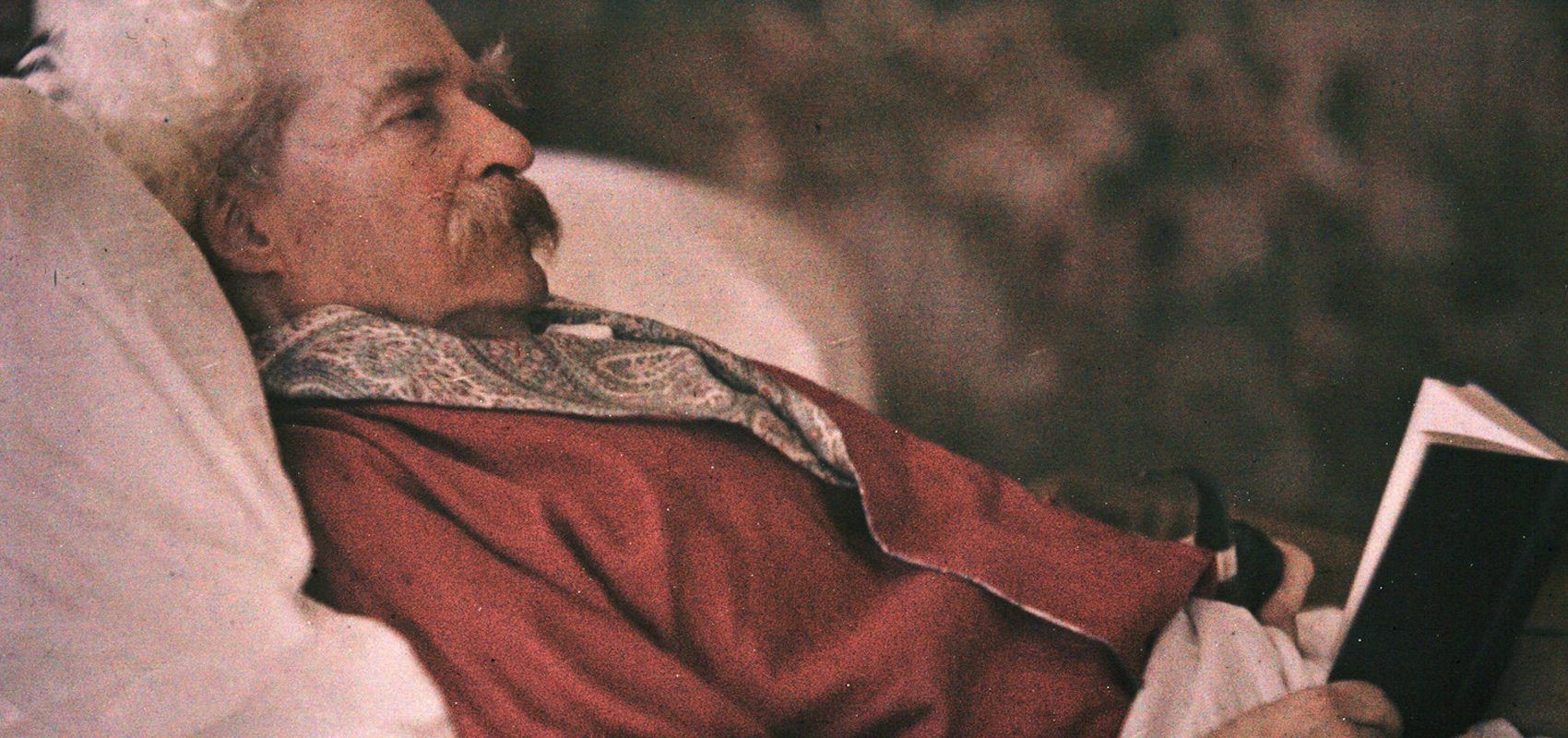
In 2014, when Kevin Malone’s opera Mysterious 44 premiered in Manchester, England, the production featured narrative voiceovers by Richard Dawkins. It was a fitting choice. Funded in part by Dawkins’s Foundation for Reason and Science, Malone’s operatic interpretation of Mark Twain’s The Mysterious Stranger accorded with the evolutionary biologist’s worldview. The final revelation of Twain’s Stranger—that “there is no God, no universe, no human race, no earthly life, no heaven, no hell. It is all a dream”—seemed to anticipate Dawkins’s conclusion that “the universe we observe has precisely the properties we should expect if there is, at bottom, no design, no purpose, no evil and no good, nothing but blind, pitiless indifference.” For Malone, Twain’s “antireligious story” was liberating. It had subverted his Lutheran upbringing when he read it as a boy.
But is this an effect that Mark Twain would have celebrated? The prevailing assumption is that he would, and with devilish delight. But his life and work contain meanings that stand in contrast, if not opposition, to the common perception of his irreverence. A few years before his death in 1910, Twain reflected that “humor is only a fragrance, a decoration” in what he called his “sermons.” He attributed his success as a humorist to one thing: “I have always preached. That is the reason that I have lasted thirty years.” Twain was a harsh critic of superstition and institutional religion’s doctrinaire tendencies, but at the core of his literary sermons (especially those he wrote late in life) is an earnest, ever-evolving, often erratic quest to discern what he called “the Deity.”
Throughout his career, religion was a favorite satirical target of Twain’s. As early as the late 1860s, as Twain’s popularity was rising, his dispatches from Europe and the Holy Land drew the ire of pious readers. The humorist’s irreverent jabs at the “imaginary holy places created by the monks” so offended one minister that he condemned Twain as “a son of the devil.”
After Twain’s death in 1910, The Mysterious Stranger: A Romance magnified this reputation. Published in 1916, the bleak narrative focuses on a satanic stranger who convinces the young narrator, Theodor, that God does not exist and that life is a grotesque dream. Scholars cite the text as evidence of the humorist’s late-life descent into pessimism and nihilism. It certainly seemed to reflect the mind of a man who had suffered bankruptcy and the deaths of his wife, Livy, and two of his daughters, Susy and Jean, during his final decade and a half.
As Twain’s last important work of fiction, The Mysterious Stranger came to be seen as the key to his last years, “a kind of Nunc Dimittis,” in the words of the scholar William Gibson. The critic Bernard DeVoto includes it among the “symbols of despair” he believes Twain had crafted near the end. Though it is inferior to Twain’s earlier works, DeVoto saw The Mysterious Stranger as having prevented the author from crossing “the indefinable line between sanity and madness.” Even so, he sees the story’s nihilistic ending as Twain’s literary detonation of the universe, by means of which he sought to absolve himself of guilt and responsibility.
Until the early 1960s, this dour view of Twain and The Mysterious Stranger was the scholarly consensus. Roger Salomon concluded in 1961 that, although in The Mysterious Stranger Twain had failed “to develop a coherent imaginative response” to life’s absurdity, at least he had succeeded “in making this absurdity vivid.” Writing a year later, the literary scholar Henry Nash Smith asserted that Twain had found a refuge from life’s futility only by identifying with Satan, a “supernatural spectator for whom mankind is but a race of vermin, hardly worth contempt. And this,” Smith concluded, “marks the end of his career as a writer, for there is nothing more to say.”
But the groundbreaking discovery in 1962 that The Mysterious Stranger was not the narrative Twain intended proved Smith’s report premature, if not greatly exaggerated. The literary detective work of John Tuckey found that the version published in 1916 was actually a patchwork of three different drafts Twain had worked on between 1897 and 1908, along with a bridgework paragraph he had not written. Tuckey also noted the alteration of characters’ names and the addition of an astrologer figure. Two of Twain’s drafts were unfinished: “Chronicle of Young Satan” (1897–1900) and “Schoolhouse Hill” (1898). The other, No. 44, The Mysterious Stranger, which Twain had worked from 1902 to 1908, was a longer work in multiple chapters and with a clearly marked conclusion.
In 1969, all three drafts were published for the first time in Mark Twain’s Mysterious Stranger Manuscripts, with William Gibson’s introduction untangling some of the mystery surrounding the 1916 publication. Gibson calls this version “an editorial fraud . . . that almost certainly would have enraged” Twain. The culprits? Albert Bigelow Paine, Twain’s literary executor, and Frederick A. Duneka, an editor with Harper & Brothers. Paine and Duneka had taken the bleak, unfinished “Chronicle of Young Satan” and added to it the concluding chapter of the arguably more theologically upbeat No. 44, thereby changing its meaning. In “Young Satan,” a malevolent stranger appears hellbent on destroying the moral sense of young Theodor (whose name means “gift of God”). In No. 44, Twain never identifies the mysterious stranger as satanic. If anything, this otherworldly visitor yearns to befriend its young narrator, August.
Among the many differences between the 1916 version and Twain’s No. 44, the most crucial disparity is theological. The concluding chapter in Paine and Duneka’s text leaves Theodor adrift in nihilistic despair. In No. 44, where the concluding chapter reflects Twain’s intended vision, it represents a more transcendent ending. The Stranger provides August with a surreal and apocalyptic experience beyond humanity’s “hysterically insane” religious fictions, one that empowers him to “dream other dreams, and better!”
And yet Paine and Duneka’s fraud continued to shape perceptions of the Stranger and of Twain. Tuckey declared as late as 1980 that “a false ‘Stranger’ has . . . been parading before the world while the real one has remained hidden and unknown.” Indeed, as Kevin Malone’s opera attests, the dark shadow cast over Twain’s religious outlook by the fraud endures into this century. Shortly before Dawkins and the other Horsemen of the New Atheism galloped onto the scene, an article in the Hartford Courant, the newspaper of the city where Twain lived with his family for two decades, dubbed him the “comic village atheist” who took “a one-way trip to the darkside” and became “a proto-existentialist bemoaning being and nothingness.”
Given the delight Twain evidently took in ridiculing religion while delivering increasingly angry invectives against the biblical God, does the convoluted history of The Mysterious Stranger even matter to our understanding of his religious sensibilities?
John Tuckey believed that in light of No. 44, Twain’s late writings and what they reveal about his frame of mind warranted reappraisal. At the very least, as he concluded in the 1960s, DeVoto’s “interpretation may now be seen to need some questioning.” Despite the conventional emphasis on “the despair-laden portion of Twain’s later work,” Tuckey argued in notes for an unfinished study that the late Twain “had his exuberances and enthusiasm” as well. These positive impulses, Tuckey asserts in notes from the late 1970s, culminated in No. 44’s transcendent concluding chapter, in which August “learns to extinguish time” and experiences “a remarkable breakthrough . . . [into] the void that non-exists before the creative act.” Tuckey came to see the “exuberances and enthusiasm” that informed this conclusion as “much more the result of normal and pervasive trends and movements and forces than has been appreciated.” In my view, Tuckey referred here to trends and movements that were part of the nineteenth century’s liberal religious ethos.
From his youth in Hannibal, Missouri, through his later years in Connecticut, Mark Twain engaged with many of the liberal religious trends and movements that were shaping his culture. Following the Enlightenment, religious liberalism emerged in the West as a way to preserve ancient faith claims in a world that was rapidly changing. Liberal Christians, hoping to sustain the vitality of their faith amid modernity, sought a middle path between atheistic rationalism and authority-based religious tradition.
Within America’s religious liberal spectrum were devout Christians, such as the controversial divine Horace Bushnell, who were open to what some saw as heretical reforms. Others, like Ralph Waldo Emerson, were religious radicals who wanted to liberate orthodox religion “from every sort of thraldom to irrational and merely traditional authority” (in the words of William Potter, founding member of the Free Religious Association). Contrary to the assumption that Twain’s criticisms of religion expressed mocking skepticism or hostile atheism, he possessed a religious sensibility that was deeply informed by these heterodox theologies.
During Twain’s boyhood in Hannibal, his father was a freethinker and his uncle a universalist. Though he attended a Presbyterian church as a boy, he read Thomas Paine’s Age of Reason as a cub riverboat pilot and joined a Masonic lodge in St. Louis. Perhaps most significantly, he confessed his “powerful” ambition as a youth to be “a preacher of the gospel.” What thwarted that ambition was the profession’s “stock in trade—i.e. religion.”
Though some scholars see this split between the gospel and religion as informing Twain’s sense of irony, it also happens to be a key tenet of religious liberalism. The influential Unitarian minister Theodore Parker drew a similar distinction in his 1841 sermon “The Transient and Permanent in Christianity.” Declaring that “real Christianity . . . is not a system of doctrines,” Parker distinguished the “Word of Jesus” from the institutional religion that had grown around it into what “men call Christianity.” Twain was likely familiar with this view, thanks to his friendships with leading Unitarian Christian ministers during the Civil War, including Thomas Starr King and Henry Bellows, both of whom were closely associated with Parker.
Though Twain was not to be ordained as a minister, he discerned his calling at this time as a humorist in religious terms. His vocation was not to shepherd souls to heaven; his calling, he said, alluding to the parable of the talents in Matthew 25:14–30, was to use his God-given talent “to excite the laughter of God’s creatures” in this earthly realm. His early writings were infused with liberal assumptions such as Starr King and Bellows would have preached in sermons against what “men call Christianity.” Defending himself against the pious minister who had condemned him as a “son of the devil,” Twain revealed his motive for ridiculing “imaginary holy places” in the Holy Land. He had wished to show
how much real harm is done to religion by the wholesale veneration lavished upon things that are mere excrescences upon it; which mar it; and which should be torn from it by reasoning or carved from it by ridicule. They provoke the sinner to scoff, when he ought to be considering the things about him that are really holy.
Around this time, Twain, commenting on the ephemerality of emotional revival conversions, observed that “a religion that comes of thought, and study, and deliberate conviction, sticks best.” In his breakthrough Innocents Abroad (1869), Twain wondered what kind of relationship Jesus had with his brothers when they were children, considering that Jesus “was only a brother to them, however much he might be to others a mysterious stranger who was a god and had stood face to face with God above the clouds.” While ridiculing the “clap-trap side-shows” he visited in the Holy Land, Twain nonetheless deemed the site of the Crucifixion as historically accurate, esteeming it as “grand, revered, venerable—for a god died there.”
Throughout the rest of his life, Twain befriended other liberal Christian clergy, including Horace Bushnell, whom he considered a “theological giant”; Thomas Beecher, Henry Ward Beecher’s unconventional brother; and Joseph Twichell, his closest friend and pastor. Even as he moved beyond Christianity, Twain’s friendship with the radical Emerson protégé and former Unitarian minister Moncure Conway led him to contemplate other paths, such as the esoteric Hinduism that Conway helped to popularize in the West.
In this regard, it is interesting to note the thematic similarity of Twain’s controversial conclusion in No. 44 to the insight of a Hindu guru he met in India in 1896. Twain’s Stranger declared that “nothing exists; all is a dream.” The guru likewise preached:
The world . . . is not real. It never existed, it does not exist, and it will not come into existence in future. We all dream. . . . We are sleeping in the lap of ignorance, and as soon as true knowledge will dawn on us we shall be able to know that the world is but a dream.
Twain likewise believed in an ultimate divine source beyond this world of illusion. As late as 1906, when he was still at work on No. 44, he dictated a meditation on “the real God, the genuine God, the great God, the sublime and supreme God, the authentic Creator of the real universe, whose remotenesses are visited by comets only,” over against the myriad false gods that infested the human imagination.
Few readers today are aware of the Mysterious Stranger documents, let alone of Twain’s thwarted ambition to be a gospel preacher or his close friendships with prominent liberal clergymen. Fewer still know of his extensive lifelong reading in theologically heterodox subjects, such as the apocryphal gospels and comparative religious assessments of Christ, Krishna, and Buddha. Even during his final decade, Twain’s library included W. H. Mallock’s Reconstruction of Religious Belief (which Harper’s Monthly recommended to “those who find in scientific truth an obstacle to religious faith”) and the esoteric Advanced Course in Yogi Philosophy and Oriental Occultism, a text derived from Vedantic Hinduism.
Mark Twain was hardly a grim harbinger of atheism. His surviving daughter Clara recalled that her father’s “natural inclination was always stronger toward more poetic and mystic subjects.” His last years were dark. Yet as Tuckey observes, a “time that is one of darkness, even of despair, may indeed lead on through to a new stage of enlightenment.” It’s a side of Mark Twain very relevant to our present dark and despairing times.

YOU MIGHT ALSO LIKE
Turned Away on Palm Sunday
In politics, diplomacy, war, or pretty much any field of human interaction, one must contend not only…
Timothée Chalamet Is Right About Art (ft. Suzy Weiss)
In this episode, co-founder and reporter for the Free Press, Suzy Weiss, joins Virginia and Germán to…
A Medieval Pilgrimage in Modern Assisi
When you go to the hilltop town of Assisi, you’re immediately struck by how medieval it is:…
