

Back in 2014, my wife and I bought a house on six acres of land several miles west of Lander, Wyoming. Squaw Creek, a tributary of the Popo Agie River, forms the valley between our house, which rests on the western bluff, and the brick-red scarp of sandstone several hundred yards to the east. Getting to the creek bottom requires a long descent, and over the years, we have beaten a path of a hundred yards or so that angles past sagebrush and chokecherry trees and junipers before turning more steeply down to a clearing where we dug a fire pit in the summer of 2014. For the first five or six years that we owned the property, we could never see the course of the creek, because the whole bottom was densely overgrown with thickets. A sturdy bridge built by previous owners washed away in a spring flood a year or two after we moved in, so even getting to the other side became a project.
About five years ago, with a little time at home granted by the pandemic, I got serious about clearing the banks of the creek. I hired a man to cut some of the worst overgrowth, and then I built four simple bridges, which I could move in case of another flood. As I began what became a years long labor—my wife would call it an obsession—I learned the names of the trees and shrubs that grew along the creek and obscured it: red willow, golden willow, red osier dogwood, buffalo berry, hawthorn, water birch, golden currant. Everything that crowded up to the water had a bottom half of dead branches, new limbs intertwining with dead ones. Clearing the creek meant cutting out decades of this stiff, gray, splintering, jagged stuff that wanted blood and usually got it.
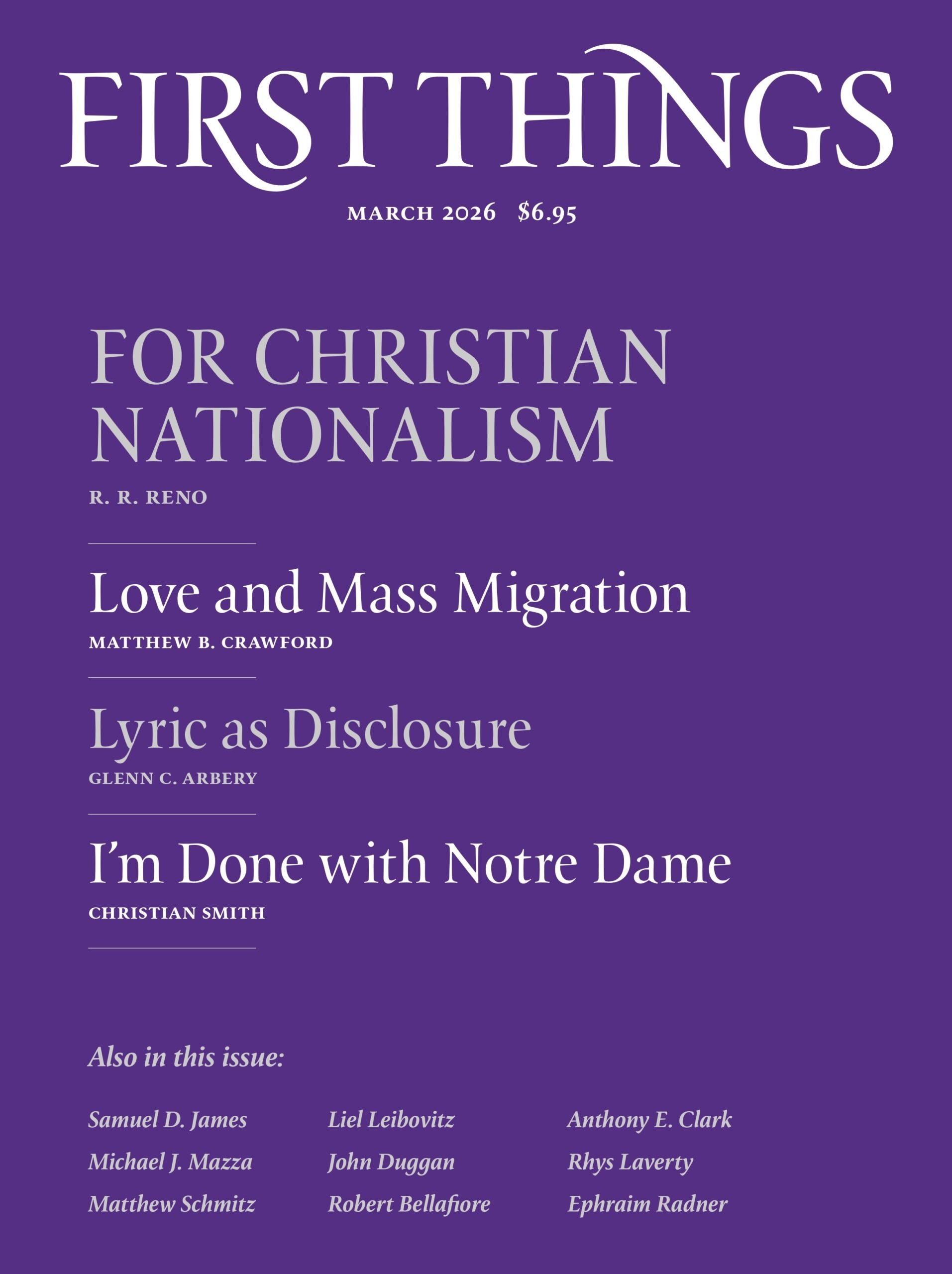
And just as bad was clearing the bed of the creek itself. I had to wade thigh-deep to cut fallen limbs deep beneath the water and heave up on the bank sunken things so waterlogged they weighed like stone. But what has happened, month by month, year by year, is that the creek has begun to find itself and remember the sun, the feel of light on the skin of the water, and we have begun to see the flow and turn of that lovely current that comes down from the Wind River Mountains and cuts through the foothills to the west of us. The labor has become for me a metaphor for lyric poetry—or, more precisely, for the labor of getting back to some essential insight: lyric as disclosure, lyric as the recovery of this shining, this boon of God.
What do I mean by disclosure? I have to confess to a summer spent not just clearing the creek but also wrestling with phenomenology more seriously and systematically than I had done before. I don’t propose to turn philosopher at my age, but since I was in my early twenties, I have found phenomenology the most appealing of the philosophical approaches to literature. Fifty years ago, I used Gaston Bachelard in my master’s thesis at the University of Georgia. At various times since then, I have drawn from Georges Poulet, Hans Georg Gadamer, and Paul Ricoeur; since the 1980s, I have taught essays from Heidegger’s Poetry, Language, Thought. What I found the phenomenologists describing was similar to what John Crowe Ransom, leader of the Southern Fugitive-Agrarians, called the primary power of the poet: “the faculty of presenting images so whole and clean that they resist the catalysis of thought.” Ransom describes what Jean-Luc Marion later called a “saturated phenomenon,” an experience that exceeds the capacity of a concept to “constitute” it.
In his Introduction to Phenomenology, Robert Sokolowski distinguishes between the truth of correctness and the truth of disclosure. Correctness has to do with the accuracy of statements or propositions that can be proved or disproved with evidence; for example, suppose I say that the town of Atchison is on the Mississippi River. It is a statement, in this case incorrect, since Atchison is on the Missouri River. By contrast, the truth of disclosure is the manifestation or display of a state of affairs that simply comes before the mind, like the Missouri itself. It is disclosed, like what you see when you round a curve in the mountains and find a valley opening up before you, or what appears when a janitor turns on the light in a gymnasium on the morning after a basketball game, or what a mother sees (or smells) when she opens the door to a teenager’s room.
Disclosure is not merely sense experience, because we sense things all the time inattentively. In disclosure there is always an element of unconcealing, with something coming out of the unseen into the seen, an element of revealing. Martin Heidegger claims that this sense of unconcealment underlies the Greek word for truth, aletheia. For Jean-Luc Marion, even the realm of “the visible” has this element of disclosure within it, because, out of all the ceaselessly incoming tide of everything that presents itself to sight, the look—the act of attention—is drawn to focus on some particular thing. Why do people take so much trouble to wrap gifts, say on birthdays or Christmas? Because unwrapping them allows the truth of disclosure: It’s not just a thing, but this thing revealed in its givenness, its character of bestowal. It’s not just a sweater or a book or a necklace but something enhanced as a gift and so received in the consciousness that someone else selected exactly this thing just for you. The truth of disclosure has this aura of gift, especially in poetry, where the perception or display comes through the poet’s language.
I am reminded of Ezra Pound’s poem “In a Station of the Metro”: “The apparition of these faces in the crowd: / petals on a wet black bough.” That’s the whole (famous) poem. Some students think it’s a joke. But suppose that Pound had written, “The appearance of these faces in the crowd is like seeing flowers on a single branch.” Nothing. What is it that the word apparition brings with it? An apparition is something beyond the ordinary power of the eyes, more than natural, perhaps ghostly. In the first act of Hamlet, the ghost of the old king is described as an apparition. Or perhaps it’s divine. We speak of apparitions of the Virgin Mary. The apparition, then, of extraordinary faces in a crowd of ordinary people on a rainy day in the subway in Paris, these faces, beautiful, unexpected, even holy—but why would we remember them? Then, in a flash, comes the metaphor that transforms them and reveals them and seals them in our recollection: “petals on a wet black bough.” Not flowers, petals. Petals—pale, finely textural, all of a color, on a single bough in a single moment. “The apparition of these faces in the crowd: / petals on a wet, black bough.”
If we try to ransack the poem for meaning—What do the petals stand for? What is Pound trying to say about modern urban life?—we miss the simple beauty of disclosure. Pound avoids anything that could be taken as a truth of correctness, providing not even a complete sentence or predication—unlike William Carlos Williams in his equally famous imagist poem, which likewise scandalizes students:
so much depends
upona red wheel
barrowglazed with rain
waterbeside the white
chickens
Williams makes a statement about the red wheelbarrow, and I suppose we could test it for correctness, but the point is that we wouldn’t come to the image without being told how much depends on it: so much. I’ve wondered whether Williams was influenced by phenomenology or simply thinking in the same way. His famous saying, “No ideas but in things,” closely resembles Husserl’s dictum, “Back to the things themselves.”
Robert Frost’s short poem “Dust of Snow” is another example of a poem as a simple disclosure, this time without even a metaphor, but next to Pound and Williams it seems almost like a discourse:
The way a crow
Shook down on me
The dust of snow
From a hemlock treeHas given my heart
A change of mood
And saved some part
Of a day I had rued.
Here the focus is on the emotional state of the poet. Before this dust of snow cascaded down on him, he had “rued” the day. We’re familiar with the word in this sense: “You will rue the day when you trust his advice—or buy that stock—or hire that woman.” The poet has already rued the day, which means he has bitterly written it off. So why the change in mood? The poem would not work if the bird were a robin, say, or a cardinal. What would they be doing there in the snow, anyway? It has to be a crow; and it has to be a hemlock tree, with its echo of Socrates’s deadly hemlock—but also with hints of being hemmed in, locked up; and it has to be a dust of snow, with its reminder of “dust to dust.” We can reconstruct such things from the associations of the words and the winter scene, but what’s really going on is the way the crow—this insouciant crow—shakes the snow on the poet and brings him to a halt, the halt that comes in the pause between the two stanzas. On the page, it’s the white space, the dust of snow, let’s call it. When he walks on, the trickster in the tree has freed the poet from moping, not permanently, but for part of a bad day—maybe just long enough to give him the poem we’re reading a century later.
In speaking of lyric as disclosure, I’m really talking about the way literature works as a mode of knowledge: It does not reason so much as it shows—not that it’s without an argument of sorts, or an emotional logic. In my estimation, lyric poetry is the most intense kind of disclosure. Louise Cowan claims that “the lyric realm is the place of origins and sources, the land of heart’s desire, symbolized by the garden.” By the garden, she means Eden, that archetype of gardens, whose mood and intensity lyric poetry evokes. The wholeness of love, the union—both sexual and mystical—of the Song of Songs is one of its manifestations:
Awake, O north wind,
and come, O south wind!
Blow upon my garden,
let its fragrance be wafted abroad.
Let my beloved come to his garden,
and eat its choicest fruits.
Cowan divides lyric into “three moments, all related to the beloved object: anticipation of its coming, consummation in its presence, and lamentation at its absence—desire, fulfillment, and loss.” This description seems to apply primarily to love poetry, like Sappho’s or Petrarch’s or Sir Philip Sidney’s Astrophil and Stella or John Donne’s “The Canonization” or “The Ecstasy.” Love poetry might even be addressed to God, as the Psalms are—full of anticipation, consummation, and lamentation. Such poetry reveals a state of desire or joy or desolation with respect to the beloved.
But in modernity, lyric poetry changed its focus from the beloved to the truth of disclosure itself. The novelist Milan Kundera, writing about Cervantes, says that the roots of the modern crisis for Husserl, the founder of phenomenology, “lay . . . at the beginning of the Modern Era, in Galileo and Descartes, and the one-sided nature of the European sciences, which reduced the world to a mere object of technical and mathematical investigation and put the concrete world of life, die Lebenswelt, as he called it, beyond their horizon.” For Kundera, the rise of the novel in modernity has helped restore “man’s concrete being, his ‘world of life,’” in a way that counters or redresses the abstracting character of the sciences. But the same has arguably been true of lyric poetry, especially since the Romantics. Long before Husserl and other phenomenologists began their work, lyric poetry seized upon perceptual experience of the natural world as its primary subject matter—what Jacques Maritain calls “that intercommunication between the inner being of things and the inner being of the human self which is a kind of divination.”
I don’t mean to be absolute about this turn, but let me contrast two poems, Edmund Waller’s “Go, Lovely Rose” and Wordsworth’s “I Wandered Lonely as a Cloud.” Waller’s song, written sometime in the early 1640s, appeals to the beloved through a symbol, the rose, whose budding, blossoming, and death encapsulate all the phases of lyric in Cowan’s sense. Like Marvell’s “To His Coy Mistress” or Herrick’s “To the Virgins, to Make Much of Time,” the poem urges the beloved not to delay, and the argument is the rose itself. First it is commissioned to show the beloved that she resembles the rose, whose beauty would be worthless if it were not seen, just as hers will be if she does not respond to love. She must come forth and let herself be seen, because beauty like hers exists only briefly before it dies. Now from the ungainly paraphrase to the precision of the poem:
Go, lovely rose!
Tell her that wastes her time and me,
That now she knows,
When I resemble her to thee,
How sweet and fair she seems to be.Tell her that’s young,
And shuns to have her graces spied,
That hadst thou sprung
In deserts, where no men abide,
Thou must have uncommended died.Small is the worth
Of beauty from the light retired;
Bid her come forth,
Suffer herself to be desired,
And not blush so to be admired.Then die! that she
The common fate of all things rare
May read in thee;
How small a part of time they share
That are so wondrous sweet and fair!
As I said, the argument of the poem is the rose itself, the “rose-as-symbol.” The poem does not reveal a particular rose, and it has no interest in doing so; its argument is about letting beauty appear. I would suggest that the poem also has no real interest in a particular beloved. The beloved exists, like the rose, only for the sake of the poem: a beautiful girl being urged to come forth to reveal her beauty and suffer the dangerous magic of desire. Both rose and girl are figures in the poem’s fresh deployment of conventions, disclosing the general truth that “all things rare” have the common fate of death. The verb “waste” in the first stanza—“Tell her that wastes her time and me”—at first sounds casual—but “wastes” becomes a terrible word from the perspective of the last stanza, because it names her thoughtless participation in universal destruction. The lover already feels it in himself as his beloved “wastes” him, almost in the contemporary informal sense. But nowhere in this poem, so perfect in its form, do we sense that the poet’s primary concern is with a particular young woman, or with the givenness of the natural world (hardly conceivable as a concern to Waller), so much as with a literary trope perfectly realized.
Now, by contrast, let’s consider Wordsworth, whose famous poem “I Wandered Lonely as a Cloud” describes a day interrupted by a sudden vision:
all at once I saw a crowd,
A host, of golden daffodils.
Beside the lake, beneath the trees,
Fluttering and dancing in the breeze.Continuous as the stars that shine
And twinkle on the milky way,
They stretched in never-ending line
Along the margin of a bay:
Ten thousand saw I at a glance,
Tossing their heads in sprightly dance.
This scene, which overwhelms the poet, is the more intense because it is entirely unexpected. It becomes the work of the poet to make the daffodils fill the whole imagination of the reader. He explains “what wealth” this “show” has brought him:
For oft, when on my couch I lie
In vacant or in pensive mood,
They flash upon that inward eye
Which is the bliss of solitude;
And then my heart with pleasure fills,
And dances with the daffodils.
That “flash” of recollection comes back instantaneously and unbidden. Yet what was given in the original moment of disclosure is crucially important: its unexpectedness, its givenness, which marks a kind of grace in nature itself. Wordsworth works to make the poem manifest this experience and inflect it emotionally amid the “bliss of solitude” of a reader far removed from his own place and time. The reader needs to experience that “flash upon the inward eye” of the imagination. Unlike Waller’s rose, the daffodils per se matter, not as the literary symbol of something else, but as a particular perception, a disclosure that amounts to revelation.
But what does that mean? Why call it revelation? In fact, why do I look at Wordsworth at all instead of turning, say, to Gerard Manley Hopkins, whose poems are explicitly about the relation of the natural world to the Creator—as in “God’s Grandeur” (“The world is charged with the grandeur of God . . .”) or “Pied Beauty” (“He fathers forth whose beauty is past change: / Praise Him”) or “The Starlight Night”? But my point is that, in an increasingly secular and technological world, lyric itself has a revelatory nature. It can open something interior, as prayer does, and bring us out of overgrown habit, out of our clutter of dead language, and into a baptized, Edenic relation to the given world.
The New England poet Richard Wilbur shows how it might be done. In his poem “Mayflies,” he describes a walk that Frost might have taken:
In somber forest, when the sun was low,
I saw from unseen pools a mist of flies,
In their quadrillions rise,
And animate a ragged patch of glow,
With sudden glittering—as when a crowd,
Of stars appear,
Through a brief gap in black and driven cloud,
One arc of their great round-dance showing clear.It was no muddled swarm I witnessed, for
In entrechats each fluttering insect there
Rose two steep yards in air,
Then slowly floated down to climb once more,
So that they all composed a manifold
And figured scene,
And seemed the weavers of some cloth of gold,
Or the fine pistons of some bright machine.Watching those lifelong dancers of a day
As night closed in, I felt myself alone
In a life too much my own,
More mortal in my separateness than they—
Unless, I thought, I had been called to be
Not fly or star
But one whose task is joyfully to see
How fair the fiats of the caller are.
This glimpse of the mayflies deep in the forest, illuminated by a late sunbeam, reminds the poet of seeing an arc of the night sky through the clouds. The brief existence of the insects becomes metaphorically the “round dance” of the constellations, which the ancients understood as an image of the eternal heavenly order. In thinking about the paradoxical similarity between the stars and the mayflies, Wilbur takes occasion to look at the mayflies even more closely, this time seeing them in terms of art or techne—craft and design. He sees not mindless randomness, in other words, but a ballet, a golden weave, “the pistons of some bright machine” in which apparent randomness coalesces into an order that Dante might use as a simile in the Paradiso.
But the poem culminates in Wilbur’s reflection on his own calling as poet. Let me read it again:
Watching those lifelong dancers of a day
As night closed in, I felt myself alone
In a life too much my own,
More mortal in my separateness than they–
Unless, I thought, I had been called to be
Not fly or star
But one whose task is joyfully to see
How fair the fiats of the caller are.
Like Frost in “Dust of Snow,” the poet undergoes a change of mood from loneliness and separation to the possibility of joy: “Not fly or star / But one whose task is joyfully to see / How fair the fiats of the caller are.” What are the “fiats of the caller”? A fiat is a decree, a “let it be done,” and the fiats of God are creation itself. Mary also voices her Fiat mihi in echo of the creation. But specifically, the call to the poet is to “see how fair”—that is, how just, but also, in the older sense of the word, how beautiful—creation is, and not just to see it, but to witness to it joyfully by making it appear in its givenness.
Beauty revealed like this is the poem simply given, and both the poet and the reader feel in it for an instant the givenness beneath what we are and everything that we experience. I think about the difference between this kind of immediate, unsought revelation and the labor of clearing the creek, which started this whole meditation. It seems wrong to say that a gift can be the result of hard labor. But that’s surely part of the paradox of lyric as disclosure—the smile of the beloved after the effort of wooing.
The problem of the lyric poet comes from the nature of language. No poem like “Mayflies” comes to someone inattentive to insight or unpracticed in language. As the critic and poet T. E. Hulme puts it, “language is by its very nature a communal thing; that is, it expresses never the exact thing but a compromise—that which is common to you, me, and everybody. . . . And to get out clearly and exactly what [the poet] does see, he must have a terrific struggle with language.” Language is full of dead metaphors, and for Hulme, lyric poetry tries “to prevent you gliding through an abstract process. It chooses fresh epithets and fresh metaphors . . . because the old ceased to convey a physical thing and became abstract counters.” These “abstract counters” resemble what phenomenologists call “sedimentation,” which means the falling-back into vagueness and obscurity of the original ideas on which current understandings are based. Sedimentation is always at odds with the truth of disclosure. We get used to things; we no longer feel things once felt or think things once thought.
Clearing Squaw Creek feels like what Sokolowski describes as the attempt to get “to the essentials of things [which] also means getting to the archaic and original.” How do we recover the garden experience of the imagination? It’s interesting to think about when the nouns garden and landscape became verbs: to garden, to landscape, this action of working with nature to disclose the quick of a lyric fluency. Reading lyric poetry can also be a matter of working through a sedimentation of readings to the original live surprise of disclosure—for example, reading Keats’s metaphor of the European explorers on a peak in Darien (Panama) silently looking at each other with a “wild surmise” when they see the Pacific Ocean, whose existence they never suspected. Reading the poem well means feeling this astonishment, powerful as it is, but also recognizing this shock as the metaphor for discovering Homer after centuries of cultural sedimentation.
How do we see again what we’re too used to seeing? Working in the creek, I often think of the English poet Ted Hughes and his 1983 volume of poems, River. In the poem that begins the volume, written in three-line unrhymed stanzas, he writes:
From a core-flash, from a thunder-silence
Inside the sun, the smelting
Crawls and glimmers among heather-topped stones.
It takes a moment to apprehend the image. If we imagine the interior of the sun as a nuclear furnace, a “core-flash” beyond sight and hearing, then the smelting that flowsfrom this unimaginable heat should be some incandescent molten metal, but—miraculously, mercifully—it is instead the river, this cool water that “Crawls and glimmers among heather-topped stones.” It is an astonishing disclosure:
The mill of the galaxy, the generator
Making the atoms dance
With its reverberations, brims out lowly
For cattle to wade.
Even as Hughes asks us to see the river’s source in the sun itself—which is true in the sense of correctness over countless intermediate steps—he also makes us feel a startling metaphor (if we’re attentive to the suggestion) of the Incarnation, which brims out of the Godhead to enter a world in so lowly a form that cattle can wade the river, as they stirred around Christ in the manger. Hughes calls the poem “Flesh of Light,” as though to echo the Nicene Creed. Later in the book, he picks up this startling identification again. The title, “River,” is also the subject of the sentence with which the poem begins:
River
Fallen from heaven, lies across
The lap of his mother, broken by world.But water will go on
Issuing from heavenIn dumbness uttering spirit brightness
Through its broken mouth.Scattered in a million pieces and buried
Its dry tombs will split, at a sign in the sky,At a rending of veils.
It will rise, in a time after times,After swallowing death and the pit
It will return stainlessFor the delivery of this world.
So the river is a godKnee-deep among reeds, watching men,
Or hung by the heels down the door of a damIt is a god, and inviolable.
Immortal. And will wash itself of all deaths.
This is simply what the word river means, what a river is, and from the first disclosure there is pathos: “River / fallen from heaven, lies across / the lap of his mother, broken by world.” River is Michelangelo’s Pieta, and Mary is earth itself, gē, Gaia. Whether or not Hughes himself is Christian, he finds his archetypes deep in the culture. Here is the passivity of Christ’s body deposed from the cross, “broken by world”—“world” in the sense of civilization, commerce, conquest, all the constructs of man’s enterprise and pride and sin, the world that Wordsworth evokes when he writes that “the world is too much with us.” This is River fouled by waste, “hung by the heels down the door of a dam,” exploited for energy, like the Rhine in Heidegger’s essay “The Question Concerning Technology,” but for all that still uttering “spirit brightness” from its broken mouth. River reveals Christ, as though his baptism in the River Jordan, which announced the beginning of his public ministry, had been at the same time a revelation that he is the River from which he rose, “inviolable. / Immortal.” He will “wash [himself]”—and therefore us—“of all deaths.” Regardless of what foulness and willfulness we empty into River, “It will rise, in a time after times, / After swallowing death and the pit / It will return stainless / For the delivery of this world.” River is baptismal, resurrectional.
Is it some such hope that keeps drawing me down to the creek? Working on it feels purgatorial, I admit, as though the recovery of the living water were at least a hint of the promise of Eden in the flesh of light, the disclosure of lyric. In a way this whole understanding of lyric is naive, of course. Just the other day I found a note I had written more than ten years ago about how I wanted “a sense of the veil of familiarity being stripped from existent things, so that they ‘shine’—these terms and ideas already thirty or forty years old in my habitual imagination.” They are even older than that, I suspect. But I also wonder whether the lyric doesn’t ultimately want more than the garden, this brief disclosure of Eden and the Edenic loss. I wonder whether there is also a foretaste implicit in the lyric—in other words, not simply the recollection of Eden but the anticipation of paradise. In Canto 30 of Paradiso, Dante uses two images that draw together much of what I have been trying to say about lyric as disclosure. The first comes when Dante’s sight clears so much beyond its previous powers that, as he writes (in Allen Mandelbaum’s translation):
I saw light that took a river’s form—
light flashing, reddish-gold, between two banks
painted with wonderful spring flowerings.Out of that stream there issued living sparks,
which settled on the flowers on all sides,
like rubies set in gold; and then, as ifintoxicated with the odors, they
again plunged into the amazing flood:
as one spark sank, another spark emerged.
In effect, the pilgrim undergoes disclosure after disclosure. In order to perfect his sight, he leans to the river at Beatrice’s instruction and bathes his eyes in its “waters,” and at once the river resolves into the great circle of the celestial rose. The flow of being, the historical motion of revelation in time, the flesh of light once broken by world and now washed of all deaths, now reveals itself as one simple blossom, as particular as Pound’s faces, as surprising as Wordsworth’s daffodils, as deep with all symbolism as Waller’s rose. Ultimately, writes Louise Cowan, “the lyric reveals the secret at the heart of poetry.” That’s why we keep going back to clear that current of what obscures it, because the secret is worth the labor.

YOU MIGHT ALSO LIKE
Timothée Chalamet Is Right About Art (ft. Suzy Weiss)
In this episode, co-founder and reporter for the Free Press, Suzy Weiss, joins Virginia and Germán to…
Helene Schjerfbeck’s Defiant Paintbrush
Helene Schjerfbeck (1862–1946) did not go gentle into that good night. In 1944, war still raging, the…
How Kanye Went Nazi
Last year, Kanye West—sometimes known as Ye—released a song titled “Nigga Heil Hitler.” The music video featured…
