
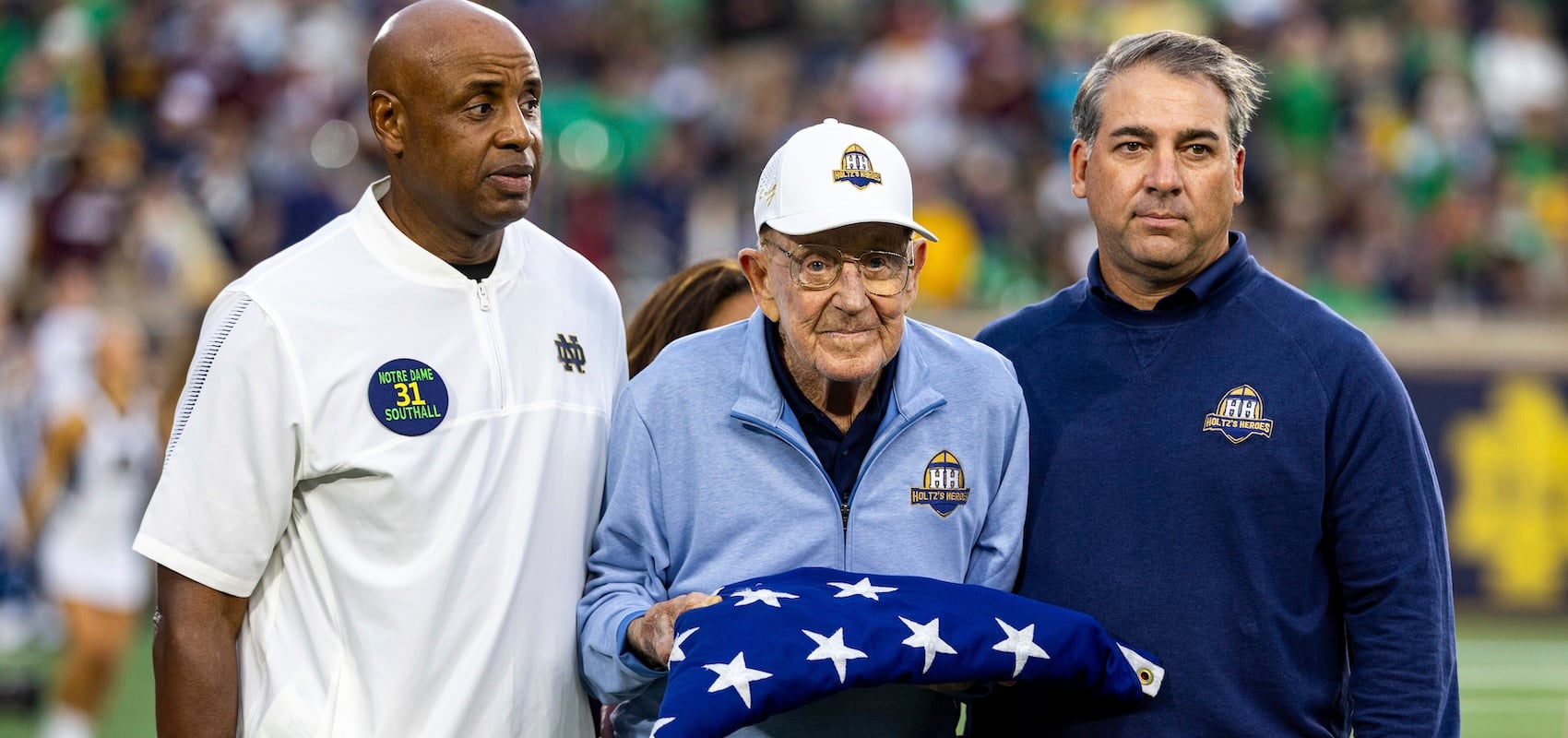
Lou Holtz hated to lose at football. Texas A&M’s 35–10 victory over his Notre Dame team in the 1988 Cotton Bowl deeply discouraged him. His team’s 8–4 record was an improvement over the previous season’s 5–6, but this gave him little satisfaction. In the spring of 1988, as he geared up for what would be his great national championship season, he wrote a long letter to the whole football team.
The master motivator outlined in compelling fashion the need for discipline and perseverance, loyalty and respect. This was standard fare for good coaches of the day, and especially so for Holtz, who aimed to forge men of character capable of handling the pressures of life after their playing days were over. But then in the heart of his message to his players, of whom probably half were not Catholic, Holtz emphasized that Notre Dame was “founded as a tribute to Our Lady on the Dome.” He quoted Fr. Edward Sorin, the Holy Cross priest who established the school in 1842: “I’ve raised Our Lady aloft so that men will know without asking, why we have succeeded here.”
Holtz proceeded to lecture his team on the Notre Dame mystique and its meaning for each player:
When we do what is right, we bring glory and honor to Notre Dame. When we win in football, we help this university. To reach your potential, you must learn to love this university. Put your faith, confidence and belief in Jesus. That is what this university is all about. It’s your decision, but I firmly believe that Our Lady on the Dome will watch out for you. Spend some time at the Grotto, and you’ll discover that this school is special.
Lou Holtz’s heartfelt sentiments, which may seem schmaltzy to anyone except Notre Dame true believers, capture the essence of what made Louis Leo “Lou” Holtz such a distinctive football coach. He loved the Blessed Mother and, as he deemed it, her school. The football program was not ancillary to Notre Dame’s Catholic mission but integrated into it.
Holtz had extensive head coaching experience before coming to Notre Dame, having overseen football programs at William & Mary, North Carolina State, Arkansas, and Minnesota prior to his arrival in South Bend. He brought with him enormous gifts as a motivator and a track record for rescuing flailing programs, like the sad one he inherited in South Bend. The wiry and wily coach undertook energetically to resuscitate Notre Dame’s football reputation. It was obvious from his very first day that he would succeed. Such was his determination and his genius for coaching.
The magnificent 1988 season included the dramatic “Catholics vs. Convicts” triumph over Miami and then a victory over West Virginia in the Fiesta Bowl, which secured the national championship for the Fighting Irish. Over the subsequent years Holtz’s team enjoyed notable success, with impressive bowl appearances and victories. Fair-minded observers agree that the team should have shared the national title with Florida State in 1993. Holtz was a demanding taskmaster who drew the best from his players. He restored Notre Dame to football greatness in a manner similar to Ara Parseghian’s feat a generation before. Holtz’s credentials as a coach are unquestionable, and he warrants the statue outside the Holtz Gate of Notre Dame Stadium.
Yet Lou Holtz was much more than a successful football coach. Dan Devine, the Notre Dame coach in the 1970s, had real success on the gridiron and also won a national championship, but he never managed to endear himself to the Notre Dame faithful as did Holtz. “Lou,” as he was known to all, was a terrific speaker—both witty and moving—who quickly won the student body and the alumni to his side. More notably, he effectively understood and articulated the spirit of Notre Dame. Here Holtz’s faith was crucial.
Lou’s Catholic faith had always been important to him. The Sisters of Notre Dame at St. Aloysius Grade School in East Liverpool, Ohio, gave him a good start. He and his treasured wife, Beth—they were married for fifty-nine years until her death in 2020—served as good Catholic parents for their four children. But Lou’s faith was both challenged and deepened at Notre Dame. In his memoir, Wins, Losses, and Lessons, he observed: “Faith was the only thing that allowed me to cope with the responsibilities and expectations of my job.” When on campus, he was a daily communicant at the 6:30 a.m. Mass in the Crypt Chapel of Sacred Heart Basilica. His faith-filled witness served to inspire others in their own religious practice.
Holtz relied heavily on his faith during his final years at Notre Dame, when some health challenges and tensions with administrators eventually led him to resign the coaching commission that defined him. His love for and commitment to Notre Dame continued unabated. Lou Holtz and Fr. Ted Hesburgh had forged a close friendship during his years as coach, and this continued even after Holtz moved on. Coach Holtz had provided a substantial donation to cover the publication expenses and honoraria for all contributors for Hesburgh’s edited volume The Challenge and Promise of a Catholic University. This was but one of many generous gifts that Lou and Beth Holtz bestowed on Notre Dame over the ensuing decades. The Beth and Lou Holtz Family Grand Reading Room on the first floor of the Hesburgh Library stands now as a tangible sign of their loyalty to Notre Dame.
Following the eventual end of his coaching career—after a turbulent stint at South Carolina—Lou Holtz enjoyed a successful spell as an ESPN commentator. He also proved willing to speak to various audiences, and in his talks and writing he began to make his faith commitments ever more public. He emphasized the importance of faith and family and of service to God and country. He served as the spokesman for the “Catholics Come Home” campaign and spoke regularly on Catholic campuses. He acknowledged that difficult times would come, but he recommended deep faith and hard work as the antidote to them. His firm pro-life convictions led him to call out pro-choice Catholic politicians, including Joe Biden, for failing to uphold Church teaching on the sanctity of life. Such declarations annoyed certain progressive elements on the Notre Dame campus, but Holtz was undeterred. He knew at some deep level that the Lady on the Dome approved of what he said. His simple but profound Marian spirituality continues on campus in the devotional practices of groups like the Militia of the Immaculata, as recent events revealed.
After his funeral at Sacred Heart Basilica, Lou Holtz will be laid to rest next to his wife in the university’s Cedar Grove Cemetery—where the earthly remains of both Ara Parseghian and Knute Rockne also now lie. No doubt their graves will attract visitors on occasional Saturdays in the fall. Alumni will recall many of Lou Holtz’s famous quips, including his often-repeated: “I don’t think God cares who wins [the game], but his Mother does.” May the Blessed Mother—Our Lady on the Dome—intercede with her Son and reward Lou Holtz for his Christian convictions and fidelity in the most important contest of all.
Image by ASSOCIATED PRESS.

YOU MIGHT ALSO LIKE
Turned Away on Palm Sunday
In politics, diplomacy, war, or pretty much any field of human interaction, one must contend not only…
Timothée Chalamet Is Right About Art (ft. Suzy Weiss)
In this episode, co-founder and reporter for the Free Press, Suzy Weiss, joins Virginia and Germán to…
A Medieval Pilgrimage in Modern Assisi
When you go to the hilltop town of Assisi, you’re immediately struck by how medieval it is:…
