
Young Catholics are on the rise in New York City, according to the Washington Post, the New York Post, and social media influencers who sell the faith with an implicit message: “Everyone’s becoming Catholic—you should too.” But to a Reformed Protestant—and, judging by the comment sections, the typical, critical scroller—the media’s fixation on Catholic influencers and Gen-Z popularity doesn’t make the vibe shift seem like an organic religious revival: It makes it look like a passing trend.
This Easter weekend, I embarked on a journey to find the Catholic Church beyond the curated image so many encounter online. St. Joseph’s Church in Greenwich Village promised an unquestionably counter‑algorithmic Easter Vigil experience: three and a half hours—from 8:30 p.m. Saturday night to 12 a.m. Sunday morning—of liturgy, lengthy readings, and the induction of dozens of new Catholics. To be completely honest, it sounded brutal.
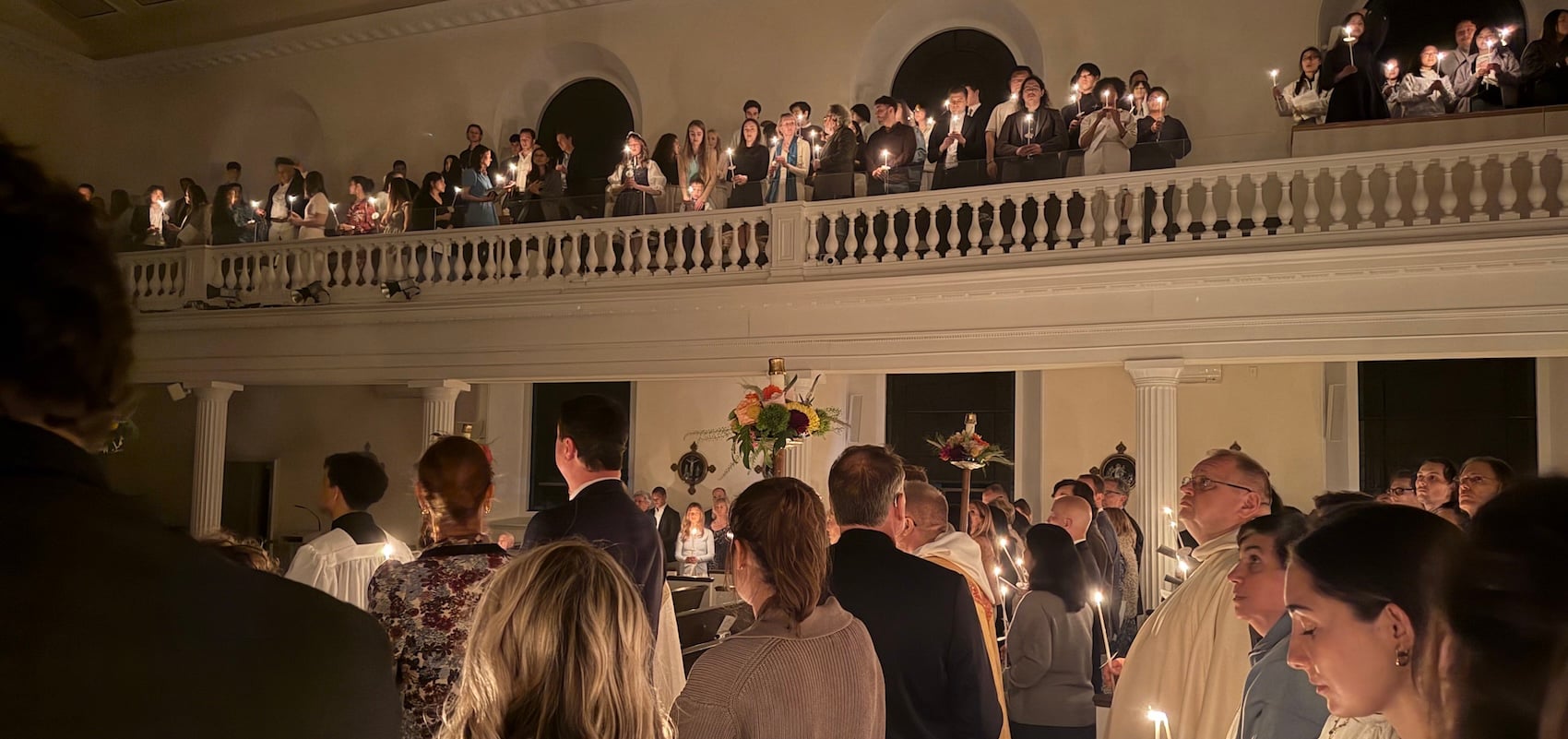
I arrived around 7:30 p.m. to find the church not yet full. The sanctuary was dark. The windows were cracked, in anticipation of excess body heat. City sounds bled through the walls: honks, sirens, conversations, arguments, laughter, revving engines. I was surprised to find that the sanctuary lacked the ornate woodwork, formidable stained-glass windows, vaulted ceilings, and Baroque flourishes that I have come to expect in New York City Catholic churches. The color palette was white with gold accents, including columns holding up the balcony and the front facade. The altarpiece appeared faded. The church itself is relatively small, fitting around eight hundred.
Despite the humble appearance, numbers have not suffered. “For the past seven to eight years, St. Joseph’s has seen a steady increase of people,” Fr. Jonah Teller, O.P., said. “There was a noticeable jump starting last Advent, when some people started posting about how crowded Mass was, how many young people there were, but, again, that was a jump on top of an already crowded church,” he said. Annual baptism and confirmation rates have surged from thirteen to sixteen people per year (2021–2024) to eighty-eight people receiving their sacraments in 2026.
As the sanctuary started to fill, conversation grew but never became raucous. Young people streamed in—including one young man sporting a pair of “YOLO” socks, which seemed ironic, given the holiday—but also plenty of presumed parents and Gen X supporters. Fr. Jonah wagers that roughly 55 percent of the congregation is Gen Z, while 25 percent are millennials and 10 percent are Gen X.
Maybe due to a cultural distrust in journalism, or a dissatisfaction with recent media coverage, nobody atthe vigil wanted to speak to me about St. Joe’s or his or her conversion experience. But I overheard one recent convert behind me explain to his neighbor why he chose St. Joe’s. Our Lady of Pompeii Church right down the street is “beautiful,” he said, “but it’s empty.” The parishioners at St. Joe’s, he explained, are normal and down to earth; the priest’s message is clear and understandable; and the congregation is growing. When he had converted a few years prior, it felt “weird” to do so; now, he said, “it feels like everyone is doing it.”
Rebecca Krinzman received the sacraments at St. Joe’s in January, earlier than expected after being diagnosed with cancer. Her early childhood experiences with the Church in Spain led to Mass attendance in college, but as a “somewhat prophylactic ritual.” When she moved to New York City last year after graduation, a friend invited her to a “Catholic reading group,” which turned out to be OCIA. What kept her coming back was Fr. Jonah and the way he spoke about the faith.
“His intellectual and pastoral integrity was really inspiring and instrumental in my journey with the faith,” Krinzman said. “The larger community at St. Joe’s is also nothing short of incredible. The amount of support I received from Fr. Jonah, the parishioners, and my OCIA classmates was unbelievable. I’m eternally grateful that I stumbled upon such a special community. St. Joe’s really makes visible the body of the Church in both its concrete and abstract meanings.”
She cited the aesthetic coherence and cultural and political visibility of the Catholic Church as some of the reasons for the Gen-Z draw, but pointed to its call for community and discipline as the more fundamental pull.
“This structure is not restrictive, but rather stabilizing and formative. I think, increasingly, people my age are recognizing that,” Krinzman said. “In that sense, I see Gen Z’s turn toward Catholicism as a kind of ‘rebellion’ against the disenchantment and atomization of our era. Perhaps that’s an overly optimistic reading, but even beneath the many layers of irony and anemoia among the so-called ‘TradCaths,’ I believe the draw is rooted in a genuine and pure desire to recover something real that has been lost.”
While we journeyed through the mysteries of God’s work to save his beloved creation, the room was illuminated by candles representing the light of Christ that shines in his Church, “a fire into many flames divided, yet never dimmed by sharing of its light.” After the readings concluded, the lights came on for good, signifying the elucidating work of faith in our lives: faith that requires the same endurance, patience, and fortitude to see into its mystery as the Mass requires of its attendees.
After a nine-minute homily, the first seven rows of pews cleared out with converts and their sponsors. They lined up and wrapped around the front of the altar platform. Twenty-nine catechumens were baptized, and there were fifty-six confirmations in total, with another group scheduled for confirmation this coming Sunday. The Mass concluded at 11:42 p.m.
When concentrating on rising Gen-Z interest in the Church, one is tempted to forget the counter-trend: the number of cradle Catholics leaving the Church over the last fifty years. In 1973, 84 percent of all those raised Catholic still identified as such when surveyed as adults. By 2022, it had dropped to 62 percent, and only 11 percent of those raised Catholic still participated in Mass every Sunday. Will this conversion trend, passing or not, have the energy and the momentum to build back the numbers the Church has hemorrhaged over the last few decades? The exuberant joy that takes hold of a Protestant congregation in celebration was largely missing from the vigil, especially in its baptismal liturgy and congregational singing. That which overemphasizes austere reverence is often drained of its vitality, and vice versa.
While it’s hard to say definitively, the question will not find its answer in reels or influencers whose success depends largely on submission to the algorithm. Short-form social media content, in all its ephemerality and convenience, bears little resemblance to what the Church actually asks of its members.
“The claims that the Church makes and the discipline and sacrifice it requires were really what drew me in,” Krinzman said. “Once I began to live out the teachings of the Church, I noticed a tangible and profound change in my life that was impossible to ignore. Catholicism, unlike any other religion I’ve encountered, offered me something doctrinally and existentially solid.”
