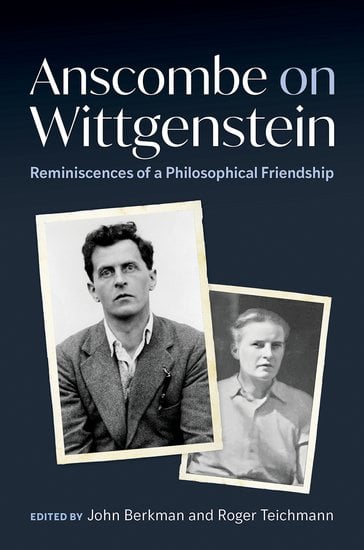
Anscombe on Wittgenstein:
Reminiscences of a Philosophical Friendship
edited by john berkman and
roger teichmann
oxford university, 248 pages, $34.99
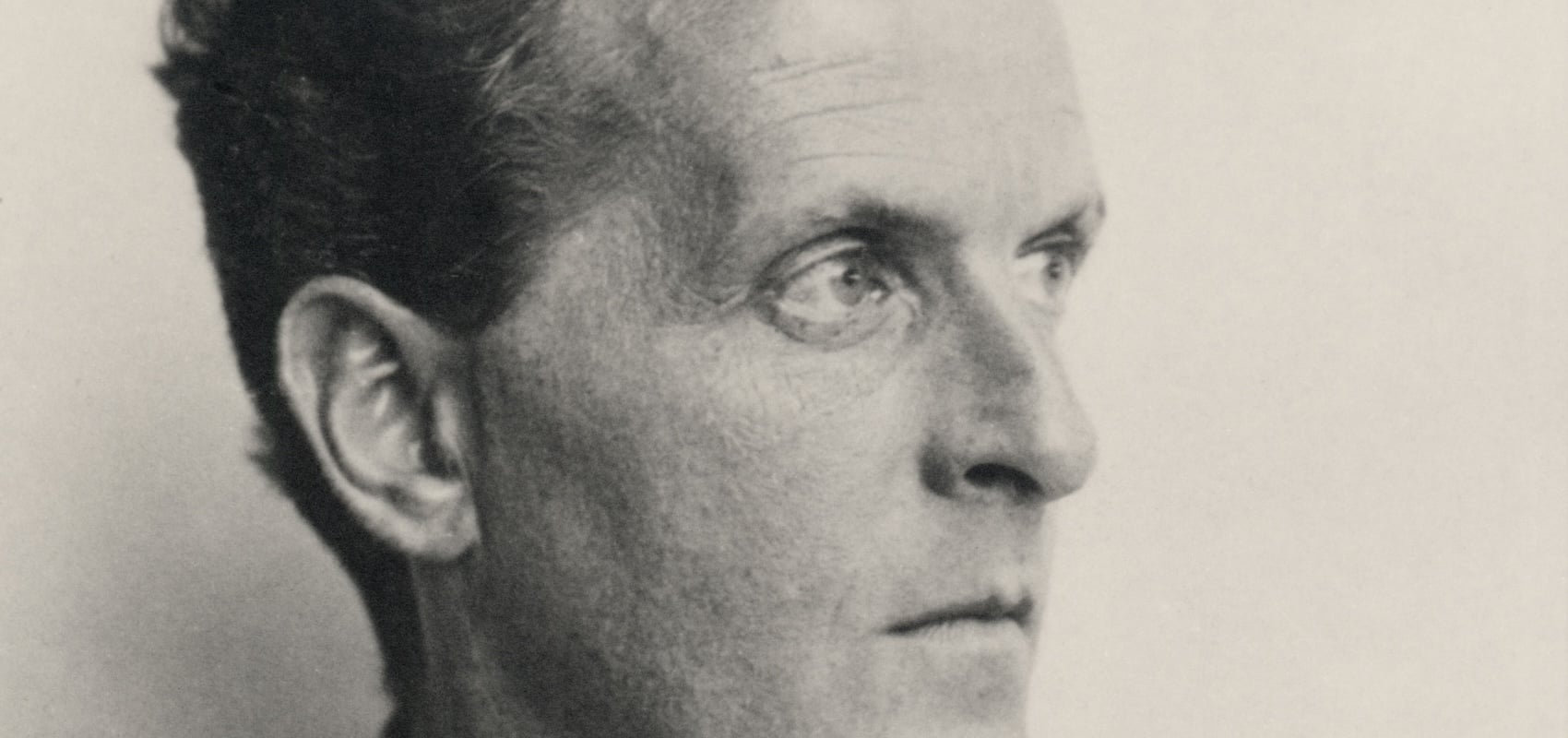
In the autumn of 1944, Ludwig Wittgenstein noticed a young doctoral student in attendance at his lectures at the University of Cambridge. She was “a woman, Mrs so and so who calls herself Miss Anscombe, who certainly is intelligent,” he wrote in a letter to his friend Rush Rhees. During the years that followed, that Miss Anscombe became one of Wittgenstein’s closest confidants. In April 1951, she was one of the few friends whom Wittgenstein had at his bedside when he died, and one of the three philosophers whom he chose to bring his unfinished work to publication.
This wonderful book illuminates the relationship that unfolded in the short time that Anscombe and Wittgenstein knew each other, as shown through Anscombe’s written “Reminiscences of Wittgenstein” (as they are titled here) and John Berkman’s extremely thorough research into Anscombe’s life. The “Reminiscences” supply us, as Roger Teichmann writes in his valuable introductory essay, with “a rounded, often subtle, and distinctly human portrait” of one of the great philosophers of the twentieth century, and also of his friendship with the woman who was undeniably his greatest student.
Anscombe had come to the University of Oxford in 1937; she read Wittgenstein’s Tractatus Logico-Philosophicus in the course of her undergraduate studies. In 1941, she won a scholarship to study at Oxford for the D.Phil., working under the Austrian émigré Friedrich Waismann on a dissertation titled “The Identity of Bodies.” Anscombe wrote several versions of this thesis but was dissatisfied with all of them—a judgment shared by Wittgenstein, who according to the “Reminiscences” described the work as “‘Bought for a farthing’ and ‘Shit on the floor’—though the way he put this latter to me was ‘Not house-trained.’” The dissertation was never filed with the university.
At the time Wittgenstein noticed Anscombe at his lectures, she had been married for almost three years to the philosopher Peter Geach, whom she met at a Corpus Christi procession in 1938. Anscombe and Geach were both converts to Catholicism, and were quite distanced from each of their families by the time of their marriage. Their first child, Barbara, was born in April 1943, and in 1944 Anscombe was essentially living as a single mother, as Geach had been assigned to forestry work as a conscientious objector to the Second World War. The family’s financial situation had always been extremely tenuous, and it was worsened when Newnham College, Cambridge, declined to award Anscombe a grant that would have continued the two-year studentship that they had given her in 1942. The simple truth, laid out in Berkman’s introduction, is that for most of the 1940s Anscombe, Geach, and their children were living in poverty, dependent on the charity of others.
It is a remarkable thing, revealing her personal tenacity as well as her very deep love of philosophy, that Anscombe’s academic career survived those early years. Reading this book, it seems clear that her friendship with Wittgenstein was another one of the things that sustained it.
According to Berkman, what kept Anscombe living in Cambridge after 1944 was not that Wittgenstein lectured there, but rather that, as a charity case, she was allowed to generate income by subletting rooms in the house she rented. Nevertheless, this fortunate proximity allowed her to keep attending his lectures, and as he got to know her better, Wittgenstein supported Anscombe in a number of specific ways. In early 1945, Anscombe read a paper to the Cambridge Moral Sciences Club—an important philosophical society—that Wittgenstein thought was very good, and soon he asked her to be the club’s secretary. Later that year, Wittgenstein not only wrote on Anscombe’s behalf when she reapplied to Newnham for a fellowship, describing her as “the most talented female student I have had since 1930,” but he even put on a tie and visited the principal of the college to advocate for her. Less conventionally, and in a remarkable act of generosity, when Geach and Anscombe’s second child, John, was born in December 1945, it was Wittgenstein who paid the hospital bill.
Even more significant than these concrete gestures was the example Wittgenstein provided of a philosophical life. In the “Reminiscences,” Anscombe recalls “finding [Wittgenstein] embarrassing early on,” pointing to a moment in the autumn of 1944 when he took unwarranted offense at not being put down as chairman of the Moral Sciences Club. There is no doubt that Wittgenstein could be thin-skinned, but this had much to do with the radical tenor of his approach to philosophy—something “which he did not want to do just as a profession,” Anscombe recalls. In other words, Wittgenstein did not see philosophy as a matter of addressing purely intellectual puzzles, let alone doing so just for the sake of professional advancement. As she writes: “It had to be living work, or he was not happy to do anything in it.” At another point, she recalls him saying of Plato: “What is so good about him is that it is clear that these questions are a matter of life and death to him.”
In Anscombe’s eyes, this attitude of Wittgenstein’s stood in contrast to the professionalized atmosphere that prevailed among academic philosophers at the time, especially in Oxford. One of the most influential figures in postwar Oxford philosophy was J. L. Austin, whose lectures on perception Anscombe would have attended as an undergraduate. After the war, in which he had played a leading role in assembling the military intelligence that was the basis of the Normandy invasion, Austin set to work developing a research team that would take a similar approach to resolving philosophical problems through the careful analysis of ordinary language. One of their hopes, in Austin’s words, was to “get rid of philosophy, by kicking it upstairs” into the hands of some scientific discipline, such as linguistics.
For Anscombe, this approach failed to recognize the roots of many philosophical problems, seeing them wrongly as the result of simple errors. Berkman’s introductory essay quotes the philosopher O. K. Bouwsma’s record of a conversation with Anscombe in 1950, in which she expressed her low opinion of Oxford philosophers:
She thought I would find the atmosphere depressing. Cheap. Cheap. There aren’t any problems. And these people are all above it. They have easy dispositions for all difficulties . . . a certain shallowness which goes with their cleverness. It’s as though they feel they have the key to all mysteries and feel now a delight in their unmasking of the emptiness of all pursuits.
The attitude described here, according to which all philosophical problems dissolve upon reflection, is one that is commonly associated with Wittgenstein. There are some good reasons for this association, as Wittgenstein always resisted the idea that trying to build a satisfactory theory was the right way to respond to a philosophical difficulty, and often refused to take philosophers’ accepted starting points for granted. (For example, Anscombe recalls him criticizing the argument form Cogito, ergo sum by saying that he didn’t understand it: “If someone were to say: ‘I think it’ll rain today—therefore I exist,’ I wouldn’t know what he meant.”) Still, it is very clear from Wittgenstein’s life and work that he was tormented by philosophical problems, and saw them in just the way he attributes to Plato: as a life-and-death matter. So did Anscombe, as the rest of Bouwsma’s recollection illustrates:
Wittgenstein talks about [some] men as serious and deep. Perhaps it’s just that these [clever but shallow] men strike Miss Anscombe as like magicians who with a certain trickery and sleight of hand expose the poor ninny philosophers whom they seize upon. The ninny philosophers may not have had the benefit of borrowed cleverness, but they were very earnest, they had problems to which they gave their lives and hard labor. These people have nothing to do but debunk. . . . It isn’t then that these people are mistaken in what they say. It is that they have nothing but this show they put on. What a clever boy I am! These other philosophers made mistakes, in earnest, but what now are you doing in earnest? There you are crowing over the mistakes of earnest men. So you will never make an important mistake, for nothing is important to you. Wonderful! Crow!
While the published versions of Bouwsma’s recollection do not specify which shallow and unserious figures Anscombe was speaking of, it is certain that Austin was among her targets. Their mutual dislike was partly personal, but Anscombe also saw Austin as going in for a show of cleverness that covered up a lack of philosophical depth. (For his part, Austin would have accused Anscombe and Wittgenstein of putting on a mere show of profundity.) In Wittgenstein, she had a model of a philosophical life.
Wittgenstein’s fondness for Anscombe did not mean that he let her off the hook for what he saw as her philosophical mistakes. Earlier I quoted his verdict on the draft that he saw of her dissertation; in another place Anscombe remarks on “the amazed pleasure when he liked what one wrote”—a pleasure that she claims to have felt only twice, once being when she read her paper to the Moral Sciences Club in 1945. More often, when Wittgenstein thought someone had got something wrong, his response could be brutal: Anscombe describes him as alternately irritated and wearily impatient in what she calls his “unforeseeable condemnations” of one’s ideas, “which would be wholly unanswerable when they came.” Nor was this the kind of criticism that his students would look forward to learning from. Instead, Anscombe describes “a disagreeable relation of fear and stupefaction [which persisted] for the first four years or so of our friendship, and largely in connection with philosophy,” and recalls that when she was preparing the last version of an essay that was published in 1950 she “did not take the risk of showing it to [Wittgenstein]; I was too cowardly.”
In the years that followed, Anscombe’s “original state of besotted reverence for Wittgenstein” turned into something healthier and more philosophically generative. As she recalls, her early tendency to be convinced by Wittgenstein, when she understood him, “was a matter of an overwhelming influence”:
And in philosophy that is not good. That is to say, influence which improves standards of argument and seriousness—which he certainly had on me—is good; but not influence which makes something seem convincing because it is part of X’s teaching. That light of convincingness is bad; and I soon began to struggle against it. I told myself that I had no right to think something which impressed me in this way; I had got to be able to think whatever I could really claim to think in, so to speak, a dull way, and with reasons which I could give and which ought to be visible as having point and force to minds that had not suffered that great impression.
There is much more light shone in this book on the impression that Wittgenstein made on Anscombe, not just as a brilliant philosopher but also in his simple humanity. What is amazing, as I have said, is that all this unfolded in a span of just six and a half years, during which time Anscombe had two young children and was mostly living apart from her husband, dealing with more than her share of life’s usual troubles as well as some serious illnesses, including a disease in her left eye that ultimately left it effectively blind. When Wittgenstein died in 1951, Anscombe was eight months pregnant with her third child, Mary, and at his funeral she wept so severely that Peter Geach worried she would miscarry. The final passage of the “Reminiscences” recalls what she had lost: “His friendship was one of the best things I ever had and was of great use to me and I do not know of any harm it ever did me; I wish that mine had been of use to him, but it hardly could be, I had too little understanding.” This last judgment is surely mistaken.