Regular First Things readers will know that one of my preoccupations is the dehumanization that grips our cultural moment, from the casual abuse that right and left hurl at each other from the safe, disembodied haven of social media to the implications of such things as trans ideology, AI, and medically assisted suicide. We cannot combat these things by mere argument. We are not a collection of ideas. We are flesh-and-blood creatures, and we are persons made in God’s image. To be truly human, therefore, we must live our lives in a truly human fashion.
Which brings me to Rome. Each year at spring break my wife and I head to the Eternal City, to spend the week with good friends from Atlanta. We have visited enough times now to have seen all the major tourist attractions and learned the geography of the old city. We therefore typically eschew public transport and, freed by familiarity from over-reliance on Google maps, we spend the days wandering the old streets in the morning, drinking cocktails in the late afternoon, and eating well in the evening, all the time watching the world go by. And having seen the sights, we take few photographs these days, preferring the immediacy of the company of our friends to a life mediated through a lens and frozen in pixels.
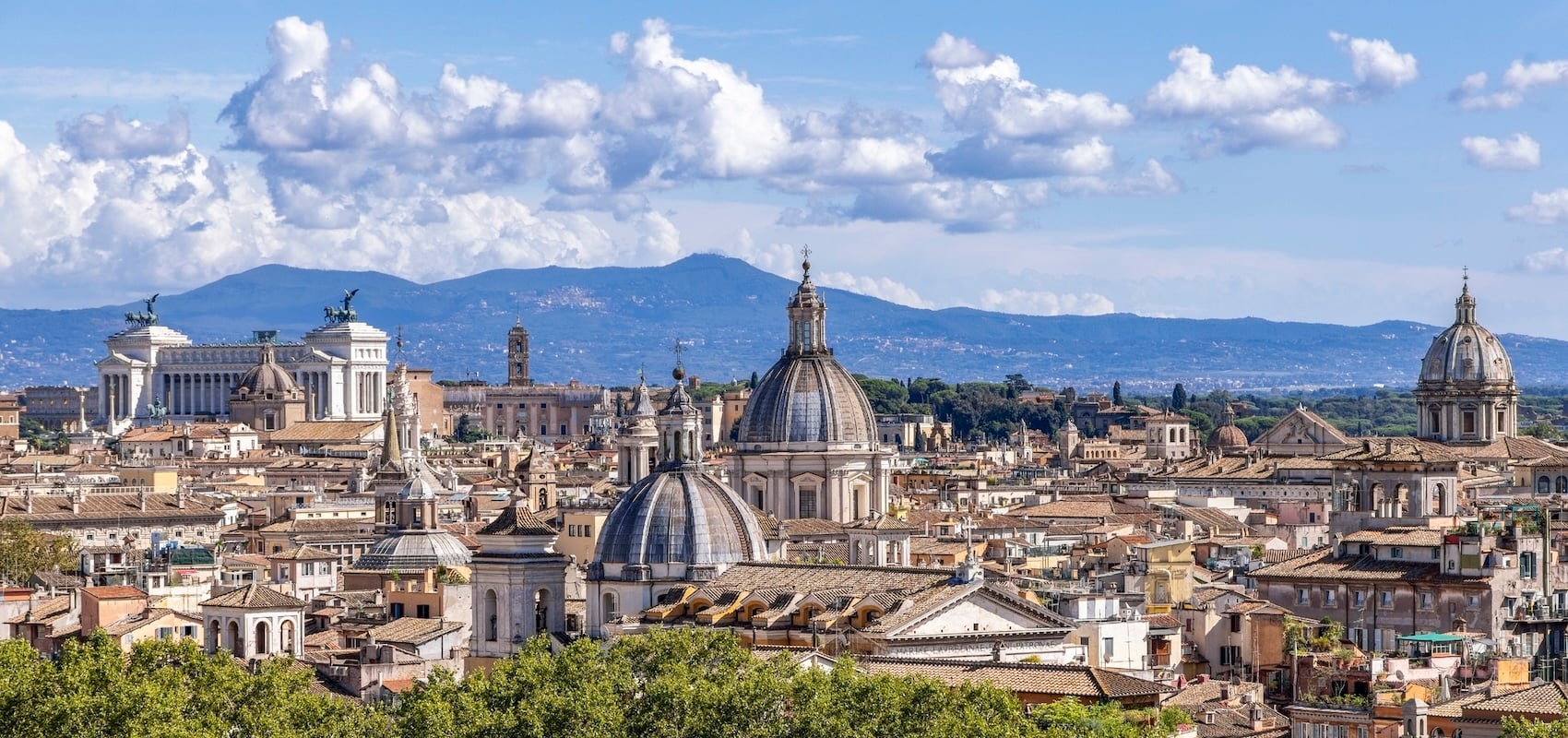
For me, the annual trip to Rome is thus a time to step back and grasp once again something of the truly human. The city itself pulsates with humanity. It has avoided the homogenized skylines formed by the skyscrapers that dominate so many historic urban centers. It is replete with buildings, public statues, and streets that are beautiful. As to churches, where else can one wander randomly into a house of worship and find paintings by Caravaggio or a sculpture by Bernini simply there, in the sanctuary? Forget St. Peter’s—put any Roman church down anywhere in the U.S. and it would likely be in the top ten of the most remarkable places of worship in the nation. Indeed, so much of the city testifies to the Catholic Reformation’s charge that Protestantism neglected physical beauty—one we Protestants often fail to take seriously. Rome also has distinct sounds, not the perpetual blaring of car horns and police sirens of Manhattan or Philadelphia but church bells and human voices. And the people take pride in the way they dress. If you see someone wearing sweatpants, a hoodie, and crocs, you’ve found an American tourist.
Most striking to me this time was how restaurants and cafes were generally not populated by people staring at their cell phones. Instead they were enjoying each other’s company. And the dinner table is yours for the evening, a place to sit and talk long after the meal is finished, a place to be human. In the U.S. or U.K., the dining table has become a place where loved ones may be geographically near each other but are metaphysically separated by a vast distance. Dining together should be a means of acknowledging others as persons, and of being acknowledged as such in return. Unlike the debased interactions of social media, real, face-to-face conversations make it hard to reduce the other person to the aggregate of his views.
On this topic, one of the joys of visiting the Eternal City is a serendipitous friendship we four Presbyterians struck up with a young priest in the Vatican, the result of a random encounter in St. Peter’s Square some years ago. Dinners with him are a delightful and constructive collision of two typically discrete worlds. The four Protestants learn about the inner workings of Catholicism’s bureaucracy, and he learns about Presbyterianism. This year we even had the opportunity to recommend Kevin DeYoung’s Daily Doctrine as both a source of reliable Protestant theology and a model book for engaging young people in the parish. And all of this in the context of enjoying each other’s presence.
Above all, the annual week in Rome culminates in that most humanizing of things: gratitude. Gratitude that God has given me good friends and the possibility of strengthening our friendship in the context of beauty, reinforced by fine food and entertaining conversation. The week makes me realize that I am who I am thanks to others, not because of my own merit.
All good things must, of course, come to an end. As we sat in the departure lounge early Saturday morning, my wife and I noticed the couple next to us with a young daughter who looked about four years old. She was charming, spending the time—all three hours—trying to capture the attention of her parents. But they were staring for the entire time blankly at their phones, their minds elsewhere. They apparently preferred the company of video clips on Instagram to the smiles and laughter of the child that their love had created. Yes, I thought, we are on our way back to reality. I am grateful for the week but sad about the routine dehumanization that now characterizes so much of our modern life.