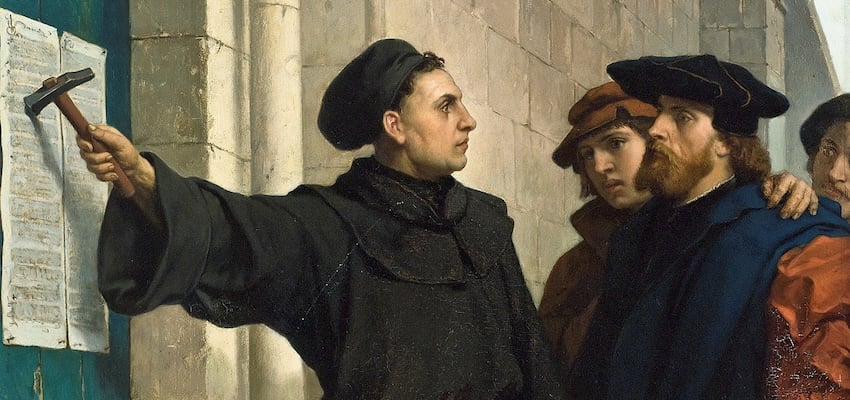
Recent events in Canterbury and Rome underscore this year’s significant anniversaries. I am not thinking here of the obvious one: the 1700th year since the first ecumenical council set in motion the creedal discussions that culminated in the Nicene Creed of 381. I am thinking rather of the 500th anniversary of the centerpiece of the early Reformation, Martin Luther’s treatise De Servo Arbitrio, and the 180th anniversary of the reception of John Henry Newman into the Catholic Church. They would make strange bedfellows, but both would be distressed by recent events and for a similar reason.
The differences between Luther and Newman are immense, not least on the issue at the heart of De Servo Arbitrio: the clarity of Scripture. But their understanding of Christianity does share an important principle. Christianity is at its core a doctrinal faith, defined by dogmatic statements. Confronted with Erasmus’s reduction of the faith to vague practical pieties, a concern partially driven by the Dutchman’s desire to defuse doctrinal conflict, Luther asserted that any Christianity without assertions was no Christianity at all. And in his Apologia Pro Vita Sua, Newman argued that a basic point of continuity between his teenage Protestantism and his later Roman Catholicism was his conviction that Christianity was a dogmatic faith.
This has practical implications for those Protestants and Catholics who share this conviction: Christian doctrine stands prior to, and is formative of, all Christian practice, whether institutional or personal. Neither the church nor any individual who belongs to her is a free, autonomous individual. Rather, they are bound to a form of life. From preaching to pastoral care to behavior in the workplace or on social media, Christian truth determines Christian behavior. This is not to claim that Christians are automata who respond mechanistically to life’s challenges. But it is to say that Christians are to judge how to respond by looking to the prior shape of the faith.
Recent events illustrate how today’s church leadership is informed less by dogmatic conviction and more by managerial pragmatism.
First, in responding to the controversy surrounding Cardinal Cupich, Bishop Paprocki, and Sen. Dick Durbin, Pope Leo made a statement that elided the difference between abortion and the death penalty. Christians disagree (and, for this Protestant, legitimately so) over the latter. But one would hope that all see a qualitative difference between a medical procedure that is exclusively aimed at the killing of an innocent and a legal procedure that is, at least in intention, for the purpose of the punishment of the guilty. For any Christian pastor to fail to see the difference is sad. For the pope, it is scandalous and, given his intelligence, raises the question of what is really behind such a statement—though the usual Catholic suspects saw it as confirmation that the liberal Protestant ethos of the Francis papacy would continue.
Meanwhile, in Canterbury, the world saw the practical consummation of a process whose logic was established some thirty years ago. Once the ordination of women was allowed, it was inevitable that the archepiscopal office in the Church of England would be occupied by a woman. Her sex was therefore not a shock. Nor, sadly, was the fact that the appointee is somewhat liberal on both LGBTQ+ issues and on abortion. Only weeks earlier, a former archbishop of Canterbury, erstwhile conservative evangelical George Carey, made a speech in the House of Lords in favor of assisted suicide. Christian doctrine no longer informs how leaders in the Church of England ought to think, speak, and act.
What do Rome and Canterbury seem to share at this point? The answer is a view of church leadership as a matter of managerial control of institutions with eclectic constituencies. The new primate of the Church of England is being lauded not for her orthodoxy but for the unity she will bring by the marginalization of traditionalists, those pesky types who take seriously the idea that the gospel is not a function of the wider cultural predilections. And while Rome is committed to continuity, the gaffe by the pope is intriguing. It involves an elementary confusion, but it is consonant with his current pattern of behavior. For example, he treats the traditionalists to a positive gesture on the Latin Mass, but he also entertains Fr. James Martin at the Vatican and then allows him to control the subsequent story. Now he acts in a way that undermines a senior American bishop and confuses basic categories.
True, it is early days in Leo’s papacy, and a charitable interpretation would be that he is learning the lay of the land before making any decisive moves. I have been sympathetic to such a reading; but this latest incident inclines me to think that maybe a desire to avoid necessary housecleaning and conflict, even to maintain the Francis trajectory in a less ostentatious manner, is the real motivation for the ambiguity of recent months. Indeed, perhaps “ambiguity” will soon be too charitable a word. When ambiguity always seems to benefit one side, it is not ambiguous for very long. And the appointment to Canterbury of yet another advocate of the day-before-yesterday’s cultural tastes would indicate the Church of England’s hard-earned reputation for cultural irrelevance and courageously baptizing anything other than orthodoxy is set to continue.
Different as they were, Luther and Newman understood that Christianity stands or falls by its dogmatic commitments that pay no heed to the exigencies of the times or its institutional politics. There is no compromise or halfway house that reconciles the ways of the world with the ways of faith. Managing institutions such that all sides are somehow held together in a form of specious unity that ultimately favors heterodoxy in belief or practice contradicts the very essence of the faith. The choice is really very simple, and Christians the world over deserve leaders who model faithful, uncompromising commitment to Christian doctrine.