
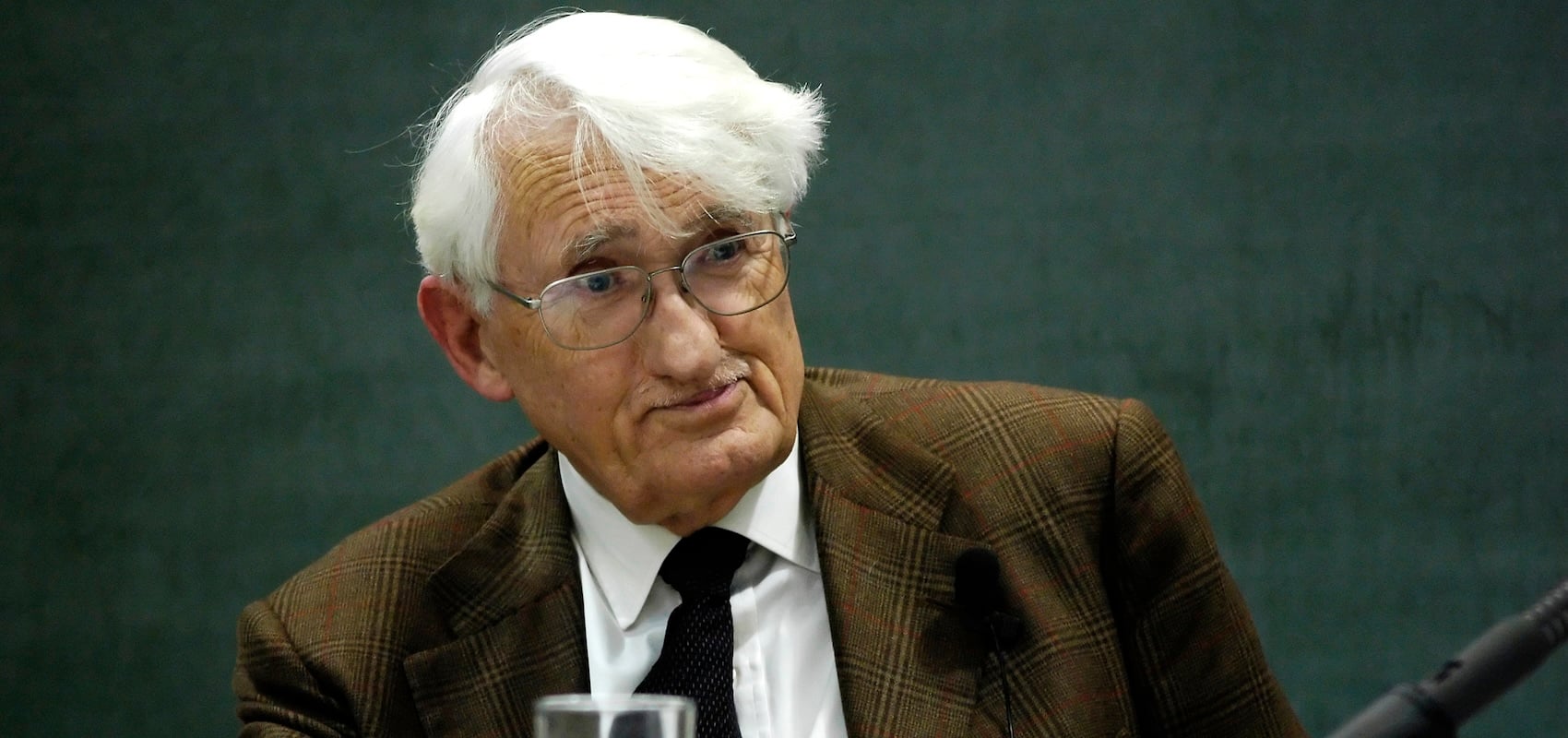
The German philosopher and critical theorist Jürgen Habermas has died at the age of ninety-six. The tributes and encomia pour in and will continue to pour in. He deserves our respect if not necessarily our admiration or adherence.
Habermas was a fundamentally decent man who became considerably less ideological, and predictable, as the decades passed. The Marxism he inherited from his mentors in the Frankfurt School became less pronounced, less militant, and less activist after the fall of the Berlin Wall, even if Habermas initially opposed German reunification, fearing that it would reinforce a toxic form of German nationalism. Habermas was anti-totalitarian but in a qualified or incomplete sense. He adamantly opposed fascism and Nazism, and rightly so, but like so many on the left reduced the crimes of communism to its Stalinist aberration. He was pained by the bureaucratic sterility of the DDR (East Germany) in its final years. But he never truly repudiated communism as an intrinsically perverse ideology that was totalitarian in both its aspirations and consequences.
In the famous German “historians’ dispute” (Historikerstreit) of the mid-1980s, Habermas was right to oppose those historians such as Ernst Nolte who tended to relativize Nazi criminality by making it derivative from, and imitative of, Leninist-Stalinist brutality. But he was wrong not to acknowledge that recognizing the “uniqueness of the Shoah” did not require giving communism something of a pass because of its humanist or humanitarian pretensions. As the distinguished French historian and man of letters Alain Besançon convincingly argued in his book A Century of Horrors: Communism, Nazism, and the Uniqueness of the Shoah, communism “falsified the Good” in a way that made its version of the totalitarian temptation at once more alluring and perhaps even more perverse than the openly demonic National Socialist regime.
As Roger Scruton argued in his 2015 book Fools, Frauds, and Firebrands: Thinkers of the New Left, Habermas’s writings from the 1950s through the 1980s are strikingly turgid and tedious. Indeed, they read like the jargon-ridden musings of a PhD candidate in sociology. Moreover, they are distorted by an adamant refusal to take the bourgeois virtues, or the merits of bourgeois civilization, seriously. In bourgeois society Habermas could find only egoism, a crude “instrumental rationality,” and stirrings of authoritarianism. As a result, Habermas judged the new German Federal Republic of Konrad Adenauer far too harshly. If that society had a “legitimation crisis,” as Habermas called it, it was instigated in no small part by the unwillingness of intellectuals committed to an untenable vision of “emancipation” and “authenticity” to give the prosaic liberal order its due. Habermas hopelessly romanticized the ’60s student movement. Its middle-class denizens, who were often spoiled brats with little historical perspective, confused liberal democracy with fascism, and took reckless aim at the humanizing hierarchies essential to any viable and self-respecting social order. In his own way, Habermas contributed to the widespread conflation of genuine authority (and authoritative institutions such as the army, the churches, and the liberal university) and authoritarianism. Such mindless antinomianism is perhaps the deepest source of our contemporary “legitimation crisis.”
We will read much in the coming weeks about Habermas’s sturdy and admirable defense of liberal rationalism against the radical skepticism, even nihilism, that characterizes so much of the postmodern left. There is some truth to this. But the “reason” the German philosopher upheld was radically “postmetaphysical,” as he himself put it. He found even Kant’s defense of the “transcendental subject” and the person who is owed moral respect in his famous categorical imperative to be too “substantive” and thus insufficiently “formal.” Habermas thus set out to “detranscendentalize” reason, to free it from the residues of metaphysics and classical ethics that continued to inform it even in the modern era.
His rationalism was thus shorn of real content, except for the remarkably abstract and quintessentially academic search for a formal “discourse without domination” that he began in the 1970s and 1980s to call “communicative rationality.” This is Habermas’s version of John Rawls’s equally empty and abstract “original position.” Genuine practical reason, in contrast, takes its bearings from the moral contents of life, the tension-ridden goods and claims of interest and justice that we experience in everyday life. On the political level, real prudence takes its bearings from the concerns of citizens and statesmen and not the “ideal speech situations” posited by academics and critical theorists. These theorists, as Scruton points out, assume a “kingdom of ends” about which they can say little or nothing except to valorize emancipation, autonomy, and ever-expanding “human rights,” which are said to trump all other moral and political concerns.
There is no doubt that Habermas desperately wanted to avoid a descent into the nihilistic abyss. But his version of “communicative rationality” with its “ideal speech situations” more or less guarantees that only academic progressives—and activists—get a seat at the table. As he acknowledges in Also a History of Philosophy, Volume III (a rather more readable volume published in English in 2025), the “universalist” (and I would add remarkably doctrinaire) egalitarianism at the heart of his social theory has no “moral justification” per se. Practical reason in its Habermasian form is left helpless in the end, even if it is endlessly trumpeted by the later Habermas as the only viable road forward for postmodern men and women who remain committed to the Enlightenment project of reason, equality, progress, and human dignity.
Perhaps these considerations help explain Habermas’s openness to dialogue with religious believers in the last quarter century of his life. A civilized man, Habermas had learned from the German experience under the Third Reich that without a broader ethical framework, “instrumental rationality” could lead to the most terrible cruelties as well as the comprehensive dehumanization of human beings. “Communicative rationality” and blind faith in indiscriminate human equality were too “insubstantial” to provide a firm ground for resisting contemporary biotechnological and genetic assaults on human dignity. While remaining attached to an excessively thin conception of secular reason and a view of faith devoid of nous or ratio (right reason), Habermas nonetheless respectfully debated the problem of faith and reason in postmodern democratic societies with the future Pope Benedict XVI in 2004. His theoretical starting point limited the place for real movement in such a dialogue, since Habermas rejected the deeper and more capacious reason that alone could speak with authority about the Good Life or the meaning and purpose of human existence. Habermas remained deeply committed to the “dehellenization” of reason that Pope Benedict lamented and took to task in his 2006 Regensburg Address.
But Habermas’s willingness to debate cordially with Cardinal Ratzinger and to explore biblical religion’s contribution to human liberty and dignity reflected a step forward as well as real generosity of soul. As Habermas acknowledged in a 2024 book-length interview entitled Things Needed to Get Better that has just been published in English:
If Kant’s strong concept of practical reason is, as I think I have shown, partly indebted in the West to a rationally reconstructive appropriation of biblical traditions, then we can’t rule out the possibility of gaining further ideas for compelling ethical arguments from this body of tradition in the light of new, vexing challenges, such as growing technical possibilities for intervening in the human genome.
Clearly, Habermas had come to see that egalitarian formalism by itself had led to a practical dead end. The lesson is clear: The dialogue between faith and reason must be thoughtfully and respectfully reengaged. But what is equally clear is that Habermas simply could not provide us with the rational resources to do this in a robust and compelling manner.
In the last period of his career, Habermas remained a man of the democratic left. In his later writings and interviews, he deceptively spoke of the need for a more “political” and less “technocratic” European project. Initially, this sounds promising. By this he meant, alas, a bigger welfare state, more “social rights,” and the ever-greater inclusion of the “excluded” such as homosexuals, immigrants, and so forth. He saw a transnational Europe as in principle a vital first step toward the universal overcoming of national sovereignty. But doesn’t that entail the ultimate depoliticization of European and global democracy? Habermas’s much-vaunted advocacy of “constitutional patriotism” ignores everything concrete, particular, or “historical” about a nation or people. In Habermas: A Very Short Introduction, James Gordon Finlayson quotes Habermas’s account of how “constitutional patriotism” should be applied in a post-1990 German context: “For us in the Federal Republic constitutional patriotism means, among other things, pride in the fact that we have succeeded in permanently overcoming fascism, establishing a just political order, and anchoring it in a fairly liberal political culture.”
But what is specifically German about such patriotism? Doesn’t it risk permanently identifying old-fashioned patriotism and love of one’s own with illiberalism, or worse? Can such a conception ever lead to what Abraham Lincoln called “the last full measure of devotion”? This liberal and hyper-rationalist patriotism is far too bloodless to stir the hearts, and kindle the loyalties, of most ordinary people.
Sometimes, Habermas can surprise. In the interviews in Things Needed to Get Better, the German theorist speaks movingly about his trips to the state of Israel and his deep friendship with the great Jewish scholar Gershom Scholem. After October 7, 2023, Habermas rightly affirmed that “in principle” Israel had the right to defend itself after Hamas’s murderous assault. No pacifist, he supported European and American efforts to arm Ukraine in its fight against Russian invaders. (Whether he was sensitive to all the complexities of that conflict is another matter).
Yet Roger Scruton is undoubtedly right that social conservatives and traditional patriots are very unlikely to be invited to the “ideal speech situation” that Habermas and his epigones have in mind for transfigured democratic political communities. Near the end of Things Needed to Get Better, Habermas speaks of “the irrational characteristics of Trump’s voter base in the USA.” That facile dismissal would no doubt apply to national conservatives, liberal conservatives, and conservative populists everywhere. Habermas makes clear that he much prefers the company of the likes of Richard Rorty and Jacques Derrida. Whatever this is, it is not authentic “centrism.” Despite real steps in the right direction, Habermas’s political and social theorizing remained to the end too narrow, dogmatic, and self-referential. What a pity that such a decent, intelligent, and learned man could not open his heart and his mind to goods that transcend a purely horizontal “communicative rationality.”
