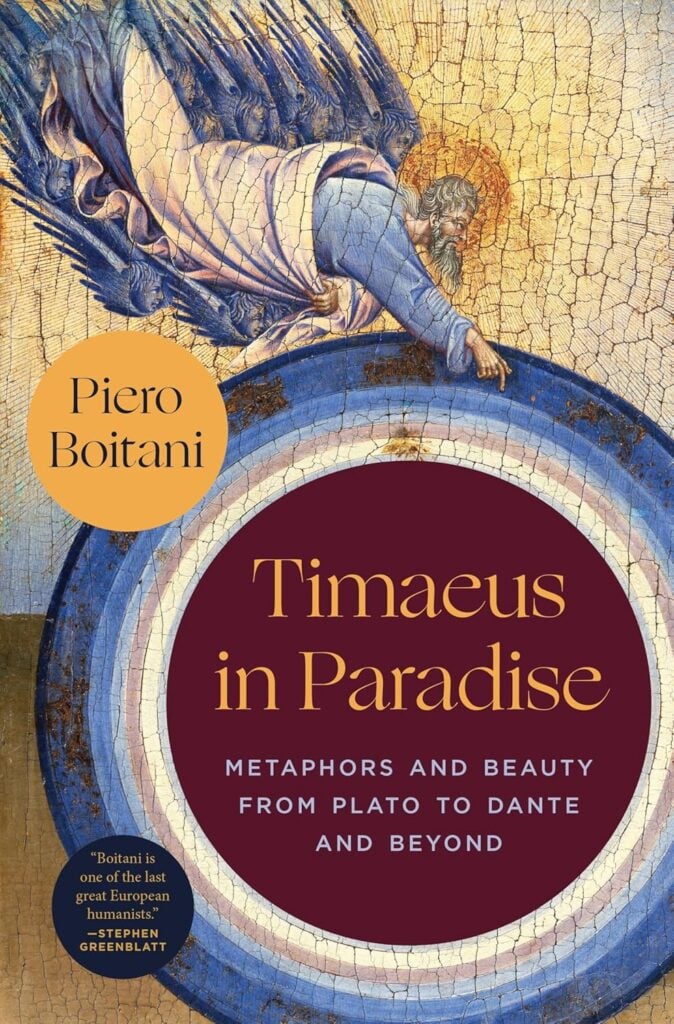
Timaeus in Paradise:
Metaphors and Beauty from Plato to Dante and Beyond
by piero boitani
princeton university, 408 pages, $45
Over the past decade, somewhat surprisingly, many people have become born-again defenders of Western civilization. New Atheist intellectuals, reality TV stars, and tech founders used to spout liberal platitudes on the couches of irreverent late-night talk shows. Now they wax lyrical about the virtues of the West from the studio recliners of long-form conservative podcasts.
Unexpected as it may have been, this turn didn’t come out of nowhere. There were of course conservative counter-revolutions in the Thatcher–Reagan and Bush years. But these were “reassertions” by an existing majority rallied by politicians, as opposed to the current phenomenon of converted cultural elites. And these counter-revolutions were less explicit about returning to a grand, millennia-long civilizational heritage.
Plenty of people were working actively for this renewal long before it became (almost) mainstream. Anyone who got in on America’s classical Christian education revival back in the 1980s and 1990s has been stupendously vindicated. When it was founded in 1993, the Association of Classical Christian schools had just ten member schools. Now, it has more than five hundred and is growing all the time. In 2023, Florida approved the Classical Learning Test as an admissions test at all public universities, and in 2026, U.S. military service academies will begin to do the same. Even in my homeland of Great Britain, a classical education spring is emerging, despite our current Labour government’s attempts to tax all private education into oblivion.
I imagine most First Things readers welcome these developments. Others remain unconvinced. At the extreme end are those who dismiss any deference to Western civilization as thinly veiled white supremacy. More credible is the suggestion that this seeming revival of appreciation for the West is in fact a death rattle—a nostalgia for something that it is already too late to save, which in turn spawns a cynical cottage industry of writers, influencers, and so-called educators for whom “Western civilization” is merely an aesthetic to be repackaged in aid of diatribes against wokeness.
I am more optimistic. But the sudden civilizational volte face has undoubtedly made it easy to peddle a cheap imitation of Western civilization to those only faddishly interested. This is not to say that one must be an expert in a civilization’s history to appreciate it, or even to be a part of it. Most members of Western civilization have probably never heard or read more than a few lines of its great texts other than the Bible. Yet plenty of those who claim to have “done the reading” on Western civilization start shuffling their feet when you ask them to talk in any detail about what our great thinkers actually wrote. They might orate breathlessly for a few minutes about “the true, the good, and the beautiful,” or pontificate about “the idea of this” or “the concept of that.” But if you ask them to talk about their favorite Platonic dialogues other than the Republic, they suddenly remember they have somewhere else to be. One should always be suspicious of those using the phrase “Plato taught that . . .”
Of course Western civilization means “big ideas” that can be talked about in general terms. But the transmission of these “big ideas” is impossible without the careful preservation and iteration of specific texts across many centuries—a fact that our new crop of Western civilization enthusiasts is in danger of overlooking. Fortunately, it is a fact that Piero Boitani makes abundantly clear in his new book Timaeus in Paradise, a whirling, creative, and evocative study of what is essentially the reception history of one of Plato’s most influential dialogues.
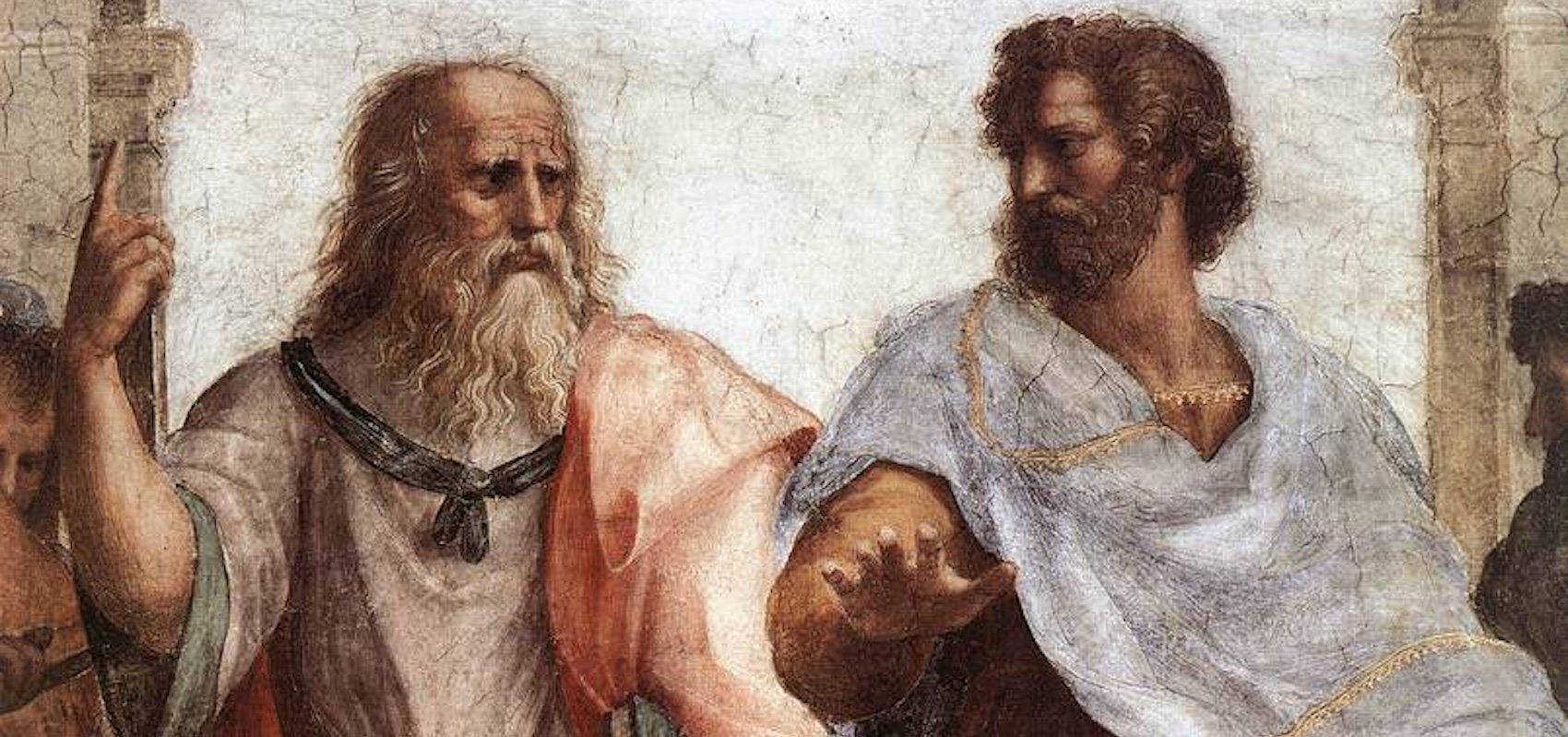
If you asked anyone today with a passing knowledge of Plato which of his dialogues has had the widest reach throughout Western history, most would assume the Republic. But they would be mistaken. Although it was known in the ancient world, more in the Greek East than in the Latin West, its dominance is a post-Renaissance phenomenon. The highest Platonic honor goes to the Timaeus. In Raphael’s famous fresco, The School of Athens, it is this dialogue that Plato has tucked under his arm as he undertakes his tête-à-tête with Aristotle. Boitani makes this illustrious history clear:
Partially translated into Latin by Cicero, [the Timaeus] survived the catastrophe of the ancient world in the incomplete version and commentary of Calcidius, a fourth-century Christian . . . the only dialogue of Plato known in the West for a thousand years! It remained so until Marsilio Ficino translated the entire Platonic corpus in the fifteenth century.
This is the story Boitani seeks to recount, “an intellectual, philosophical, aesthetic and literary adventure.” It is the tale not just of transcendental ideas working to leaven the West, but of a specific text successfully and idiomatically transmitting one of those ideas, that of the beautiful, and providing a spur not just for the development of Christian doctrine, but for art, literature, architecture, and more.
The Timaeus is usually pegged as Plato’s “creation story,” and it is certainly not less than that. Despite my suspicions of people who declare that “Plato taught such and such,” the Timaeus is arguably one of the most straightforward and doctrinal parts of the Platonic corpus. It is, however you take it, his cosmogony—and yet so much more. Boitani begins by noting the two main qualities of the Timaeus acknowledged by readers over the centuries: “its logical, rational reasoning” and “its metaphorical language: its ‘verisimilar’ discourse or myth—the eikos logos Plato used in so many of his works.” That is, it contains both detailed discussion of the origins and physical makeup of the universe, and obviously poetic imagery designed to stir something in the reader. This mythical element and its influence are what Boitani unpacks throughout his book, in relatively short, impressionistic chapters that flow freely among Plato, Scripture, late-antique Neoplatonism, Dante, and much else besides. Boitani soars with his chosen writers and artists among the stars. Most secondary literature on Plato is worthless, but this will stir the soul and stimulate the mind. Boitani doesn’t just comment, he reads.
Boitani presents Plato as a poet, echoing other ancient commentators:
Plato is sublime . . . because he competes with Homer, vies with the greatest poet, draws inspiration from him. This is an extraordinary, enormous statement. Plato is not a poet on a par with Lucretius, as Cornford would have it; he is on a par with the Iliad, the Odyssey, and the Hymns. Longinus [the first-century author of the treatise On the Sublime] has no doubt about this: he speaks explicitly of poietikas hylas, of poetic ‘matters and language’ [in Plato].
This may seem an odd assertion. Isn’t Plato the one who taught that poets would be banished from his perfect city? Once again, beware the expression “Plato taught.” Ancient tradition maintains that Plato began as a poet, a tragic one, before burning his books upon encountering Socrates. Yet the poet dies hard, as close reading of Plato soon shows to those willing to do it. He gives himself over to the paradox: He can demolish the pretenses of the poets only by writing poetically.
The poetry of the Timaeus, with its focus on beauty,runs throughout the dialogue. It is there in the grand opening statements about why the Creator made the world and why he did so in such a way. (“It is not, and always was not, right that the best make anything but the most beautiful thing.”) Likewise, it is in the highly detailed descriptions of the creation process and structure of the world and humanity, which encompass highly detailed geometrical and astronomical models, as well as arresting images such as that of the human soul returning to the stars in death. Boitani’s account of how these images from pagan philosophy made their way into Christianity is sometimes grandly speculative (as with his passing reference to J. M. W. Turner’s painting Light and Colour [Goethe’s Theory]—The Morning after the Deluge—Moses Writing the Book of Genesis) and sometimes a well-evidenced case based on a close reading of philosophers and poets. Some readers may find this variety jarring, but Boitani’s omnivorous approach to both content and method is not simply refreshing in an overspecialized age, but the sign of a confident and genuinely well-read humanist.
The most prominent of his detailed studies, as the book’s subtitle suggests, is Dante, who makes explicit reference to the Timaeus in the Paradise sectionof his Divine Comedy. There, Beatrice explains to Dante the doctrine of divine accommodation, how “Scripture condescends / To your capacities, and says that God / Has hands and feet—though meaning otherwise.” She then turns to the Timaeus, suggesting that Plato, although un-Christian in his (apparent) belief that souls come from and return to the stars, can be read similarly: “Perhaps his bow shot hits upon some truth.” That truth is the fitting correspondence between the stars and God, their suitability as a poetic image, which doesn’t ride roughshod over philosophical logic. This training in how to speak of the divine within the limits of human language and images drawn from creation is why the Timaeus has become not simply much read, but nearly indispensable.
Boitani’s work takes us deep into the territory of the Hellenization thesis, which posits that Christianity was heavily influenced early on by Greek philosophy. Critics of Hellenization—who see Christianity’s partnership with Greek philosophy as at best a misstep away from its Hebraic roots—generally think of the process as a highly intellectual one, in which Christianity was fitted to the Procrustean bed of an overly rationalistic pagan philosophy. The driving force is imagined to be the “logical, rational reasoning” that Boitani notes as one of the Timaeus’s two main qualities. But the Hellenization question often overlooks the power of the Timaeus’s second quality: its poetic language. Boitani demonstrates how, for generations, the Timaeus has resonated with Christian writers not simply because Plato’s logic often aligns with Christian doctrine, but because his language ravishes the soul with a divine beauty that the bride of Christ recognizes all too well.
Plato’s other poetic high point is arguably the Phaedrus, with its heady descriptions of the winged soul ascending into the circles of heaven to glimpse what lies beyond it. Like the Timaeus, it is concerned with the beautiful, adding man’s eros for the divine to the equation. Such poetic imagery can, of course, be a distraction from the divine, a blasphemy even, when the glory of the immortal God is exchanged for images made to look like mortal beings. And yet poetry is also a divine spur to the affections without which man, in his weakness, cannot begin to grasp and love his maker.
The stairway to heaven can seem like a tightrope where human language is concerned. Boitani’s book is an affecting and learned study of how the Christian West has attempted to maintain balance on that ascent with the help of the Timaeus. It is this careful reading of certain great texts that has sustained and deepened our understanding of the true, the good, and the beautiful for centuries. If we want that understanding to continue, we must go and read likewise.