
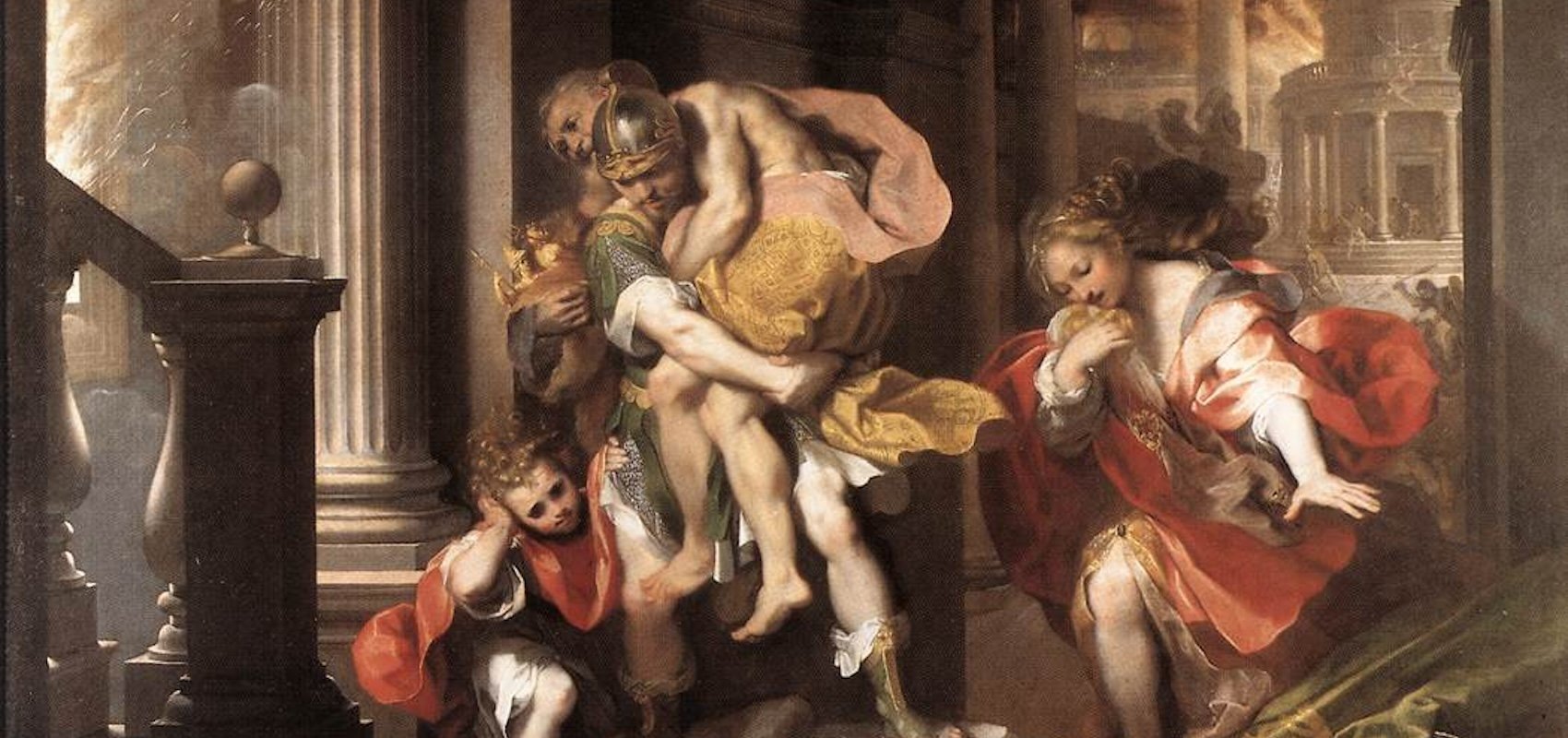
Gian Lorenzo Bernini had only just turned twenty when he finished his sculpture of Aeneas, the mythical founder of Rome, in his escape from the conquered city of Troy. I was twelve when I first saw it in Rome’s Borghese Gallery—not much older than Aeneas’s son Ascanius, the little boy who peeks from behind his father’s knees with an expression of terror and confusion. On Aeneas’s shoulders sits his father Anchises, his jaw set and his gaze fixed on the road ahead. But on the face of Aeneas is a blank, hollow stare. I was shocked to peer up, from Ascanius’s vantage, and find the father of Rome looking so helplessly exhausted. Yet that’s how the story goes. In Virgil’s Aeneid, the poem that elevated Aeneas from a minor player in the mythic canon to the emblem of the Augustan age, the hero begins his journey a broken man.
My parents had taken me to Rome because I was in love with the classics, probably to an annoying degree. I had lain awake on my grandparents’ apartment floor in New York, ripping through Richmond Lattimore’s translation of the Odyssey. I explained what the Iliad was to my elementary school librarian (o tempora, o mores) so I could ask her to order it for the yearly book fair. I loved Homer’s fabulous tales of war and adventure.
Still, nothing could prepare me for the first time I read the Aeneid, in translation on that trip and then slowly, doggedly, in Latin class. It is a poem that transformed Western literature. Even while its composition was in progress, the word went round in elite literary circles that it would eclipse everything that had gone before. “Make way, you Roman authors, make way, Greeks!” wrote Virgil’s admirer Propertius. “Some unknown thing is being born that’s greater than the Iliad.” It was a time when momentous deeds and epochal changes were very much expected. After a hundred years of gory civil strife, Julius Caesar’s heir, Octavian—later renamed Augustus—took control of the state and proposed to usher in a new era of peace. It was a point of pride with him that Roman arts and letters were undergoing a renaissance to match his new regime. The Aeneid, if it really could exceed the glory of Homer’s Iliad, would demonstrate that Rome had supplanted Greece as the cultural as well as political center of the world. Naturally Augustus requested—not to say demanded—a peek at some early drafts. There was a lot at stake.
In form, at least, Virgil certainly delivered. The Aeneid makes a show of doing in one poem of twelve books what Homer had done in two poems of twenty-four books each. Aeneas spends the first six books wandering painfully away from his destroyed homeland, trailing in the wake of Homer’s Odyssey. Then he spends six books fighting a war in Italy, like the Greeks who besieged Troy in the Iliad. Augustus would have been pleased to find this son of the goddess Venus, flatteringly related to him through Ascanius, matching the deeds of Homer’s Odysseus and Achilles almost point for point. So it is all the more astonishing that when Aeneas comes on the scene in book 1, he appears to be totally miserable in the role of an epic hero. He seems like he would rather do anything than found Rome.
Homer’s protagonists are notoriously flawed. Achilles flies off the handle; Odysseus lies through his teeth. But one thing they very rarely do is abandon themselves to self-doubt or despair. They are too magnificent for that—they belong to the glorious race of almost-gods, which is already a misty memory from Homer’s perspective. They can toss around boulders that two men, “such as men are these days,” would struggle to lift. Mortal though they are, they are superheroes. Readers of Virgil’s poem would have expected a Roman champion to rival Homer’s in stature. Instead, the first time he opens his mouth, it is to curse his fate and wish his own death.
The scene is a storm at sea, a mainstay of the epic genre. The goddess Juno, incensed that Rome will one day wipe her beloved Carthage off the map, sends a tempest in an effort to stop Aeneas from fulfilling his destiny. He seems inclined to let her: “All his limbs go limp with cold; / He moans, and gropes toward the stars with both his hands, / And cries aloud as follows: ‘three and four times blessed / Were those who died in Troy’” (all translations in this essay are my own). It’s not that no epic hero ever contemplated suicide before: Odysseus, confronted with similar weather conditions, briefly wondered “whether I should cast myself into the sea and perish there.” But his deliberation lasted for about a line and a half before he resolved to tough it out. Aeneas spends eight lines fantasizing in detail about how he could have joined the lucky corpses at Troy, then falls silent again. He really, truly does not want to be on this quest.
It goes on like that. Odysseus was famously driven through his many twists and turns by an overpowering desire for nostos, the return home. But Aeneas has nowhere to return to. The home he has known all his life is burned to cinders in a harrowing scene of carnage, thanks in no small part to Odysseus. The Greeks, recast from the Trojan perspective as a band of shameless marauders, lay waste to everything Aeneas loves. Even his wife, Creusa, gets caught in the mayhem and can only give her blessing to the journey as a ghost, evaporating as she does so into the smoke that streams from Troy’s citadel. Her last instructions to Aeneas are to “‘preserve the love we share by cherishing our son.’ / And after giving me these words,” Aeneas recalls, “she left me there / In tears, and longing still to say so many things, / But she receded on the wind.”
It is in this moment that Virgil starts to reveal what he’s up to, and what he’s capable of. Creusa’s son is Ascanius, the boy who has just been singled out in a burst of light from heaven as the future patriarch of what will become Rome. His grandfather Anchises, who was previously inclined to turn his face to the wall and let the flames take him, now brims with fresh vigor at the thought of such a glorious future for his progeny. But Aeneas, the man with the apparent honor of bringing all of this to pass, can only watch in speechless horror as his entire life is incinerated. When he reaches out to grab for the woman he loves, he finds what all epic heroes find when they try to embrace the dead: empty air.
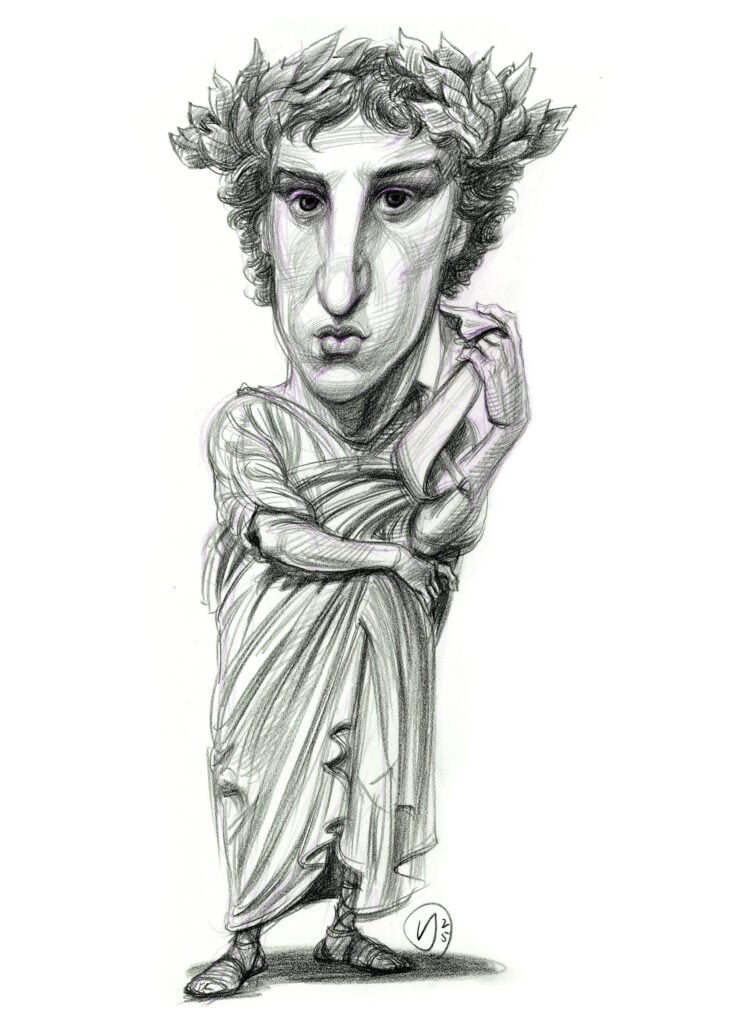
Virgil’s indelible image of Aeneas in flight from Troy, with Anchises on his shoulders and Ascanius toddling along behind, is a picture of courage as gratifying to the Roman mind as one could wish. “Pious Aeneas,” the dutiful son, salvaging his ancestral gods and following his father’s guidance, carries the future with him in the person of Augustus’s own ancestor. And yet Virgil has introduced an unsettling note of melancholy into the poem’s first crescendo. It becomes clear that this will not only be a story about the valor it takes to found a great civilization like Rome. It will also be about how much must be lost, left behind, and even destroyed if something new is to be built. The vacant look that Bernini sculpted into Aeneas’s eyes is the look of a broken-spirited veteran. It’s the look we imagine him giving to Dido, the beautiful queen of Carthage, when she asks him to tell the story of his escape: “unspeakable, oh queen, the grief you now command me to relive,” he says.
He tells her the story anyway, since it is already plastered all over the walls of the temple she is building to Juno and (we are invited to recall) soon to be recited everywhere in the form of the Homeric poems. “Where in all the regions of the world,” asks Aeneas, “Is there a land not yet brim-full of all our toil?” As much as the Iliad and the Odyssey are the inspiration for the Aeneid, they are also the Greek shadows Roman literature can’t get out from under. Homer’s stories contain the grief Aeneas can’t escape. Homer’s genius made Virgil’s possible, but now Virgil has the impossible task of surpassing it. Aeneas, like Virgil, is charged with creating something dazzlingly new—a city to outshine Troy. But all he has to work with are the ruins of everything he once loved.
This must be why Anchises’s death, on the journey from Troy to Carthage, leaves Aeneas well and truly rudderless. His cry of dejection at the memory of this loss is one of the most pitiful moments in the poem, as he explains to Dido how his father’s breath finally gave out in the Sicilian port of Drepanum: “Here, so many ocean tempests in, / Oh, my sire—lightener of blows and burdens— / I lost him. Anchises! Here, oh best of fathers, / You abandoned me.” In some sense Anchises has to die for Aeneas to come into his own—as every son who grows to full stature must outlive his father, as Troy and Carthage must fall for Rome to rise, as Homer must be usurped for Virgil to succeed. None of those concerns can comfort Aeneas, though. History, fate, and the will of the gods are all converging to thrust him to the head of his household and his people. But at a personal level, he’s not remotely ready. He feels in this moment less like a father of nations than like a scared, abandoned little boy.
It is in this condition of vulnerability that Aeneas washes up on the shore of Carthage and finds Dido at the dazzling height of her powers. Virgil compares her to the untamable huntress Diana, virgin goddess of the moon. She is clearly modeled after the Amazons and the proud heroines of myth. Faced with the enviable progress of Dido’s fledgling city, Aeneas does something understandable and totally disastrous: He lets her take over. She, meanwhile, is inflamed with a wild attraction to him, thanks to the scheming of Aeneas’s mother, the goddess of love. By the time the pair abscond into a cave and consummate their union, Aeneas has become so passive that he’s not even mentioned by name. “They go astray,” writes Virgil, “the leader, Dido, and the Trojan / In a cave.” Aeneas lets this dux femina, this formidable leading lady, take total control. He melts into the background. Finally, the gods have to descend from on high to jolt Aeneas out of his funk, at which point he has to toss Dido aside and leave her weeping on the shore.
Ever since this doomed love story was written, it has struck readers as almost unbearably heartbreaking. It is a Greek tragedy in the midst of a Roman epic. Dido transforms from Diana into Medea, the raving woman scorned, and takes her own life in a scene that made the young St. Augustine weep. Among other things, the whole episode is an allegory for Rome’s battle royale, as a growing republic, with Carthage’s maritime empire. Carthage was powerful, wealthy, and ancient compared to Rome, which at that point still had a reputation a little like that of Australia at its founding—a rough and rugged land farmed and defended by ex-convicts. Like Dido in her fling with Aeneas, Carthage was very much the senior partner in the Punic Wars that pitted her against Rome. And like Dido, Carthage ended up ruined.
Most Romans would have looked back on the victory in the Punic Wars with a sense of satisfaction and pride—as Cato the Elder relentlessly stressed, Carthage had to be destroyed. Carthago delenda est. Virgil, too, portrays the conflict and its outcome as necessary and inevitable for the formation of Rome. But what he adds to the picture is the feeling of profound regret with which Aeneas leaves Dido’s shores, knowing quite well how devastated she will be. Italiam non sponte sequor, he tells her: “It is not my will I am following to Italy.” This is one of the poem’s conspicuously unfinished lines. It has always been part of the Aeneid’s mystique that Virgil died without perfecting it, allegedly wishing it should be burned rather than survive in its incomplete state. Even so, it is at least extremely fitting, if not downright providential, that this particular line remains incomplete. There are six resounding beats of silence where there ought to be more syllables, but what words could Virgil or Aeneas possibly fill that space with? He has to go, and she has to die, much as Rome’s expanding republic was bound to collide with Carthage eventually. Dido’s anguish is riveting, of course, but it is Aeneas’s sorrow that expresses Virgil’s tragic vision most completely. Even history’s grandest acts leave destruction in their wake.
It’s in realizing this, and accepting it, that Aeneas finally begins to grow into his destiny. C. S. Lewis, who loved the Aeneid more than almost any other poem, wrote to Dorothy L. Sayers that its “effect is one of the immense costliness of a vocation combined with a complete conviction that it is worth it.” If Aeneas begins to feel that conviction as he turns away from Dido’s shores, then he comes to full stature as the man he has to be two books later, when he meets his father’s ghost in the underworld. Book 6 is the hinge point of the poem, the katabasis or descent into death that defines the hero’s journey. Anchises is at rest in Elysium, where the blessed wait for resurrection. The speech he delivers is history disguised as prophecy, the story of Rome up to Virgil’s day foretold as the destiny of Aeneas’s descendants. Its high point is a tribute to Rome’s distinctive achievements, set against those of other peoples:
Others will mold the breathing bronze with softer touch,
I’m sure, and coax out living faces from the marble,
Plead their causes better, chart the heavens’ motions
With a staff, predict the rising of the stars.
Remember: your dominion, Roman, is of nations.
These will be your arts—impose the ways of peace,
Show mercy to the conquered, crush the proud in war.
With these words, Virgil stakes out a claim to greatness for himself, for Aeneas, and for Rome. Greeks may excel in wordplay and aesthetic refinement; the astronomers of the eastern empires may trace the planets and the stars in their courses. Rome will never reach its full potential by imitating them, just as Aeneas will never fulfill his calling by rebuilding Troy and Virgil will never make his mark on literary history by reproducing Homer. Sad as it is to leave the past behind, the moment calls for something totally new.
What is that new thing? For Virgil, it is surely the Aeneid itself. The poem has often been dismissed as a pale knock-off of Homer, a way station between the Iliad and Dante’s Divine Comedy. The Hungarian Marxist Georg Lukács wrote that “the heroes of Virgil live the cool and limited existence of shadows, nourished by . . . blood that has been sacrificed in the attempt to recall what has forever disappeared.” But Virgil thoroughly anticipated this accusation and understood his place in history far better than his critics do. Precisely by seeing and acknowledging that the Homeric world of legend is dying away, he creates a gritty new kind of realist epic and a vividly human kind of hero. Surely that’s why Dante chose Virgil to lead him right up to the gates of paradise, and why T. S. Eliot saw him as the bridge between the fading pagan era and the dawning age of Christendom. To the greatest authors of the Christian West, the Aeneid has always represented the fullest literary consummation of what the pre-Christian world had to offer.
What the poem is to literature, Rome’s empire was to history—the sum and summit of antiquity. That is how Virgil portrays it: as the one power that can gather together the world’s nations and “impose the ways of peace.” Modern scholarship on the poem has often been preoccupied with a debate over whether Virgil meant to extol the majesty of Augustan Rome or covertly denounce the evils of imperialism. The catastrophes of the twentieth century made readers hypersensitive to moral anxieties about nationalist excess, and they sometimes project those anxieties onto Virgil. But it’s a poor fit. Virgil’s contemporary readers were certainly alive to the possibility that power could be abused. But they were also convinced that it could be wielded righteously, and they tended to believe they were the ones to wield it so, given their peerless martial virtues and sense of justice. Virgil portrays empire as Rome’s divine commission, but he is also more honest than any mere triumphalist about what it will take to shoulder that singular burden. Perhaps the Romans would rather not confront the moral complexities of their new regime; perhaps they would rather try to reconstruct the bygone age of the republic or escape to Greece and practice philosophy. Perhaps Aeneas would rather go back to Troy. It’s irrelevant—Troy is gone, and so is the republic. The moment calls for what it calls for.
So it is that Aeneas climbs up out of the underworld, through an ivory gate reserved for false dreams. This is one of the moments typically cited by “pessimists” as evidence that Virgil thinks of Augustus’s gleaming promise of peace as nothing more than a deceitful fantasy. But here Virgil is hearkening back one final time to the Odyssey, in which Odysseus’s wife, Penelope, can’t believe a dream she has that her husband has returned. It must be a dream from the ivory gate, says Penelope, and the point is that she’s wrong: Odysseus is in fact back. The reality of his return brings an end to his wanderings and her loneliness, as if they had woken up from the same bad dream. It’s possible that the dream Virgil means to dispel is the one Aeneas is leaving behind him, the lost past of Troy and the disoriented wanderings of his Odyssean journey. What comes next is hard, solid, and real: a war for control of Italy that takes its cues from the Iliad. It ends with the merciless slaughter of Aeneas’s rival, Turnus: “His life fled down beneath the shadows, moaning, in contempt.”
At least, that’s how the poem ends as it stands. There’s some possibility that Virgil intended to soften the blow by adding scenes of reconciliation after the war. But given the trajectory of Aeneas’s development, the ending we have is perfectly fitting. Virgil introduces his hero in a moment of abject disorientation and leaves him in a moment of grim resolve. The whole majestic future of Rome is sealed in the poem’s gruesome final kill. The greatness of Aeneas’s endeavor doesn’t cancel out the severity of what he has to do. Augustus’s autocracy doesn’t vitiate the blessings of his peace. In managing to see and honor all this, Virgil changed literature as much as Rome changed the world.
Commentaries on Bernini’s sculpture of Aeneas invariably point out that it depicts the three ages of man: childhood, adulthood, and old age. If so, then to come to full stature as an adult is to embark on a journey like Aeneas’s—to find yourself thrust into the terrifying position of building a life and a family while the older generation that once defined your world starts to pass away. I feel the truth of that when I revisit the sculpture, now that I’ve grown from Ascanius’s height to Aeneas’s. I also find myself wondering whether nations go through the same ages that men do. Virgil certainly seemed to think so.
America is now in a position rather like Aeneas’s at the start of Virgil’s poem. The republic is approaching its 250th birthday—its semiquincentennial or, for optimists, its quarter millennium. It’s a milestone that seems to call for projections of national confidence and displays of patriotic enthusiasm, much as the advent of Augustus’s reign might have seemed to call for a thumping expression of jingoism on Virgil’s part. And yet the lead-up to America’s 250th, like the lead-up to the Augustan era, has been marked by things falling apart. The social consensus that obtained after World War II has fractured into a bitter confusion of hostile factions, locked in a cold civil war that sporadically flares hot. The erosion of religious faith has left a void at the heart of the nation, to be filled with fanatical political movements and millenarian forebodings of a digital singularity or an economic revolution. And the uneasy balance of powers over which America presided in the wake of the Cold War has crumbled, taking with it the morality tale we once told about the steady triumph of freedom over authoritarians from Hitler to Stalin. Donald Trump’s intervention into the ongoing Middle Eastern wars and the severe disagreements it provoked among his followers typify the kind of harsh choices and moral ambiguities we face in a reconfiguring world. There is more to come.
If that’s the case, however, maybe it’s not a sign of America’s decline so much as of its coming to maturity. Maybe what’s ending is an age of innocence, and the task ahead is a little like that of Aeneas: to forge a new consensus and a new peace out of the wreckage of the old. The Aeneid can teach us that just because our calling is harrowing and confusing doesn’t mean it’s not noble or necessary. There is a moment, just before the war that wins Italy, when Aeneas hoists onto his shoulders a shield decorated with images of Rome’s future. “He delights in all these images of things / He does not understand,” writes Virgil. “He lifts the fame and fortune of his children’s children / On his shoulders.” That is what makes him a hero for our times: He is lost, bereaved, uncertain, and broken in the midst of the very acts that make him great. Even after he climbs out of the underworld, he must feel his way through a world he does not fully understand, taking each next step as manfully and honorably as he can. So must we.

YOU MIGHT ALSO LIKE
Timothée Chalamet Is Right About Art (ft. Suzy Weiss)
In this episode, co-founder and reporter for the Free Press, Suzy Weiss, joins Virginia and Germán to…
Trump’s Civilizational Project
Secretary of State Marco Rubio spoke at the recent Munich Security Conference. Last year, Vice President JD…
Helene Schjerfbeck’s Defiant Paintbrush
Helene Schjerfbeck (1862–1946) did not go gentle into that good night. In 1944, war still raging, the…
