This essay was delivered as the 38th Annual Erasmus Lecture.
The circumstances of my life have been such that I have moved, since adolescence, in a borderland between languages. Borderlands tend to be rugged, at least if they are ancient, not the doings of spoil-sharing cartographers drawing absurdly straight lines through living habitats, or cancelling them altogether. Old borders, like that between Norway and Sweden, say, or England and Scotland, tend to wind. They are defined by the terrain, a firth or a mountain range, that permits a no-man’s-land of wildness on either side of the frontier. Travelers, mounted or on foot, are aware of performing a passage when they move from nation to nation. If the passage is fierce, it may amount to an assault, a transgression. Carried out in hope of encounter and barter, mutual enrichment, it can represent a bearing-across of goods, a translation. I have been drawn to excursions in such country always—well, at least since I realized such country exists.
While growing up, I presumed that the whole earth had one language and the same words. I heard foreign speech on television but thought it a crackable code, the mother tongue distorted into alien sounds that were salvageable by subtitlers. My perception reflected a self-sufficient outlook on the world. Such an outlook is childish, but not the prerogative of children. I used to know an old codger who was convinced that tourists who turned up in his Norwegian town were putting on an act with all their gibberish, that they would grasp what he meant as long as he spoke loudly. At some level, we are all prone to this assumption.
When I started learning English at nine, teaching was based on explications of concordance: “This says that.” It is a time-honored method. By it, the Austrian couple who feature at the end of Casablanca have assimilated English to prepare for exile. The fruit of their study is displayed as they drink to America, then fret:
“Liebchen, ach . . . Sweetnessheart, what watch?”
“Ten watch.”
“Such much!”
A degree of sense is pressed through the sieve of language in this way, but one might as well communicate in Morse, or by means of Google Translate. I started German next. It was conveyed through a manual with drawings of a dachshund. The grammar did appeal to me: It was akin to mathematics. But I could not really see the point of acquiring it.
At the same time, though, I read. Lots. I was falling in love with literature, as I loved music. An older relative noticed these interests, which made me stand out as rather odd. He was a bit of an oddball himself, an artist who sensed life keenly, sometimes cripplingly so. He affirmed my awakening to meaningful expression in a way school did not, and perhaps could not. He sent me records for my birthday: Mozart, Rachmaninov, Ravel. Once while I was visiting, he and I, before a patient sunset, listened to Schubert’s Quintet together. I saw how piercing melos can be.
He recommended books also. It was on my Schubert visit, as far as I recall, that he urged me to read Hermann Hesse’s Narcissus and Goldmund. I went straight to the library, sought out a Norwegian version, then thought, “But what in heaven’s name am I learning German for?” and got the original instead. I was fifteen.
What I discovered entranced me.
Narcissus and Goldmund was not my first non-Norwegian book. I had read a few English ones: yarns by Frederick Forsyth, Orwell’s Animal Farm. I had even, very self-importantly, gone out to purchase The Penguin Book of English Verse. Still, constant exposure to English had made me tone-deaf to it. It was too familiar. I heard it like elevator music, read it code-crackingly. German was something else. It transported me. Reading Hesse was like taking a first unaccompanied trip abroad. I found myself in a strange universe full of unfamiliar, fascinating features. I realized, for the first time, how one might perceive and speak differently. Hesse’s very first sentence was a revelation. Covering two-thirds of a page, it is made up of 143 words sinuously interconnected through organic successions of subclauses to describe a gnarled chestnut tree. The sentence is itself arboreal. It not only speaks of but shows the stem and branches sprung from a sapling brought north by a pilgrim come from Rome, subtly reminding us that German’s structure surges from a Latin root, a source to be duly acknowledged even as one savors the tree’s sweet fruits on one’s home turf, like the monk in the novel who roasts choice chestnuts in his cell’s fireplace.
Having glimpsed the scenery and heard the songs of this new land, I could no longer stay quietly at home. I had lost native confidence in my own way of talking. Not that I spurned it; simply, I knew that there were more things to be said, other ways of saying them. An explorer was born in me—and a dissident. I dimly conceived a conviction I was glad to find stated a decade later by the Siberian novelist Andrei Makine: “Monolingualism produces a totalitarian vision of the world. This object is called a book and that’s it. Whereas the bilingual child, faced with one object with two names, will have to grapple with abstract and philosophical ideas early on in life.” I thought myself awfully adult at the time but was still child enough, thank God, for this grappling to be lodged in me as something constitutional. I have since been driven by the need to gauge the resonance and trace the genealogy of words. For words are forms of life; and life, to be spoken of well, requires critical, deliberate, humane articulation.
Such articulation is under threat. Language is being impoverished. The world is turning monoglot. It happens not just through the closing down of language schools or the extinction worldwide, at the rate of one a fortnight, of indigenous tongues. A more insidious form of linguistic totalitarianism encroaches through the dumbing-down and hemming-in of terminology. Words are shorn of their semantic substance the way a pig’s foot is shaved by a butcher who stuffs the meat into a sausage machine, then leaves the bone, at the end, to be ground.
The loss of differentiated vocabulary (the German for which is Wortschatz, “word-treasure”) leads to dull and simplified communication. I have heard it said that you can get by in everyday talk with a lexicon of five hundred words supported by occasional gesticulation. I have no idea what the empirical foundation for this claim is, but I see it peddled often enough, so it must correspond to some sort of received wisdom. Be that as it may. I hazard the guess that, were you to examine government communiqués or your own text messages over the course of, say, the past month, the count of five hundred distinct words, with emojis substituting for gestures where appropriate, would not be far exceeded. That should make us thoughtful.
Then, of course, there is artificial, or inhuman, intelligence. Thanks to it, translation is mechanized. Feed in some verses by, say, Li Bai, a Chinese poet of the Tang Dynasty, and you find them spewed out in the twinkling of an eye in colloquial American, contractions and all. AI does not limit itself to rendering one “foreign” language into another. It offers to translate even the vaguest notions that arise out of our fancy’s pond-fog into cogent speech. As a result, we can increasingly excuse ourselves from coming up with our own words. There are, here and there, pragmatic advantages to this. But they come at the cost of catastrophic loss. For what will man turn into as he, formed in the image of the Word, surrenders poetry to algorithmic patterns, logos to digits, with everyone’s speech, everywhere, sounding the same?
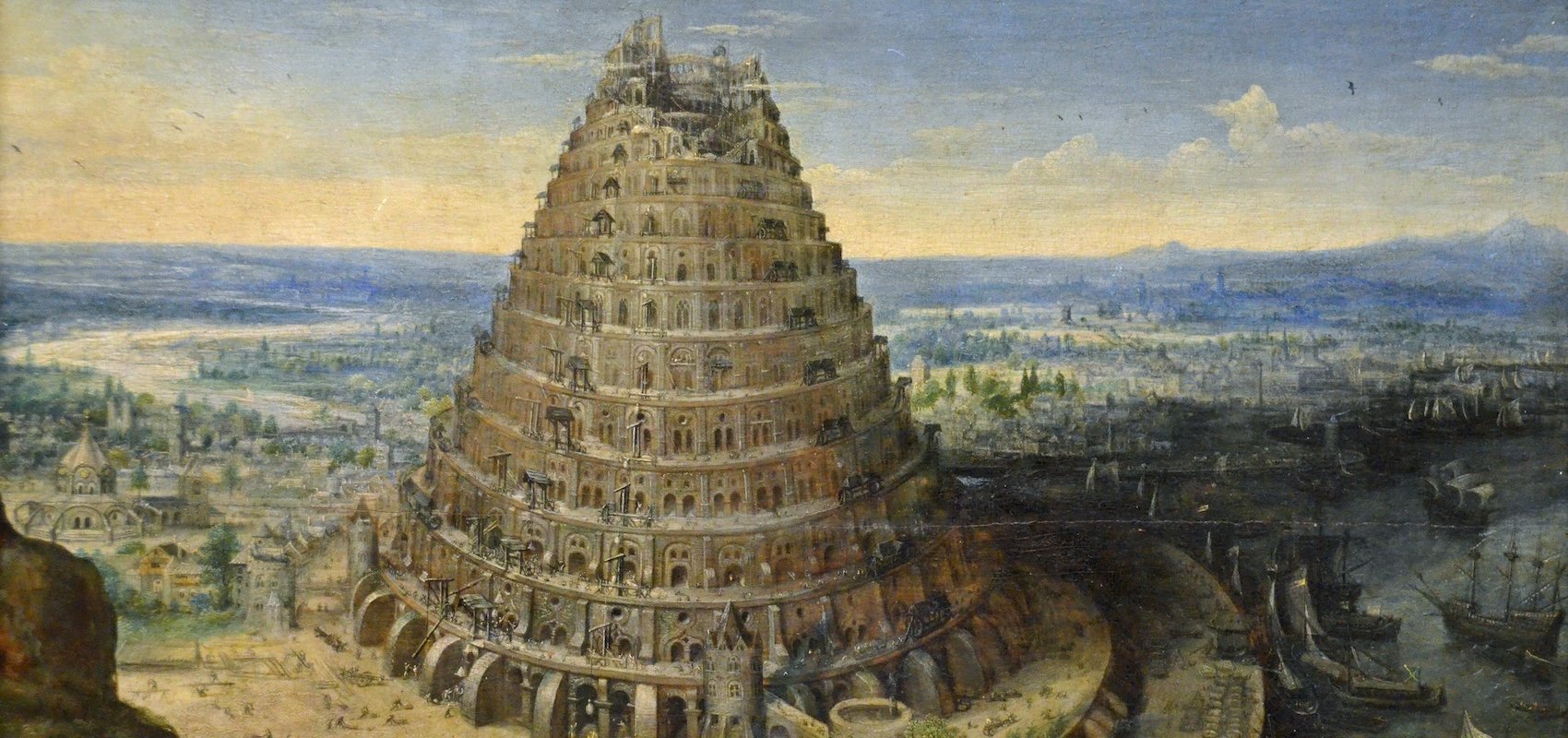
From an aesthetic point of view, there is agreeable symmetry in the fact that hubristic engineering in our post-post-modern world is effectively, by reducing discourse (the way broth is reduced), restoring a status quo that is said to have been lost through hubristic engineering in pre-history. The origin of speech-diversity, the birth of babble, is proverbially traced to the scattering abroad of men after their ill-fated attempt to make gods of themselves by constructing a tower “with its top in the heavens.” Language-lovers such as George Steiner have qualified the notion that Babel’s sanction was all bad. After all, a wealth of sound ensued, and untold potential for nuance and polyphony enriching both our intuitions and our palaver.
I am partial to this view, but the real stakes of Babel may in fact be pitched at a different level. When you think of it, Scripture talks of linguistic multiplicity before anyone had thought of tower-construction. In an account of the offspring of Noah’s son in Genesis 10, we read: “These are the descendants of Japheth in their lands, with their own language, by their families, in their nations.” Scholars embarrassed by this verse have stressed that Scripture’s narratives are not always in strict chronological order. We may, though, responsibly get round a sense of felt contradiction. In Hebrew, the beginning of the next chapter, Genesis 11:1, reads:
וַיְהִי כָל-הָאָרֶץ שָׂפָה אֶחָת וּדְבָרִים אֲחָדִים
The Revised Standard Version, voicing an established norm, translates: “Now the whole earth had one language and the same words.” This spells out, as I have noted, what is for many of us a natural supposition regarding an original status quo.
The learned Rabbi Joseph Herman Hertz, though, thought it better to translate the Hebrew phrase in this way: “Now the whole earth had one language and few words,” that is to say, a small vocabulary. If this is right, the tower of Babel stands for confederation through a handful of mobilizing slogans. Ideals tend to call for nuanced explication. Slogans are much the same in any age. We might conjecturally think that the investors and workmen of Babel were driven by timelessly attractive thoughts of, say, “greatness,” “progress,” “mastery,” “profit.” Jewish legend, adds Rabbi Hertz, “tells of the godlessness and inhumanity of these tower-builders.” Their language did not extend to the register of philanthropy: “If, in the course of the construction of the Tower, a man fell down and met his death, none paid heed to it; but if a brick fell down and broke into fragments, [then] they were grieved and even shed tears.” This image from a legendary source has, alas, perennial applicability.
The connection drawn between fewness of words and inhumanity is striking. Men and women were created, the Bible would have it, to enunciate creation. Endowed with logos, speaking in time as God spoke “in the beginning,” Adam was graced to give things adequate names. Conversant with his surroundings, he was to be creation’s steward, to “dress it and keep it,” but not to lord over it: Lordship was God’s. The enterprise of Babel sought to turn the tables. Man had grown bored with contemplatively naming things for the sake of wise appreciation. His new design was pragmatic and goal-driven: “Let us make a name for ourselves!”
The tower instantiates humanity’s ambition. Few words were needed to raise it: Graphs and figures would go a long way. The mathematical, calculable nature of the project is shrewdly envisaged by some of those early modern artists—Valckenborch, Brueghel, van Cleve—who painted the subject. On their canvases not a lot of talking goes on. Babel, it appears, brings about the death of conversation. Man is locked, with gritted teeth, in self-aggrandizing pursuit. The one word that touches him is “Me!” now and again transposed, for form’s sake, into a plural “Us!”
If we adopt this exegesis, the subsequent confusion of language and decentralization of mankind are not so much punishment as respite. Relieved of megalomaniac obsession, man is forced to look around. Once again he notices, lo! the mountains and plains, the blue sea and starry skies. He recalls what he, creation’s spokesman, owes them. The breakdown of Babelish, intercourse contracted to figures and a few mantras, provokes the rebirth of conversation. The aftermath of Babel in effect redeems man as a logical being. Even as his expulsion from Eden was a blessing in heavy disguise, effected to prevent fallen man from eating of the tree of life and thus remaining forever in a state of sin-woundedness, so his driving-forth from Babel was beneficial. Recovering word-wealth, he learned again to engage with alterity. Any notion of “thus” is tempered henceforth by knowledge that there is an “otherwise”; one can no longer speak of “here” without considering an “elsewhere.” Any biblical prospect of home is bound up, from this time on, with remembrances of exile. Man learns to refrain from absolutizing—that is, from putting all his trust in—any earthly attachment, any political or technological project, any fixed jargon.
A consciously acknowledged variety of tongues, whether or not it already existed in Japheth’s days, makes of translation a paradigm for getting by after Babel. Terms must be tried, words weighed. Confidence in private concepts is tested by the need to explain them. Sensitized to strangeness, man is asked to think of himself as a pilgrim, a word that does not designate someone backpacking to Lourdes so much as one who comes from foreign parts, a passer-through, a dweller-for-a-while.
Why was Abram, prototype of this new humanity, called out of Haran? To learn to be an alien. This happened first in Canaan, where his proclamation of “the Lord” witnessed to a metaphysical Otherness it would take centuries to name. In Egyptian exile his experience took flesh: Abram found himself talking and acting inexplicably. Israel’s other great patriarchs, too, bearers of words that exceeded them, faced incomprehension. God, it seems, would have it so, forestalling territorial pretension in geographic and semantic terms. Man is the creature that, drawn hither and thither, must ask: “What does this mean?” When Israel at last crossed the Jordan, two types loomed large over the nation’s destiny: that of Moses, the hard-of-speech, born and buried in strange lands, and that of Jacob, the wandering Aramaean.
The give-and-take of converse with the Pharaonic south and Mesopotamian north, then with the eastern tribes, with Gaza, Syria, and Sidon, was inbuilt in the Abrahamic, and later Israelite, project of nationhood. We find, too, that in Israel’s God-given Law, the stranger, designated oxymoronically a “resident alien,” appears intrinsic to the nation, lodged within it, we might say, as a providential irritant.
By having to engage with differently formed foreign-tongued people, Israel is kept in a tension of non-familiarity regarding its ultimate identity and task, reminded that the God behind its social contract says, “My thoughts are not your thoughts,” that the people’s freedom is premised on their memory of having once been slaves abroad. The nation is not an end in itself, but an instrument with a universal purview: “Out of Zion shall go forth instruction” for “many peoples,” so that together they might “beat their swords into ploughshares, their spears into pruning hooks.”
Whenever the chosen people gets too sure of itself and reduces revelation to platitudes, sacred things to talismans (as when, under Eli, the Ark was hauled into battle against Philistines), providence occasions some exclusion or loss by way of re-enacting exile. God will not let faith be instrumentalized for purely territorial ends. To relieve the people of its presumption, he reimmerses it in foreignness. A fresh thirst is born to hear new words, to be given at the opportune time.
“The word of the Lord came to me!” By this acclamation prophets would later legitimate themselves in sacred history. The gift of some new word sheds light in darkness. New words require fresh translation; fresh translations, the rereading of tired words. Settled scenarios may come to seem new. Deadlocks may loosen. A parable can be drawn from this. At times of crisis, when a nation is at odds with itself or its environs, what is needed is not the paring-down of discourse but its enrichment. Hope for restored togetherness lies in engagement with allophony, a linguistic term we may paraphrase as “other-speak.” Once I let go of the demand that my stock of words—the sense I give them, my way of speaking them—must be the norm for exchanges with others, a number of realities may rearticulate themselves.
What, then, is translation? How does it work? In an essay from 1937, Miseria y esplendor de la traducción, José Ortega y Gasset spoke of translation as a utopian exercise. By way of example he asks picturesquely how the resonant syllable of the dense, dark green, fragrant German Wald might hope to have its sense conveyed by the plosive bosque, which to Spanish-speakers summons up a tuft of trees in a parched plain. Both words mean “forest,” but do they speak of the same thing?
The semantics of a language are rooted in specific soil and in local sensibility. Its grammar, sounds, and syntax, too, presuppose a framework that makes us slide, in the way we think, “along preestablished rails prescribed by our verbal destiny.” This image is proffered in Ortega’s text, crafted like a dialogue, by an unnamed “scholar of linguistics.” He maintains that the structure of language forms our perception of the world so deeply that a statement made in one cannot fully be rendered in another. The best we can hope for is approximation. Translators traditionally follow, the linguist says, quoting Schleiermacher, one of two trajectories: “either the author is brought to the language of the reader, or the reader is carried to the language of the author.” The French, with their knack for definition, call the first option cibliste: It favors the target-language. The other, focused on the source, they call sourcier. Ortega’s linguist thinks the target language has to suffer; there is no other way. A reader of any translation must know in advance that “he will not be reading a literarily beautiful book but will be using an annoying apparatus.” It is no translator’s task to make a work easy to read. He is to make it clear, if necessary by piling up footnotes. Schleiermacher’s version of Plato is cited as an instance. It is, the linguist says, unlovely. It gives scant reading pleasure. But it may stand a chance of helping us “transmigrate within poor Plato, who twenty-four centuries ago, in his way, made an effort to stay afloat on the surface of life.”
Ortega does not quarrel with this stern view. He concedes that, in translation, language must be pushed “to the extreme of the intelligible,” as if transfer of sense from one linguistic medium to another were inevitably an imposition. His claim that the task is utopian is softened when he adds that “everything Man does is utopian.” Still, a note of wistful sadness penetrates his often-witty text. One is left with the overall impression that it is just damn hard for people to talk to each other, that translation is at some level force-funneling from person to person. And does not each of us speak, to some degree, a customized language, conditioned by unique experiences and associations? We might remember that Ortega published this piece in a Buenos Aires journal in 1937, when Spain was in the throes of a fratricidal war whose tragedy is evoked in a short story from 1943 by Stefan Andres titled, precisely, “We are Utopia.”
There are times when it seems sense can be neither spoken nor heard, when violence reigns, issuing in muteness, plunging us into incommunicable solitude, as shown in Víctor Erice’s film about the aftermath of the Spanish Civil War, The Spirit of the Beehive, made in 1973, when remembrance was still censured in Spain. Destinies play out in the film within a collective, implicit wound that is unspeakable. The husband and wife under whose roof the drama is enacted never exchange a word short of calling out each other’s names, like freight trains whistling as they pass at dusk. The tensions that have divided a house against itself represent the opposite of what translation, however imperfectly, exemplifies. Rails have been dug up and used as bludgeons.
When such tensions are abroad in society, it is necessary to practice the art of translation assiduously lest conversation be demeaned as railroading. A throwaway comment about Schleiermacher’s Plato in Ortega’s text refers to translation as transmigration. That theme is picked up in an essay, altogether more hopeful, from 2012 by Mireille Gansel, who has rendered the German poetry of Nelly Sachs and Paul Celan into French. Gansel thinks of translation as transhumance. This pastoral term, drawn from humus, Latin for “fruitful soil” (which yields “humility” as well), refers to the seasonal droving of animals practiced in mountainous regions. Whether we spontaneously see before our mind’s eye the image of a Swiss shepherd with his sheep and barking dogs winding their way through a ravine, or that of a snow-scooting Sámi driving reindeer across the Scandinavian tundra, the scene vibrates with a liveliness and energy that stand in sharp, freeing contrast to the image of inflexible railway lines we have considered in Ortega y Gasset.
Transhumance, an Intangible Cultural Heritage of Humanity since 2023, is by definition constant drifting across borders. If you are caught up in transhumance you do not stay behind a wall trying to work, or shut, out what people say and do on the other side; you move back and forth seeking sustenance in changing landscapes for yourself and your flock. Gansel develops the metaphor of transhumance in two ways. On the one hand, languages are pastures. Shepherded from one to the other is significant content—of a poem, novel, treatise, or confessional statement seeking new form. On the other hand, language itself can be thought of as a flock led from winter to summer, grazing, with the translator as its shepherd. Language, in this account, is a nomad reconciled to the transient nature of any “home.”
Gansel’s hypothesis is at once theoretical and deeply felt. She cites an early memory of her father sitting somewhere in France, in rapt silence, reading letters from his sisters in Budapest, promising: “This evening I’ll translate.” Probing revealed treasures waiting to be brought across language boundaries. Gansel remembers her puzzlement as her father, in messages to her from her aunts, kept pausing before a given phrase he would invariably render as “my dear.” “Is it the same word again?” she asked. Her father answered, “Well, it means the same,” but then began to sound subtly different strings of sweetness, drawing out endearments such as “my darling,” “my golden one,” “my little-one-made-of-sugar.” In a flash, says Mireille Gansel, “the diagrammatic clarity of French was ablaze with this rainbow of sensations, each one enriched by a possessive [term] that embraced me tenderly.” Such awakening to the pregnancy of words was one factor that made her resolve to be a translator. Another was the need, simply, to get to know what was left of her family, decimated by the anti-Semitic fury of the Third Reich. “If you wish to talk with them,” her father said, “you have only to learn German,” the lingua franca of the Middle European world in which the family’s roots were buried. German had been the language of intimacy between Gansel’s Slovak grandmother and Hungarian grandfather. Their son, her father, would not speak it, hearing in it ever the echoes of marching boots and curses.
The pasture into which Gansel moved by appropriating German was not one of restful waters. It was a ravaged land, the “world of yesterday,” which had thrived in now burned-out cities like Odessa and Czernowitz. She learnt to pick and gather—in Old German lësan, a verb that now means “to read”—elements of beauty and horror. She got to know a soft, sonorous German enriched by the melody of confluent vernaculars: Hungarian, Czech, or Yiddish. German had been a roving, cosmopolitan language, used by Kafka in Prague, Roth in Paris, Canetti in London. After the war this medium of global culture was corralled within national boundaries. Suppressing other tongues, replacing their speakers’ names with numbers, it had diminished itself, a vehicle of transhumance, into the soulless code of what the philologist Victor Klemperer called LTI, lingua tertii imperii. Gansel understood why native German-speakers like Imre Kertész or Aharon Appelfeld would not use German for creative writing after 1945, forswearing it as a form of Babelish. She saw no less why Sachs and Celan resolved to make German speak the Shoah’s awfulness in poetry soaring toward the ineffable, which Gansel decided to shepherd into French. Confronted with the unheard-of, languages have to burst boundaries. To translate is not to domesticate the unknown in known terms. It is to renounce the certainty that I am the knowing insider while everyone else is outside. When one does this, something new can be said. Gansel records her realization “that the stranger is not the other, it is I—I who have everything to learn, to understand from him.” “That,” she adds, “was no doubt my most essential lesson in translation.”
Such a statement may make us think of Martin Buber’s I and Thou, high on the list of the world’s most-cited-and-least-read texts. Published in 1923, the year the anti-Semitic rag Der Stürmer was launched, and turned into English in 1937, when Ortega published his essay on translation, the book is famously a concentrate of Buber’s dialogical thinking. Less well known is the fact that this philosophy was bound up with a labor of translation. Buber had been planning a version of the Hebrew Bible since before World War I. The project began in 1925 in alliance with Franz Rosenzweig, already deprived of speech by the lateral sclerosis that would carry him off in late 1929.
In engagement with Holy Writ, general problems of translation are brought to a head. The chasm between eternity and time is so vast that any attempt to bridge it seems hopeless. Men can try only because God has equipped them with words: the unchangeable ones of revelation, the moldable ones of the land. Rosenzweig and Buber were that for which LTI had no term: Jewish Germanists. Consummate stylists both, they revered German’s architecture, but would suffer no violence done to the Hebrew. They upheld the integrity of the Masoretic Text, understood as an immense, symphonic, sometimes playful commentary on itself. To render this scriptural wholeness, a handful of essential rules of translation were laid down. Since the Bible had speech as its origin, this new version must be orally attuned in phrasing, euphony, and rhythm. As well as the message, there was the music to convey. Hebrew effects interreferentiality by means of similar sounds, so that a distinct motif in one place recalls, as in a Wagner opera, the same motif elsewhere, inciting the reader to connect the two; therefore these features, alliteration for example, must be maintained. The etymological wealth of each Hebrew root must be given attention to keep its substance intact; by extension, a set German roots must correspond to each Hebrew root. The word for a burnt-offering, הלָעֹ, from הלָעָ, “to raise,” would be rendered, for example, as Darhöhung, “lifting-up.”
Would translation on these terms jolt the reader in the way Ortega’s linguist foresaw? No. Neologisms were required. The language of Goethe was stretched. Yet Rosenzweig could observe with relish: “It is remarkably German! Luther by comparison seems almost Yiddish.” The two men complemented each other, growing together in understanding of the text through joint endeavor. Sometimes their “exchange of letters went back and forth for weeks over a single word.” When Rosenzweig died, Buber felt bereft but carried on. He had interiorized his friend’s genius to such an extent that it remained for him a guiding light. The translation was substantially finished before the outbreak of World War II, with one exception: the Book of Job. Buber wrote: “I was simply unable to translate it.” After the war he returned to the task: “Then I was able.” That elliptic phrase is rich in pathos. It tells us that translation is more than a strictly intellectual process; it is existential. Sometimes, to perfect it, we must be changed by pain, compassion, or delight in a dilation of the heart that in turn permits the broadening of our mind and our words’ late blossoming.
A friend of Buber’s, the Catholic exegete Fridolin Stier, set about translating the New Testament by applying the principles of Buber and Rosenzweig. He enriched German literature as they had done. Stier’s paradigm for translation was hospitality. A host, he wrote, must receive guests with grace, as they are. It would be a violation “to pull a turtle-neck jumper over the head of one appearing in Oriental garb.” This snide reference to the mandatory outfit of modish academics (the remark was made in 1970) is a timely reminder that Scripture cannot be forced to wear any uniform or national dress: no ushanka, no baseball cap. Stier’s insight has, though, a wider remit. For someone else’s sense to pierce me, something in me must break:
Whoever translates must dislocate. Sworn to fidelity, he must break it. Languages will not, cannot work otherwise. Each speaks of, sees and experiences, senses and judges, perceives and relates earth and heaven, humanity and stuff variously—languages, like painters painting one mountain, differentiate the same.
The wonder is that they can, in this way, actually let us see the mountain differently.
Variety of perspective belongs to those who are pilgrims on the earth, having here no abiding city. In the Vulgate, Paul exhorts the Philippians: “nostra autem conversatio in caelis est.” Heaven will be conversation conducted in a language we have yet to learn, yet our present search for worthy words prepares us. We must stick to that search, not surrender it to automation. The Logos’s antitype is, in the Bible’s final book, a digital cipher. The Word became flesh to translate the Father’s love—“to exegete him,” says the Fourth Evangelist. Our flesh is in turn illumined by words. According to the RSV, Paul told the Ephesians that we human beings are “God’s workmanship.” What Paul wrote in Greek was: “We are God’s ποίηµα.” A ποίηµα, true, is anything made: The noun is derived from the verb “to do.” But it makes at least as much sense to translate the noun literally, as “poem.” To postulate that we are poetic creations is to own that the Logosseeks to speak itself in us beautifully. Our life’s task is to find the appropriate words, punctuation, and pauses. That done, we shall be translated as Bottom was in Shakespeare’s A Midsummer Night’s Dream. When the amiable weaver is half-turned into an ass by Puck, Quince exclaims: “Bless thee, Bottom! Thou art translated!” Mirth presages mystery: Our present nature is provisional. Our own life’s poem will be perfected only in translation when “we shall all be changed, in a moment”—when the last trumpet sounds and the dead will be raised imperishable.
Even in this life, translations may excel original designs. I think of the versions of St. John of the Cross done by Roy Campbell, an English poet who lived in Spain in the 1930s. He picked up the work to process his grief at the killing of his confessor, a Toledo Carmelite shot in the Civil War. The result was, he reckoned, “a miracle,” alight with a brilliance few of his own poems reached. Translation can call forth our richest, most various words. At the last, translation will manifest our true selves configured to God’s Word, apt to resonate as praise forever. We can thrive hospitably on our earthly pilgrimage if we are mindful that the borders that order existence now are not final. Learning to listen and to speak across them, we may yet pursue and envisage a boundless fellowship imbued with humanity, a word that used to signify “intelligent kindness.” God knows we could do with more of that.