
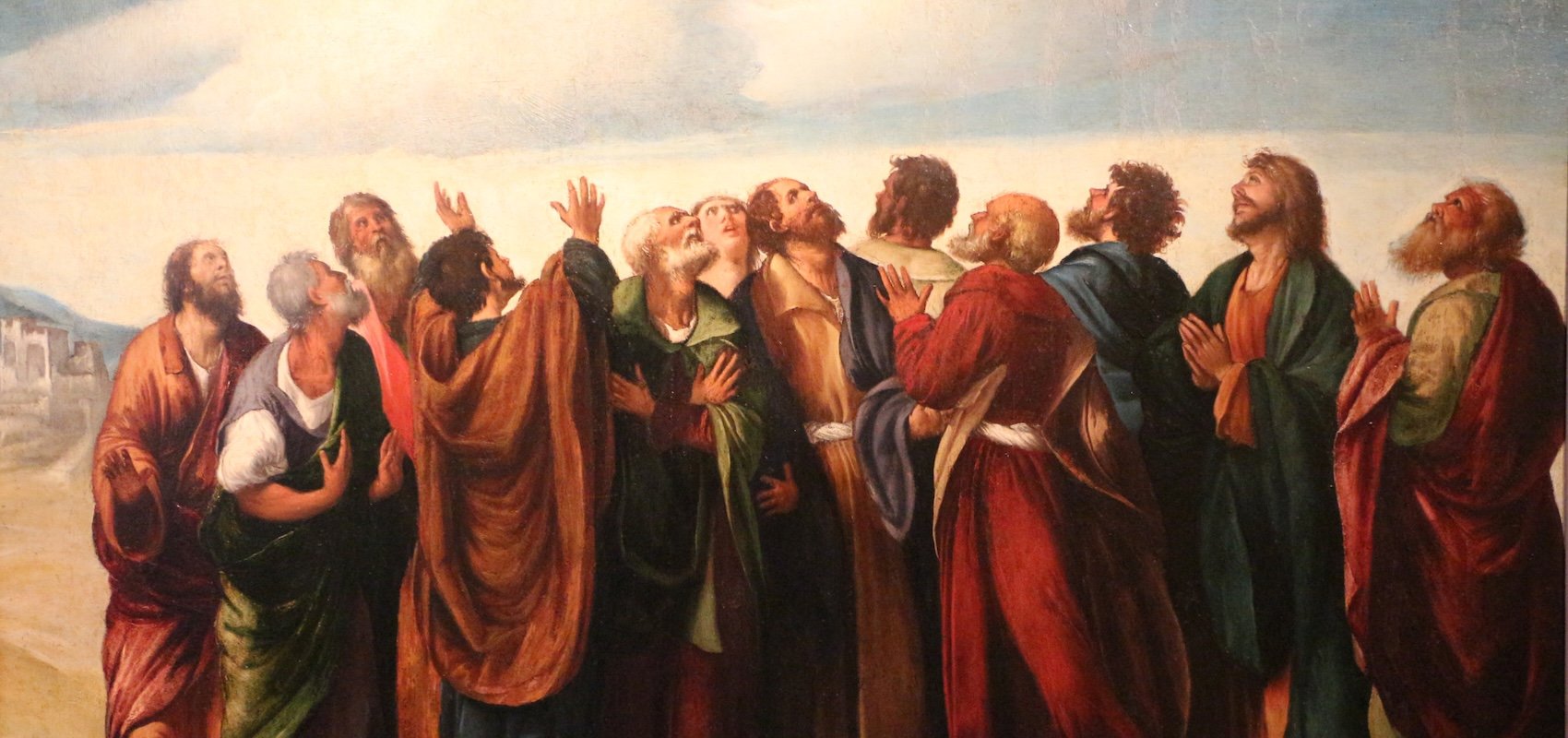
Forty days after his resurrection, Jesus meets the remaining eleven disciples on a mountain in Galilee. He declares his authority in heaven and on earth and sends his disciples out to baptize and teach the nations until all bow before the world’s true King. It’s the greatest possible adventure, also overwhelming and impossible. To encourage the eleven, Jesus adds, “Behold, I am with you all the days, until the end of the age.”
The English translation changes the word order of the original. In Greek, Jesus says, “I with you am.” What’s the difference? It appears tiny, but it’s momentous. Start with “I am.” At the burning bush, God reveals himself to Moses as “I am,” and variations of this sentence identify the God of Israel throughout the Old Testament: “I am who I am,” “I am he,” “I alone am God.” As Jesus sends out his disciples, he takes to himself the name of Israel’s God, not for the first time. He enrages his Jewish opponents with, “Before Abraham was, I am.” When the high priest asks, “Are you the King?” Jesus answers, “I am.” Throughout John’s Gospel, Jesus repeatedly calls himself “I am”: “I am the living bread,” “I am the light,” “I am the resurrection,” “I am the door,” “I am the good shepherd,” “I am the way, the truth, and the life,” “I am the vine.” Every time Jesus says “I am,” he informs his disciples and his enemies he’s the God of Israel, Creator and Lord, now become flesh to dwell among us.
What about the “with you”? At the beginning of Matthew’s Gospel, an angel tells Joseph that Mary’s son will be called “Immanuel,” “God with us.” At the end of Matthew, Jesus alludes to that name with his assurance that he will be “with you.” “I with you am” merges “I am” with “Immanuel.” At the very least, Jesus promises to go with them as the God of the burning bush, the God of Exodus and Sinai, the “I am” who led Joshua into the land.
Here’s where the word order becomes important. Jesus sticks “with you” in the middle of the name; he doesn’t tack it onto the end, as if it were an afterthought. He incorporates Immanuel into his own divine identity. This isn’t new either. Yahweh calls himself “I am,” but he also declares “I am your God” and “I am morning dew to Israel” and “I am a wall of fire around Jerusalem and her glory within her.” His name is “I am,” and also “I am the God of Abraham, Isaac, and Jacob.” He adds the name of his people to his own name, like a father who identifies himself by reference to his children: “Donald Father-of-Barron Trump” or “George Father-of-George Bush.” God chooses to be “I with you am”; he refuses to be “I am” without us. He doesn’t wish to be God at all unless he is God of his people.
It’s a daring move. Suppose, per impossible, “the God of Abraham” suddenly rejected Abraham. Suppose Abraham disappeared from history. That would not only be a tragic end to the glorious history of Abraham’s family; it would contradict God’s character and identity. It would be a denial of God’s Godness. Since God cannot deny himself, and he’s brought Abraham into his own identity, he cannot deny Abraham either. Jesus cannot deny himself, and for that very reason he cannot deny us. Conversely, the persistence of the seed of Abraham testifies to the existence and faithfulness of the God who calls himself “I am the God of Abraham.” The proliferating expansion of the Church confirms the Lordship of the “I with you am.”
One last wrinkle. God chose Abraham to repair the ruin of creation. He promised Abraham land, children as numerous as sand on the beach and as bright as stars in the heavens. He promised to bless all the families of the earth through Abraham’s seed. When God brought Abraham’s name into his own name, he subsumed these promises into his own identity. In effect, he names himself “I am the God who will repair creation through Abraham’s seed.” Abraham’s seed will inherit the land, shine like stars in the heavens, bless all families of the earth. If he fails, he denies himself, which he cannot do.
The same logic applies to Jesus’s declaration. His “I with you am” is his personal pledge that the Church will disciple, baptize, and teach the nations all he has commanded. Jesus staked his reputation, his name-that-includes-us, on doing what he promised. Thus: The nations will be discipled, as certainly as God is God, as certainly as I am is I am.


YOU MIGHT ALSO LIKE
The Case for Christian Nationalism
Recent polling paints a disturbing picture: Fewer than half of Gen-Z Americans are extremely or very proud…
Redemptor Hominis: More Important than Ever
Forty-seven years ago, Pope John Paul II issued his first encyclical, Redemptor Hominis (The Redeemer of Man).…
Providence After the Death of God
Modern Christians confront a paradox that has shaped the last two centuries: The very idea that history…
