Though it was overshadowed by the reversal of Roe v. Wade the Friday before, the Supreme Court’s decision on June 27, 2022 in Kennedy v. Bremerton School District was just as epochal as Dobbs v. Jackson Women’s Health Organization. In it, the Court removed the secularist constraints it had imposed on our public life six decades earlier in Engel v. Vitale, a case about school prayer. The consequences of this decision are great. School boards, legislatures, and other government bodies entrusted with responsibility for the common good are no longer required to pretend that religion is a purely private matter. They are now free to enrich our common life by promoting the general conditions for religious awareness, attentiveness, and practice. Pending cases about displaying the Ten Commandments in public schools present an opportunity for them to do just that.
Decided in 1962, Engel v. Vitale concerned a prayer composed by state officials in New York and disseminated for recitation in public schools. The short prayer was this: “Almighty God, we acknowledge our dependence upon Thee, and we beg Thy blessings upon us, our parents, our teachers and our Country.” Students could opt out if they wished. The Supreme Court nonetheless ruled that the exercise violated the establishment clause of the First Amendment.
Some might argue that Engel signaled little beyond its school context, since pupils are immature, impressionable, still subject to parental control—a special case. But this is not so. In the early 1960s, public support for school prayer was very strong. The Court’s majority knew that their decision would engender bitter opposition. Their willingness to defy the opposition and prohibit even a modest expression of reverence tells us that they meant business. Engel was no one-off. It was not just about kids. It was meant to be revolutionary. And it was.
As with so many revolutions, the causes of this one are shrouded in mystery. Commentators at the time fixed on what they held to be the crux of the majority opinion: “It is no part of the business of government to compose official prayers for any group of the American people to recite.” Yet in the next year, the Court ruled against devotional Bible reading and saying the Lord’s Prayer—neither text composed down at City Hall.
A close look at the majority opinion reveals that the justices had nothing to say about First Amendment jurisprudence. They offer a turgid parable about freedom-loving colonials throwing off the yoke of British oppression. Cases are cited, but none of the Court’s own prior holdings on relevant matters. The only reference to an earlier decision is meaningless, a footnote to Everson v. Board of Education (1947). Engel did not claim to be based on judicial precedent.
The reasoning, such as it was, would not have been out of place in an op-ed written by the atheist activist Madalyn Murray O’Hair. “It is true,” Engel conceded, that New York had not erected a “total establishment.” It allowed that the “governmental endorsement of that prayer seems relatively insignificant when compared to the governmental encroachments upon religion which were commonplace 200 years ago.” But we must be vigilant. Quoting James Madison (who was talking about Virginia politics, not the First Amendment), Engel intones: “It is proper to take alarm at the first experiment on our liberties.” “Threepence” today might mean your fortune tomorrow. Allowing mention of God in schoolrooms is the first step toward theocracy! By this slippery-slope logic, anything that hints of the establishment of religion amounts to the establishment of religion. The only constitutionally permissible stance is complete secularism.
The Court had previewed this secularist ideology in two earlier cases—Everson and McCollum v. Board of Education (1947 and 1948)—but then abandoned the initiative. The fifties were, as a matter of constitutional law, a godly decade. The Court made no objection as Congress added “under God” to the Pledge of Allegiance and made “In God We Trust” the national motto, and as public-school prayer was made the norm rather than the exception. On the eve of Engel, the controlling principle was best expressed in a line from Zorach v. Clauson (1952): “We are a religious people whose institutions presuppose a Supreme Being.”
The controlling opinions in Engel at all three levels of New York’s courts were based in the Zorach tradition. Chief Judge Desmond wrote for the Court of Appeals, the state’s highest, that when the Founders ratified the establishment clause,
they could not have meant to prohibit mere professions of belief in God for, if that were so, they themselves in many ways were violating their rule when and after they adopted it. Not only is this prayer not a violation of the First Amendment (no decision of this or of the United States Supreme Court says or suggests that it is) but a holding that it is such a violation would be in defiance of all American history, and such a holding would destroy a part of the essential foundation of the American governmental structure.
Desmond was expressing views widely held, not just in past centuries, but in mid-twentieth-century America. The settled law of nonestablishment in 1962 did not entail a “wall of separation,” much less a “strict” or “high” one. It entailed a picket fence permeated by cooperation between Church and state for the common good. Governments could and did encourage and aid religion and religious institutions, so long as the different faiths were treated equally and no one was coerced.
The Engel Court recognized that the prayer at issue was “non-denominational.” It, in fact, comprised a few truths about divine realities that reason can affirm without aid of revelation, along with thanksgiving and petitions that any intelligent creature of a divine Creator could offer. Engel also recognized that participation was voluntary; objecting students could absent themselves.
But a review of the oral arguments in Engel shows that the justices’ minds were made up before the gong rang. They—excepting only Potter Stewart—believed that religion should be privatized and the public sphere secularized. Probably sensing that the justices were ready to take a big leap “forward,” the complaining parents’ lawyer, William Butler, urged them to adopt the unprecedented position that the only way to preserve religious liberty in America was to keep religion out of public life. One justice asked, “Is it your position that our public schools, by virtue of our Constitution, are frankly secular institutions?” Butler answered, “Absolutely yes.”
The opposing lawyers sharpened the point. Representing the state authority, Bertram Daiker observed that from “the earliest days of this country . . . the men who put the country together have publicly and repeatedly recognized the existence of a Supreme Being, a God.” Porter Chandler represented some parents who welcomed the prayer. He correctly noted that the other side was “now seeking to . . . eliminate all reference to God from the whole fabric of our public life.”
Butler prevailed, as the Court concluded that the New York exercise was “wholly inconsistent” with the establishment clause. The closest thing to an “authority” for this ruling was not the past but the future. As the constitutional scholar Alexander Bickel explained in The Supreme Court and Idea of Progress (1970), the Warren Court characteristically bet on the future, secure “in the belief that progress, called history, would validate their course, and that another generation, remembering its own future, would imagine them favorably.” The Court bet, in other words, that a grateful populace would forgive their fanciful opinions, so at odds with American tradition in law and culture. All the flaccid reasoning would be forgotten, as would the law dons who criticized the Court, the moral conservatives who denounced it, and the politicians who vowed to overturn its errant holdings.
And indeed, corrective constitutional amendments got aloft, only to die in congressional committees. The broader political pushback against Engel went from boil to simmer within a few years, as Vietnam and civil rights overwhelmed our politics, society grew more secular, and many believers exchanged the canonical Gospels for the social one.
But Warren and the brethren forgot that what a future generation giveth, it might also taketh away. The justices thought “progress” was linear, not cyclical. They would be astonished to learn that, two generations out, many Americans reject the naked public square. They want their kids to know God, even when those kids go to public schools. They have voted and funded and organized and agitated for decades to return God to our public life. And now they have succeeded in removing an impediment to that goal. The essential holding of Kennedy is that Engel’s elevation of the secularist project to constitutional status is wholly inconsistent with the establishment clause.
Kennedy began as a humble affair. The opinion relates that a public high school football coach named Joseph Kennedy had a custom of “[kneeling] at midfield after games to offer a quiet personal prayer.” Over time, “the number of players who joined Mr. Kennedy eventually grew to include most of the team, at least after some games. Sometimes team members invited opposing players to join. Other times Mr. Kennedy still prayed alone.” The school district reprimanded Kennedy for his “public religious display,” because “reasonable . . . students and attendees” might perceive the “district [as] endors[ing] . . . religion.” Following the secularist doctrine laid down in Engel, “the District argues that its suspension of Mr. Kennedy was essential to avoid a violation of the Establishment Clause.”
Kennedy won his case on free speech and free exercise grounds. An essential part of the Court’s holding, though, concerned the establishment clause. Speaking matter-of-factly through Justice Gorsuch, the Court noted that “this Court long ago abandoned Lemon and its endorsement test offshoot.” If only this were true! The cases that the Court said “abandoned” Lemon did no such thing. In 1993, in the Lamb’s Chapel v. Center Moriches free religious speech case, Justice Scalia lampooned Lemon as living on like “some ghoul in a late-night horror movie that repeatedly sits up in its grave and shuffles abroad, after being repeatedly killed and buried.” Scalia correctly observed that “Lemon stalks our establishment clause jurisprudence once again, frightening the little children and school attorneys.” Only with Kennedy has that ghoul been exorcised from our legal regime.
Lemon v. Kurtzman, decided in 1971, was the Court’s last full expression of Engel’s secularism. In it, the Court formulated a three-part test: (1) state action must have a secular purpose; (2) the primary effect of a law must be neutral with respect to religion, neither advancing nor inhibiting its practice; and (3) a law must not foster “excessive entanglement” of government with religion.
In subsequent decisions, the Court set aside aspects of the Lemon test, though never with great clarity. But with Kennedy, the Court has explicitly “abandoned” the Lemon test as (in the Court’s words) “abstract” and “ahistorical.” The important metric here is “ahistorical.” Examining any law’s “purpose” is the basic task of the Court. It is not “abstract.” The term “secular” is not “abstract,” either. It means: God is absent. The Court here and elsewhere deploys “abstract” not in its literal sense, but as a term of opprobrium, to stigmatize a concept or form of reasoning it deems inappropriate to the judicial task. Justices often use “metaphysical” and “philosophical” in the same way. Thus, Kennedy is saying that the problem with Lemon is that its secularism is at war with American history. It is “abandoned” for that reason.
As goes Lemon, so goes Engel. It is now a dead case walking. So much so that lower court judges need not wait—as generally they must—for the Supreme Court to issue the death certificate. Without Lemon’s secularism to prop it up, nothing else in the constitutional corpus supports Engel’s ban on school prayer.
One might object here by reviving the presumption, present in Engel, that there is so much psychological pressure in a classroom to participate in “voluntary” school prayer that the provision of an optout is illusory. Notwithstanding their ostensible freedom, kids are being forced to pray.
Last summer’s “optout” case defeats this argument. Mahmoud v. Taylor concerned parents’ religious objections to their grade-school children’s exposure to LGBTQ material. They sought an optout, which the public school district refused to provide. The Supreme Court sided with the parents. What Mahmoud contributes to Engel’s demise is this: Absent from the Mahmoud majority opinion is the suggestion that a child who opts out of a required exercise would be stigmatized by classmates as an outlier, a weirdo, or worse. Mahmoud presumed that abstention can be a normal option for children rather than a perilous undertaking. The same holds for school prayer. Taking a pass on a non-curricular prayer is no more subtly coercive or productive of peer ridicule than skipping curricular readings about having two dads.
Alternatively, one might suggest that the Engel corpse could be reanimated, though this time without a soul. Engel allowed that the challenged recitations could be performed, just not as an actual prayer: “Such patriotic or ceremonial occasions bear no true resemblance to the unquestioned religious exercise that the State of New York has sponsored in this instance.” This transposition of religion into one or another secular category is a staple of the whole post-Engel era: Bible-reading for history or literature, but never as devotional; public crosses and the like as markers of a faith-filled past, not of present belief; opening prayers to “solemnize” an occasion.
The goal here is to argue that religious idioms serve a secular purpose, such as to signal that chitchat is over and the meeting is about to start. Any number of crunchy or patriotic things might do the job: reciting Whitman’s Leaves of Grass, contemplating Walden Pond with Thoreau, reading a letter from Iwo Jima, listening to the Gettysburg Address. Any of these activities would be edifying and might help those present to recollect themselves by means of personal reflection. But prayer is typically less long-winded and has a nice sheen of historical usage, and by these points it recommends itself. The whole enterprise of secularizing the sacred is a Lemon hangover, a state of mind oblivious to the import of Kennedy.
The most decisive blow to Engel comes in Kennedy’s instruction to look to the Founding Era’s “historical practices and understandings” for guidance in interpreting the First Amendment. For there was no more commonplace axiom of practical politics at the Founding than that a free government depended on the people’s virtue, and that only religion could secure that virtue.
The father of our country was a more or less orthodox Episcopalian. He famously opined that of “all the dispositions and habits which lead to political prosperity, Religion and morality are indispensable supports.” Washington’s vice president was a Christian but not an orthodox one. According to John Adams, “Religion and Virtue” were nonetheless the crucial foundations, not only of republicanism, “but of Social Felicity under all Governments and in all the Combinations of human Society.” Benjamin Franklin was almost a theist. Of his justly renowned prayer at the Philadelphia Convention, historian Daniel Dreisbach has written: “Franklin acknowledged the existence of an omniscient, superintending Deity who orders the affairs of men and nations and who is aware of the minute details of the material world.”
Quotations could be multiplied endlessly. In their sympathetic study of American atheism, Godless Citizens in a Godly Republic, R. Laurence Moore and Isaac Kramnick wrote:
Our forebears believed that the novel experiment of a democratic republic could not function without a consensus around moral principles rooted in theistic religion. Whatever their disagreements about the content of religion, they were united in the conviction that a heavenly Creator had laid down a plan for virtuous living which democratic citizens could discover by reason, or faith, or a combination of the two.
The Northwest Ordinance organized territories under the governance of the national government. Passed first by the transitional Confederation Congress and then by the first Congress under the the Constitution in 1789, this act declared: “Religion, morality, and knowledge beingnecessary to good government and the happiness of mankind, schools and the means of education shall forever be encouraged.” It is not by implication or steady inference that one gets from this sentence to the conclusion that public schools might teach—inculcate, instill—religion in their pupils. The Northwest Ordinance said they should!
Nor was it idle talk. Putting its resources behind its thoughts, the national government in 1787 stipulated in contracts for the sale of Western lands that one lot in each township “be given perpetually for the purpose of religion,” and in 1788 that land be reserved for “the sole and only use of supporting religion.” During the incumbencies of Adams and Jefferson, the Indiana (1800), Michigan (1805), and Illinois (1809) territories were organized by reenactment of the Northwest Ordinance. President Madison signed the bill organizing the Missouri territory on basically the same footing.
These measures rested on a broad consensus. Before and after the Founding, civil governments in America affirmed truths about divine realities: God’s eternal existence and his creation of all that is; God’s providential care for mankind, including the promulgation of moral law; and a final justice, which the Founding generation commonly described as a “future state of rewards and punishments.” These affirmations are often repeated in pages of the Founding documents and throughout the history of America’s public life. The Declaration of Independence is the leading specimen: “We hold these truths to be self-evident, that all men are created equal, that they are endowed by their Creator with certain unalienable Rights, that among these are Life, Liberty and the pursuit of Happiness.” The preambles of state constitutions, which the Founders wrote, strike the same notes.
We could continue retelling the history of governmental encouragement of religious practice, but to do so would fill too many pages. The evidence is overwhelming that school prayer does “accor[d] with history and faithfully reflec[t] the understanding of the Founding Fathers,” as Kennedy requires.
The Founders, and succeeding generations, adumbrated these affirmations of God’s reality and our duties toward the divine on the basis of reason. Hence the term “natural religion” or “natural theology,” which is not religious faith but a prolegomenon to it. The affirmations were “non-denominational,” not because a poll of believers evidenced commonality, but because “denominations” began where natural theology left off. Prayers such as New York’s, therefore, do not establish a state church, nor do they subject the worship, creeds, and disciplines of the churches to state control.
This same natural theology is the foundation of religious freedom. Religious freedom is an “unalienable” right, according to Madison in 1785, “because what is here a right towards men, is a dutytowards the Creator.” In religion, one makes a judgment about what istrue in ultimate matters, then acts accordingly. To this end, one must be free from coercion and manipulation.Madison concluded, “It is the duty of every man to render to the Creator such homage and such only as he believes to be acceptable to him.” The lowercase h means acceptable to the one who renders homage. It is a duty that can be fulfilled only by the free thought, judgment, decision, and action of each human individual.
The Supreme Court has quoted these sentences from Madison’s “Memorial and Remonstrance” countless times in church–state cases since 1947—without recognizing their import. The moral foundations of religious liberty were not held by the Founders as revealed doctrines, the deliverances of prophets and sacred texts, or obligatory church precepts. The foundation of religious liberty comprises truths about religion—aboutdivine realities, human intelligence and free choice, and the political common good. The Founders thought these truths accessible to unaided human reason, matters of natural religion, or philosophy. By acknowledging these truths—and encouraging our children to do so—we do the opposite of establishing religion. For these truths are the intellectual basis on which to prohibit its establishment.
Texas and Louisiana recently passed legislation requiring the display of the Ten Commandments in public schools. In both states, the legislature deferred to the ghost of Engel. They stipulated that the Decalogue is to be featured as historically significant. The Louisiana law recognizes “the historical role of the Ten Commandments,” and its display “faithfully reflects the understanding of the founders of our nation with respect to the necessity of civic morality to a functional self-government.” Texas lawmakers did not make such a statement in the statutory text. But the state’s lawyers are defending it in court on historical grounds, pointing to the Commandments’ role as an ethical foundation for our laws.
This is all true, and good as far as it goes. But it stops far short of recommending the Decalogue because it states true moral norms that students ought to observe. And by “true” I mean “to be affirmed on the basis of reason.” All the Commandments are precepts of natural reason (as well as being revealed). The only element that goes beyond what reason can and should affirm unaided by revelation is the seventh-day Sabbath. But this stipulation is a matter of determinatio, or the concrete specification of a natural duty.
Many Texas and Louisiana legislators would probably recommend the Ten Commandments as teaching true duties and prohibitions. Their presentation of them instead as integral to the historical development of American law and education probably represents the religion-for-secular-purposes dodge mandated by the Lemon test. But strategic muffling of true intent (if that is what it is) is unnecessary after Kennedy. It has also failed. Both laws have been blocked by federal district courts. Louisiana’s has been blocked by a three-judge panel of the Fifth Circuit Court of Appeals. On February 20, 2026, the full Fifth Circuit vacated the lower court injunction in the Louisiana case, ruling on strictly preliminary procedural grounds. These cases are destined to be resolved in the Supreme Court.
The outcome is as self-evident as constitutional questions allow. The forty-six-year-old Supreme Court decision that prohibited the display of the Ten Commandments in public schools, Stone v. Graham, has been overruled by Kennedy. Stone is imbued with the secular imperative that animates Engel and Lemon. In its decision, the Court offered the following sentence as irrefutably, and obviously, true: “If the posted copies of the Ten Commandments are to have any effect at all, it will be to induce the schoolchildren to read, meditate upon, perhaps to venerate and obey, the Commandments. However desirable this might be as a matter of private devotion, it is not a permissible state objective under the Establishment Clause.” In what possible world is that naked assertion in accord with the Founders’ understanding and practices?
Kennedy is the crucial first step toward a pro-life future. Thirty years before Dobbs, Roe was rescued from reversal by secularism. The decisive joint opinion of three Republican-appointed Justices in Planned Parenthood v. Casey rested on this breathtaking discovery: “At the heart of liberty is the right to define one’s own concept of existence, of meaning, of the universe, and of the mystery of human life.” Secularism makes this thought thinkable: that, as far as the Constitution reckons, each of us is the ultimate source of our own ethics, indeed our own worldview. Validity—truth—is collapsed into authenticity: My thinking or imagining a concept is warrant enough for holding it (and demanding that others respect it and me). This web of subjectivity depends on the absence of a transcendent source of meaning and value—that is, God.
Secularism made Roe possible. The Roe Court conceded that if the unborn counted as human persons, a right to abortion was constitutionally impossible. The “fetus’ right to life would then be guaranteed specifically by the [Fourteenth] Amendment,” Harry Blackmun wrote. He added that even the attorneys for Jane Roe “conceded as much.” Texas’s lawyers presented to the Roe Court a cogent argument from biology that each of us comes into being as a distinct person at conception. The justices never refuted it. They ignored it, convincing themselves, as their off-the-record memos and correspondence reliably show, that the only way to answer the question of when a person’s existence begins was through religion. And that was forbidden territory. The absurd notion that metaphysical truths are akin to revealed dogmas—the notion presumed by the secularist ideology that was presumed by Engel—exposed the unborn to lawful lethal violence for half a century.
There is little point now in lamenting the Roe Court’s ignorance. Kennedy will not undo all the ill effects of Casey’s solipsism. Even so, the dismissal of Lemon, and with Lemon, Engel, is a good place to start. It’s time for legislators to ensure that school days open with prayers to the Almighty.
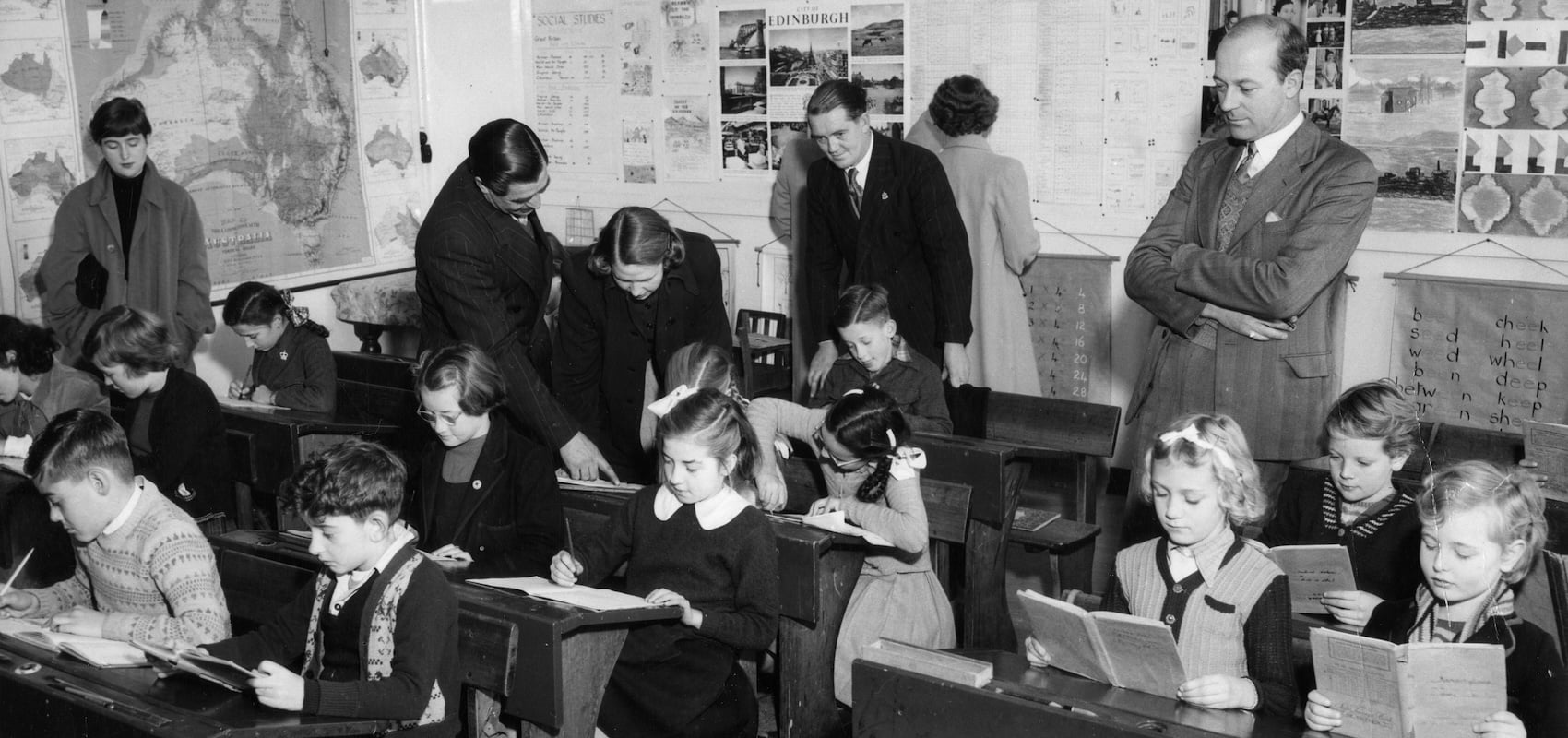
Image by Public Record Office Victoria, licensed by Creative Commons. Image cropped.