

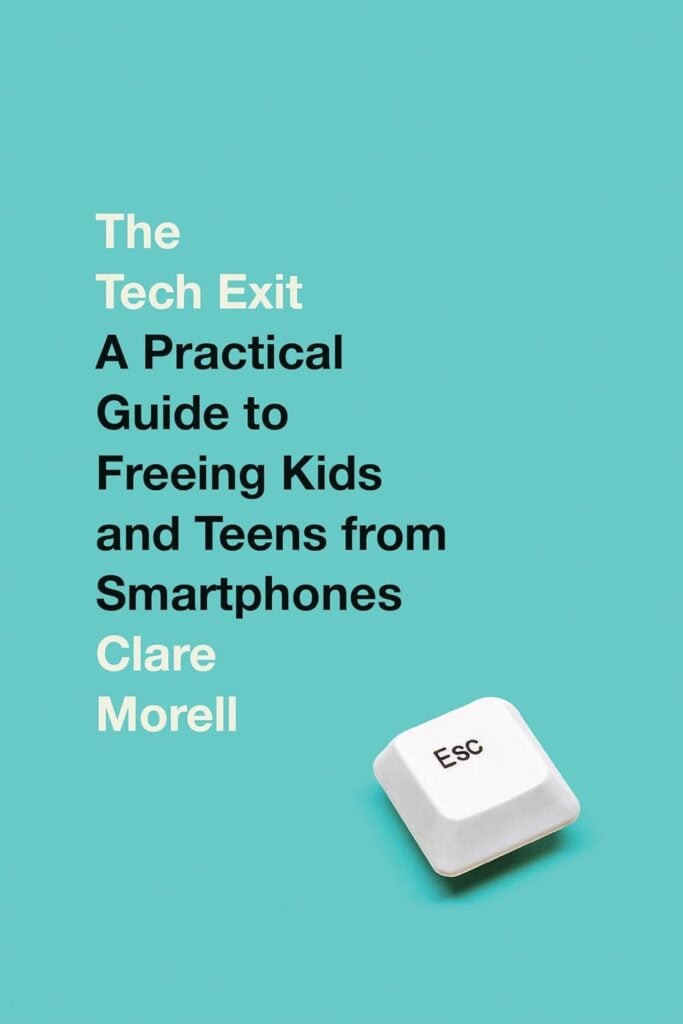
The Tech Exit:
A Practical Guide to Freeing Kids and Teens from Smartphones
by clare morell
penguin random house, 256 pages, $27
Is there a life beyond the screen? In 2010, Nicholas Carr’s The Shallows described what the internet was doing to our brains. Although still relevant today, Carr’s book came on the scene before two major events: the rapid proliferation of smartphones and the explosion of social media activity. In 2024, Jonathan Haidt’s The Anxious Generation showed that these new developments had fueled dramatic increases in rates of depression, anxiety, and other mental health issues in Gen-Z teens and young adults—and left many unable to conceive of a life that isn’t saturated by screens.
Silicon Valley, we have a problem.
Clare Morell’s The Tech Exit is strong on solutions and strong on hope. Morell begins by laying out the problem, taking aim at two powerful myths in our culture, myths widely repeated because they sound so reasonable. The first is that if technology is harming your child, you can remedy the situation with screen-time limits. Children can use screens less—an hour a day, for example.
As Morell points out, time limits simply don’t work. Teens crave social acceptance and peer approval, and these cravings are only amplified by screens. Moreover, digital experiences can make the real world feel so unbearably dull that, even after only a little time online, kids will keep longing to return to their devices. The result? Parents who try to enforce screen-time limits “are constantly having to stand between a drug-dispensing machine and an underdeveloped brain. It’s an untenable, exhausting situation.”
The second myth: Parental app controls are effective at limiting kids’ access to harmful online content. Morell demolishes this fanciful idea, pointing out that it’s often easy to find work-arounds and loopholes. She recounts how one boy circumvented a parental monitoring app on his phone by going into the app itself, clicking on the Support button, and then searching for porn from within the browser that opened up.
And Morell reminds us that kids don’t even need to go looking for explicit material. Social media is a conveyor belt for content so dehumanizing, violent, and grotesque that “the porn children view today makes Playboy look like an American Girl doll catalogue.”
Though The Tech Exit includes some disturbing and tragic stories, refreshingly it focuses not on digital harms, but on reclaiming a life free of screens. Freedom begins with what Morell calls the “fast”: a total screen detox. In a culture such as ours, which operates according to the Rule of Tech Ubiquity—technology anywhere, anytime, for anyone, to do anything—complete withdrawal may be a daunting proposal. There are nuances and exceptions in Morell’s approach, but the initial prolonged period of abstinence is essential if we are to discover who our children are.
The first couple of weeks, Morell concedes, can be “hell,” with kids upset or distressed that they can’t use their screens anymore, and parents having to spend far more time with their children. (Five hours of Monopoly a day, anyone?) But as one mom observed, once tech “gets out of their system and if you hold your guns, you will see these versions of your kid that you’re like, ‘Well, if I had known this, I would have done this forever.’”
The core of Morell’s prescription is not the fast but the FEAST—her acronym for five basic commitments toward reclaiming a low-tech life. Find and connect with likeminded families; get buy-in from kids by explaining and educating them on the harms of digital tech, and exemplifying healthy tech use; adopt alternatives to smartphones; set up accountability and screen rules; and trade screens for real-life responsibilities and pursuits.
Morell emphasizes that families cannot be islands of tech resistance, but must join with other families in their neighborhoods and schools. This gives parents allies and kids friends who aren’t on screens. Some families sign on to a version of the Postman Pledge (named after Neil Postman, the media critic), formally affirming their commitment to limit their tech use and build a new community ethos. Specific tech-reduction strategies include: having a landline at home; replacing smartphones with “dumb phones,” with only call and text options; giving children not just chores, but “adult” responsibilities such as cooking and shopping (or home repair, we would add); encouraging play in nature, walks, reading, board games, crafting, music, journaling, and tinkering.
All that might sound ambitious, but our impression—having lived as a low-tech family for twenty years—is that Morell’s approach is realistic and her hope well-founded. Some reviews of The Tech Exit have accused Morell of idealism, as if she assumed that life will be perfect once the screens are gone or greatly minimized. This is a misreading. If anything is unrealistic, it is the conventions of contemporary parenting.
Many years ago, long before we had our own children, we attended a christening. It was a solemn liturgical ceremony, as high as high church can get, except at the end, when the priest passed the swaddled infant back to the husband and wife and casually remarked, “Good luck with your project.”
It sent a chuckle through the congregation. It seemed just a quip at the time, but now, as we look back at that event a quarter century ago, we can’t help wondering whether the priest meant something more. Our culture, then, was drifting from a traditional view of family, which emphasized parental responsibility and self-sacrifice, toward an emphasis on parents’ personal fulfilment.
The same attitude was transmitted to children. The result, today, is “acceptance parenting,” whose central mantra, as Mary Harrington has written, is: “I don’t mind what you do. I just want you to be happy.” If so much of what we do and makes us happy and fulfilled emanates from a screen, then the idea of a screen-free or low-tech life remains—for many parents and their children—an unfathomable proposition.
The Tech Exit doesn’t address this foundational change in our culture. It assumes that parents will gladly take on the duty of instructing, guiding, and setting rules—such as “no private tech use” during childhood. This assumption doesn’t negate Morell’s message, but her approach might resonate primarily with parents who are comparatively traditional or authoritative in their parenting styles.
For these parents, at least, a low-tech existence is not just possible, but fruitful—a life in which children play outside together, a life of music and games and homes full of books, where “screen entertainment is a rare treat, not a daily occurrence, and where parents might decide to equip their teenage son with a pickup truck rather than a smartphone.”
The closing chapters of Morell’s book shift from ground-up FEAST solutions—what we as parents and families can change—to top-down solutions: how our laws and policies need to change. For instance, kids can easily lie about their ages in order to access adult content. Our age-verification law is useless, almost by design. Meanwhile, a law known as Section 230 is so abysmally written that internet companies face “absolutely no consequences for promoting child sex abuse material”—even if it results in the sex trafficking or death of children.
What keeps our laws so impotent? Morell, as a former adviser to Attorney General Bill Barr, writes: “Often as a bill gets close to getting a vote, either in Congress or in a state legislature, Big Tech swoops in with their armies of lobbyists and lawyers, an incredibly organized machine, and mounts a tremendous pressure and intimidation campaign to scare lawmakers away or buy them off.” Nevertheless, this is not a fatalistic book. Its last section, in particular, offers feasible pathways for change that can be implemented by schools, school districts, and entire towns.
Brad East has observed that when Christians write about technology, they tend to rehearse truisms: “God is the source of all creativity; God made us to be makers; any tool can be bent toward sin or gospel service; what we need are wisdom and virtue and good habits.” This sentiment, when applied to smartphones, is like printing a holy icon onto a pack of Marlboros and expecting teen smoking to serve the good, the beautiful, and the true.
Still, worldview matters. Our ultimate beliefs—those that declare the “first things” of life—shape our values and behaviors. Even the best tech books are often reluctant to acknowledge this point. The illuminating chapter on spirituality in Jonathan Haidt’s Anxious Generation is about psychological feeling and spiritual practice more than existential beliefs. In the final pages of The Tech Exit, Morell discusses Maslow’s self-actualization theory and our need to transcend ourselves by “focusing on things beyond the self like altruism and spiritual awakening,” but again the theme is individual growth.
So, although Morell demolishes popular beliefs around screen-time limits and parental controls, she sidesteps a conversation about ultimate beliefs. Yet just as her strategies and practices make sense only within a certain model of parenting, the FEAST to which The Tech Exit points us—real relationships and pursuits in the real world—makes sense only within a worldview that gives primacy to these domains.
Could Christianity serve as this model? It might, depending on how we frame the model, and assuming we go beyond vague and watered-down recommendations about the use of our God-given powers of creativity. There are more vital imperatives to consider. We are commanded to be stewards of the primary things God made. Above all, we are commanded to love God and each other.
Certain corollaries follow. We cannot allow virtual reality to become more important than physical reality; we cannot allow an impulsive or emotional attraction to social media or AI to become more important than our relationships of love and self-sacrifice to real people. And if technological innovations interfere with the primary imperatives, then the innovations must be rejected or radically modified.
Not everyone will agree with this application of the Christian worldview. But only an encompassing worldview can provide a foundation for our tech-reduction strategies. Without a foundation, individual strategies become ideas on a checklist, difficult to sustain amid technological and social pressures.
The Tech Exit speaks to parents who want to save their children from the digital universe. In this way it taps into the love of mothers and fathers for their sons and daughters. A parent’s love is a powerful motivation, but not everybody is a parent or a child. Our whole society would benefit from a more principled approach to technology use.
When it comes to managing our screens and devices, the only consensus, so far, is that if our tech makes us suffer badly enough, we should stop using it. But why make suffering the motivator? We have just undergone an uncontrolled global experiment in what smartphones and social media can do to the mental health of our kids. AI is now enticing those same kids, and us, into a new rat cage. But we are not obliged to plunge into another reckless experiment.
Morell concludes her book with these words: “Removing digital tech from childhood is the first step, but the far greater task ahead of us is to reclaim true human flourishing.” Quite so. This ambitious and essential book throws open the door to reality. Do we have the courage to step through?


YOU MIGHT ALSO LIKE
A Fully Human Approach to Finance
A conservative after action report on the struggle against woke corporations might highlight banks abandoning net zero…
Combating Vice
In my lifetime, American society has been transformed by widespread accommodation of vice. Marijuana has been legalized…
Announcing Portico: A New Literary Quarterly
First Things is pleased to announce the publication of its new print literary quarterly, Portico, starting in…
