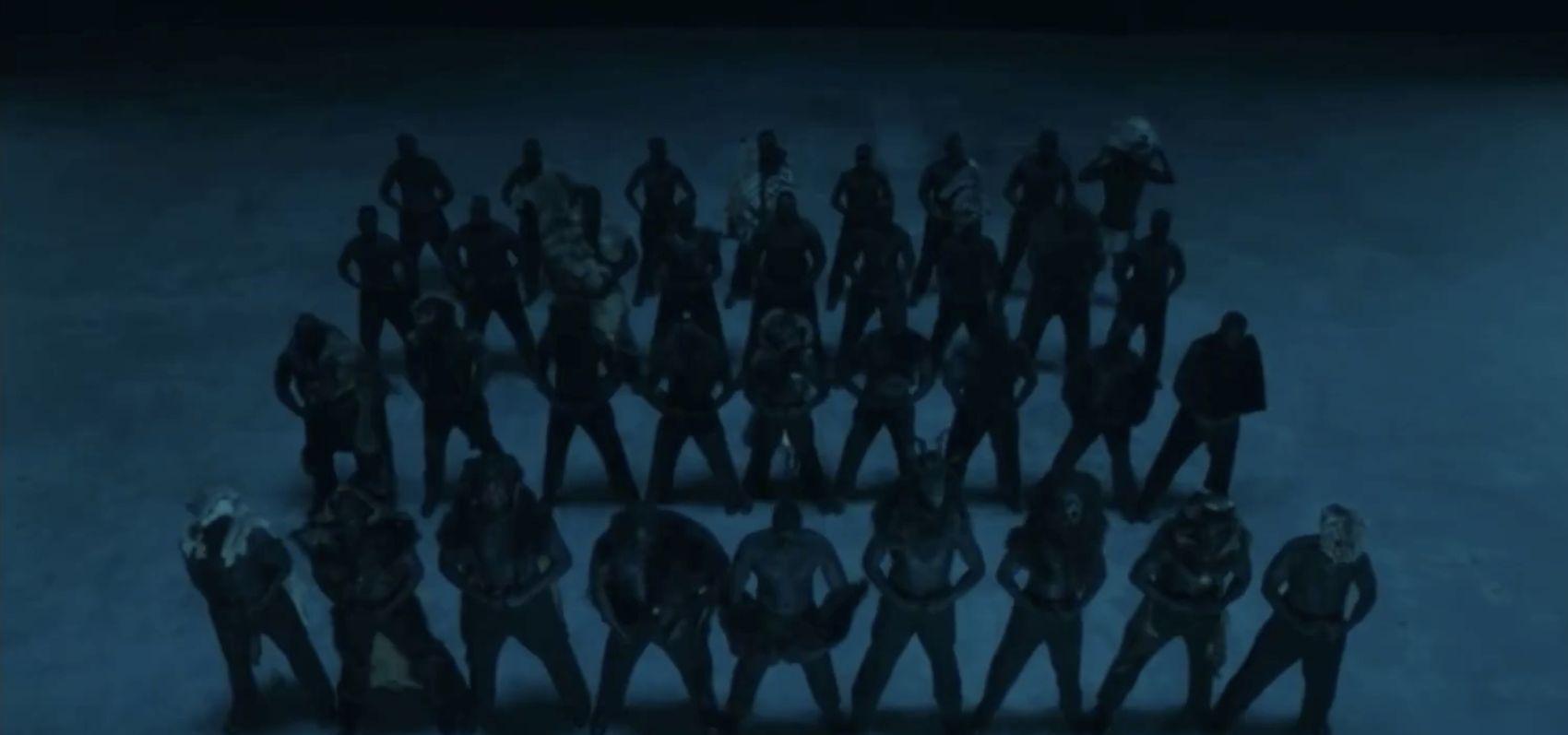
Last year, Kanye West—sometimes known as Ye—released a song titled “Nigga Heil Hitler.” The music video featured rows of black men bathed in blue light fiercely intoning the title phrase. Spotify, iTunes, and YouTube all refused to carry the track. But it spread rapidly on X, and the New Yorker’s music critic reluctantly described it as “in some way compelling.” In terms of both catchiness and cultural impact, it exceeded Cameron Winter’s “Love Takes Miles,” Pitchfork’s top song of 2025.
“Nigga Heil Hitler” was the culmination of a long string of incidents in which West expressed his admiration of Nazis and distaste for Jews. The tone was set in October 2022, when he tweeted, “I’m going death con 3 On JEWISH PEOPLE.” In a subsequent interview he declared, “I am a Nazi”—making his interviewer, Alex Jones, visibly uncomfortable. Taking his long-standing preoccupation with fashion into new territory, West started wearing a swastika tee.
Now he regrets all that. In January, he took out a full-page ad in the Wall Street Journal addressed “to those I’ve hurt.” He blamed bipolar disorder for impairing his judgment. “In that fractured state, I gravitated toward the most destructive symbol I could find.” His note received a guarded reception. But its argument was one that the music industry and countless fans had already accepted. West was reassuring the public that his tirades against Jews and glorification of Hitler had nothing to do with the rest of his art. That was exactly the position of the platforms that had banned “Nigga Heil Hitler” while continuing to stream the rest of his catalogue.
But there is another way of understanding West’s outbursts—as not a departure from the rest of his work but a logical extension of it. From the beginning, West has prided himself on overstepping boundaries. “I’m about to break the rules,” went a line on his first album. And it was true. Each new album stretched the limits of hip-hop. At the same time, West tested public patience during run-ins with George W. Bush and Taylor Swift. As the writer Elliot Kaufman noted in the Wall Street Journal, West had a “nose for transgressive energy.” This is what elevated him from hip-hop producer to bona fide rock star.
West’s first album, The College Dropout, set the pattern. It was released by Roc-a-Fella records, whose MCs cultivated an aura of street-smart invulnerability. West rejected this formula. He instead rapped as a pink-polo-wearing preppy with a weakness for embarrassing self-disclosures. He sensed that gangsta conceits had lost their transgressive value and had to be cast aside. His rejection of genre constraints was most obvious in the single “Jesus Walks.” A propulsive gospel number, it brought an earnest religious message to unsanctified frequencies like New York’s Hot 97.
As other artists began to imitate West’s signature production methods, he moved on. “How many more sped-up soul samples do you want?” he said while working on his second album, Late Registration. “We gotta push the envelope.” Time and again, this impulse would lead him to challenge his listeners with unexpected sounds. Years later, amid one of his many controversies, West posted a quote on Instagram about “the persecution of the artist who is trying to be at the avant-garde.” No matter the cost, West would be on the cutting edge.
The extent of West’s ambition became clear with his third album, Graduation. He didn’t want to be a mere MC. He wanted to be a rock star. This was not just about filling stadiums (though West hoped to do that with catchier numbers and simpler lyrics); it was about a particular vision of freedom. It meant having to respect no law, just or unjust. It meant doing whatever one pleased. “Rock stars can pull their dick out in public and then go rock 20,000 people,” West told Rolling Stone. “Rock stars can give their f*cking opinion without having to deal with . . . what’s that thing I get dealt with every day of my life? Oh, yeah. Backlash.”
West’s desire to overstep all limits was apparent in later albums. He dubbed himself “Yeezus” and declared, “I am a God.” His braggadocio was mixed with self-accusation, most hauntingly on “Runaway,” a single from My Beautiful Dark Twisted Fantasy. But however ready West was to express regret after the fact, he was unwilling to restrain himself. If being a rock star meant breaking the rules, that is what he would do—more committedly than any rock star ever had.
At each stage of his career, West defied expectations by taking up markers of white identity rather than leaning into conventional images of blackness. This was already evident in his preppy image at the time of The College Dropout. It became more explicit in his video for “Bound 2,” a single from his sixth album. West appeared in two layers of plaid and rapped not before an urban scene but over images of Monument Valley and El Capitan. As West’s biographer noted, this fantasia was “inspired by white trash T-shirt imagery.” At a time when hipsters were adopting trucker hats and taxidermy as signs of countercultural authenticity, West likewise turned to white-coded things.
Over time, West’s repurposing of whiteness became more confrontational and extreme. In 2013, he declared himself a “black skinhead.” In 2025, he gave an interview while wearing a black klan hood and robe. West’s denunciations of Jews reflected these dynamics. Anti-Semitism was hardly novel in rap, but West didn’t lean on the Nation of Islam conceits used by other black artists. He instead employed the imagery of the Third Reich. In doing so, he joined a long—and overwhelmingly white—tradition of rock and roll stars.
Almost from the beginning, rockers have been fascinated with Nazi symbols. In 1964, fresh off the debut of “A Hard Day’s Night,” John Lennon gave a sieg heil to adoring fans from a balcony in Liverpool. The scene brought to life a self-portrait he had drawn when he was a student at the Liverpool College of Art, in which he gave the Nazi salute over the legend HEIL JOHN. In 1965, Mick Jagger sieg-heiled his way around a stage in Berlin to the strains of “Satisfaction.” A year later, Jaggers’s bandmate Brian Jones sported an SS uniform in a magazine photoshoot, his gleaming jackboot poised to crush a helpless doll.
In 1973, KISS incorporated Nazi iconography into its branding, rendering the two s’s in the band’s name with the double-bolt Schutzstaffel insignia worn by concentration-camp guards. Some felt there was a truth behind the typography. “Rock stars are fascists,” David Bowie told Playboy in 1976. “Adolf Hitler was one of the first rock stars.” Germanic umlauts and Fraktur font became heavy-metal clichés.
Punk reasserted the rebelliousness of rock—and embraced Nazi imagery. Decades before Kanye West, Sid Vicious of the Sex Pistols wore a swastika tee. Punk queen Siouxsie Sioux performed in little more than a Nazi armband. Her sexualization of Hitleriana was carried forward by Madonna in a video for “Justify My Love” and by Lady Gaga in a video for “LoveGame.” More recently, the leader of the K-pop act BTS (50 million albums sold) has been photographed in a Nazi cap.
West’s tirades against Jews cannot be understood apart from this history. While they certainly reflect an unbalanced mind, they also reveal a man taking the transgressive logic of rock to its natural end point. As the music writer Daniel Rachel has observed, rock’s fascination with Nazism reflects its need to be “rebellious and boundary-pushing.” West perceived that other rock conceits—sex, drugs, blasphemy—were no longer taboo. The only way to assert rock’s rebellious nature was to lean hard into the Nazi fixation shared by many of the genre’s stars. So West put on a swastika and extended his arm. Then he went a step further and endorsed Hitler’s attitudes toward Jews.
More people are taking the logic of transgression to the same place Kanye West has. Some merely play with Hitler jokes; others take them seriously. At some point, the ironic pose hardens into a stance. This dynamic will continue until the transgressive ethic of rock—an ethic that pervades our culture—is replaced. The Nazi memes are getting old. Rather than a culture of rebellion, we need one that prizes submission to the good.