When I converted to Catholicism in 2023 after eighteen months of RCIA, I was almost totally ignorant of the mortal sins I would need to confess before taking communion. My RCIA priest had said that we were required to confess once a year, or any time we’d committed a serious sin. The sins that struck me as serious—theft, murder, trafficking—were too outré to be relevant to me, and the topic was dropped. He probably also said that confession could be “very beautiful,” but I retained a sense that it was optional and a little weird, something people didn’t really do anymore. The word “required” is itself meaningless to a secular liberal American used to making her own decisions about her personal life. It was only by accident that I learned, a few weeks before my baptism and confirmation, an item of enormous practical significance to my future: As a divorced woman, I wouldn’t be allowed to remarry, and if I did so, I’d be barred from receiving the Eucharist.
I now know that my experience was representative of the murky conflict within the Church over liberalization—for liberalization has occurred primarily not through changes to the doctrines on sin, but through the deemphasizing of sin and of the institutions for its control, such as confession. My RCIA experience was not atypical; some parishes are more explicit on these points, but many are not. I’ve also encountered younger Catholics who say that, despite growing up in the Church and attending CCD through confirmation, they were never taught about sin or the necessity and mechanics of confession. I’m doubly on the flashpoint, because remarriage is currently the next frontier of liberalization.
Proponents of this settlement wish to make the faith more welcoming to people with modern values or in difficult life situations. I am a blue-stater and sex-positive child of the sexual revolution, and a struggling mother of teenagers, living post–civil divorce. My religious conversion experience strongly suggested to me that this church was the one I should turn to, but to approach Catholicism was to override a lifetime’s opposition to many of the Church’s positions. If I’d understood more clearly what those positions were, I would have opposed them even more strongly. In this sense, there was wisdom in my RCIA priest’s welcoming, intellectual approach, which discussed love, friendship, the Trinity, religious art, and the role of the Church in the world, and didn’t tackle controversial topics. Had I been presented with a harsh and incomprehensible list of sins upon first meeting, it is possible (perhaps, if we discount God’s agency in the matter) that I would have shrugged and looked elsewhere.
But I didn’t, not even when I learned that my Catholicism was about to enter mortal conflict with my heart’s other great desire, which was to form a new romantic partnership. And since my conversion, unfortunately for my heart’s desire, the most rewarding, intellectual, generative, and faith-deepening parts of my Catholic experience have involved engagement with dogmatic teaching on sin and the practice of confession—the strict Church, not the tolerant one. It has been lovely to meet the members of my RCIA group and to make church friends. The spiritual feeling of attending Mass is enjoyable. But these have been only small parts of the offering. Without sin and the relationship between the Eucharist and confession, I’m not sure what I would have been doing all this time or how I would have grown.
So what happens when a person with secular liberal values concerning sexuality—this, mostly, is the controversial part—has a good-faith encounter with modern Catholicism? First, it’s very difficult to get information about what the Church actually teaches and requires. When I first discovered the prohibition on remarriage, I made an appointment to discuss it with my priest, a wonderful man who has greatly influenced me and had already become a friend. Before the meeting, I observed that this restriction contradicted what I saw all around me. We had openly cohabiting unmarried couples in RCIA. I knew remarried people who’d seemingly been devout Catholics all their lives. Everyone at Mass on Sunday seemed to shuffle up front, and surely they weren’t all without sin. I expected my priest to confirm that the rule was a technicality, or a matter of personal conscience, but I found him unexpectedly firm, which landed me in delicate territory. What had seemed an obvious point—that no one was really doing this—suddenly became taboo.
I asked a few questions about this restriction—such as “But what about unmarried couples with children?”—and received unworldly, incomprehensible answers, such as that they might live together “like brother and sister.” This seemed like the old, sex-fearing, woman-fearing Catholic Church we know from the newspapers, but I didn’t want to say that to my priest, nor did I want to insist on the value of physical intimacy to a celibate man. Women are in an especially uncomfortable position in such conversations. I left confused, plagued by wild speculations. Could I have regrettable casual sex, a sin that could be honestly confessed, forever, and still take the Eucharist, but not form a stable partnership? What kind of system was that? I also felt some indignation. The Church proposes to regulate our sex lives but won’t create the conditions in which to talk about it?
For me, the uncertainty led to a search for more answers. By an incredible coincidence spanning the Vatican City and rural Vermont (or by divine intervention, if you wish), I made a new friend, a militant young priest whose challenging preaching about sin made it seem possible to challenge him in return. He provided me with an old-fashioned examination of conscience and explained the theory of “unitive and generative” sexuality. This was another excruciatingly awkward conversation, and it revealed concepts even more outrageous in view of my former value system, but we got it done. Again I went away horrified, but this time I had a lot to think about, and more importantly, I had something to do. I would have to look at the list, understand it, and then blow it off or not, confess or not, take the Eucharist or not. My conscience was engaged, no longer in the misty way wherein I hoped for opportunities to love my neighbor or make charity a greater part of my life, but in a daily struggle with questions on much more than sexuality. Was I really supposed to pray every day? And keep Sundays free of heavy labor? Such practices didn’t fit modern reality and seemed weirdly legalistic and too small to be relevant—gardening on a Sunday is a sin? This is dumb. Yet there it was, on the list.
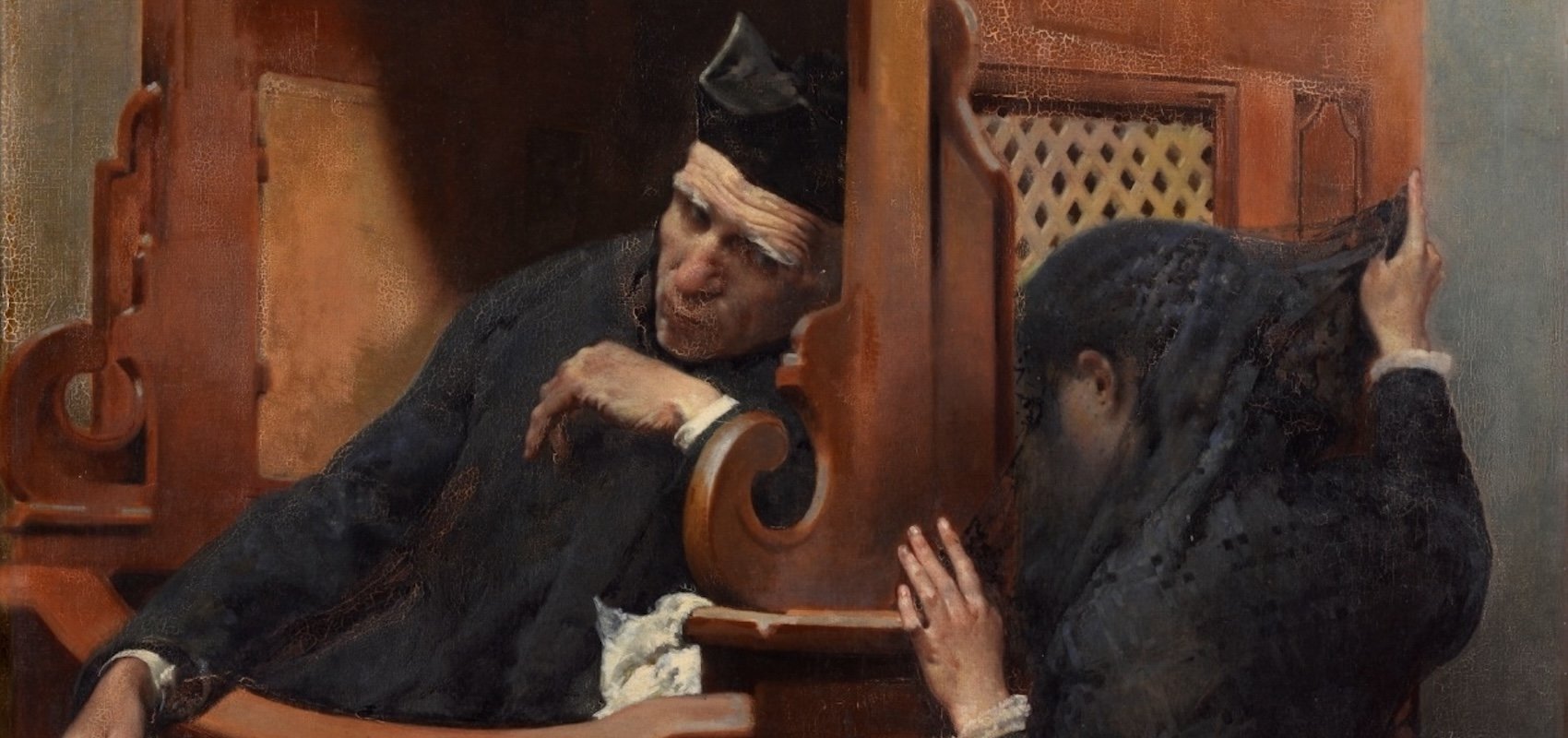
I started going to confession (a saga of its own in a big, busy city with few available hours and a crazy-quilt of procedures). I couldn’t not, once I knew it was required of me. I had an inner voice, and I listened to it. I more or less confessed to the sins on the list, and when I didn’t really think they were sins, I confessed to doubting the word of the Church, too. Slowly I began praying for something my rational mind did not want, which was to actually believe this stuff. I can’t pray to be single forever; it goes too deeply against my heart. But I can pray to do Christ’s will instead of my own, so I pray for that. I didn’t take the whole list seriously all at once, nor did I always recognize all of the sins as sins, and I probably still don’t, but over time I’ve understood more. And I started modifying my behavior, not because I was fully convinced, but because I wanted to take the Eucharist, and it was inconvenient to have to confess.
None of this has been easy, morally or logistically. I’m free of mortal sin and able to take the Eucharist around once every six weeks—not a great record. But it has been profoundly, almost comically rewarding. People with active prayer lives know the way prayers are answered, and the way answered prayers provide new signposts toward the good. I would likely never have learned this if I hadn’t been prompted to daily prayer by the examination of conscience. And people who make some attempt to keep their Sundays free for God know the lovely Sabbath feeling of a clean house and a waiting heart on Saturday night (or the pleasant, lazy feeling of blowing off all work till Monday). In fact, every time I’ve overcome my own will and prejudices to try one of the list’s impossible demands, revelation has followed, offering deeper faith, spiritual insight, and often bizarre and unexpected real-world rewards.
The Church’s restrictions on sexuality have been the most difficult teachings for me to consider—they’re such a radical departure from my former standards. To tell people what to do with their own bodies, and then to police them on it, feels like a violation of human dignity from a sex-positive perspective. I was taught as a child that what the Church calls “self-abuse” is an act of self-respect and self-care, the foundation of a healthy sexuality. And for my whole life, the free expression of one’s sexuality has been both an impassioned cause and a human right. It’s the restraint words that seem grotesque to me: modesty, chastity, celibacy. I have been to sex parties and seen endless pornography, and would discuss either with glee in the right company, but in most social situations I’d be actually ashamed to talk about sexual restraint.
Yet the more I’ve considered the “unitive and generative” approach, the more it seems to solve many of our vast social problems by drawing a clear line in the only place where it can reasonably be drawn. And it conflicts less than expected with the deeper underpinnings of my former beliefs. As a secular person, I was sex-positive because I thought sex was very, very important, perhaps even a window onto the sacred. Reordering one’s vision of sex around a utopian ideal, as the Church demands, isn’t really such an outrage, especially in a world where so many people seem unhappy, damaged, and isolated in their sexuality, and where the results of liberalization have become increasingly toxic. Moreover, when I learned the hidden truth about the Church’s restrictions for all people, it made what had seemed like a double standard for gay people much more palatable. The half-measures in communication are underselling a beautiful doctrine.
As for the painful issue of remarriage, so far I’ve made the uneasy compromise of occasionally dating while also beginning proceedings for a hoped-for annulment. I pray that someday God will bring me a man with whom I can have a legal union from the Church’s perspective. Even this is a huge change from my previous plans—I used to joke that I’d be a serial monogamist forever—but I’m trying, however imperfectly, to submit my will to Christ’s. Like my other attempts, it has been beneficial. Reorienting my thoughts toward remarriage has had a wonderfully clarifying effect on my romantic encounters and has revealed just how carelessly I’ve treated other people, and myself, in the past. To me it seems that these onerous rules, when taken seriously, force us into an inner alignment with things we, in our deepest hearts, already knew. We resist. We insist on our own will and that we know what’s good for us, which is a breathtaking assertion, really, when you consider how much pain most of us bear. And so often we’re wrong.
It is this Church, and only this Church, that rolls up its sleeves, militantly and gently, offering the lists, the booths, the men on duty if you need them, the long slow interplay of experience and self-examination, aided by prayer and the promise of the Eucharist as a reward. Confession is beautiful, despite the difficulties. More converts should be aware of it.