
Donald Trump’s 2016 presidential campaign was powered by its embrace of the white working class. It also drew energy from its rejection of feminist conceits. While critics charged Trump with racism and misogyny, his supporters reveled in official obloquy, gleefully accepting Hillary Clinton’s epithet, “deplorables.” When he stood for a mugshot in 2023, Trump’s outlaw appeal was underlined. His initial rise and later return to office suggested that, in a society devoted to feminism and diversity, whiteness and masculinity possess a countercultural energy.
Unwelcome as this suggestion may be, it is by no means novel. The phenomenon of millennial hipsterism anticipated Trumpism in its embrace of white and masculine cultural markers as signs of countercultural authenticity. Because so many hipsters were scrupulous liberals, the connection is easy to overlook. But tracing the evolution of hipsterism clarifies why Trumpism, ostensibly a backward-looking political formation, has entered the cultural and political avant-garde, while liberal America races to catch up.
The term “hipsterism” gained currency in the 1940s to describe a black subculture that was noted for its love of jazz, snappy style, drug use, and jive talk. The critic Anatole Broyard offered the classic description in his 1948 essay “A Portrait of a Hipster.” He described how the black hipster emerged as a figure of countercultural appeal, whose violence, instinctiveness, and outlaw stature accorded him prestige and authenticity. In Broyard’s words, the black hipster was a “creature of the darkness” who lived in a world where “bold acts of consequence occurred.” The hipster channeled the forces mainstream society sought to suppress: sex and aggression. He also had an alternative form of knowledge, what Broyard termed “a priorism.” His jive talk was a secret language. It provided him and his fellow initiates with an alternate source of authority, independent of the broader society that in many respects denied them their rights.
All this appealed to intellectuals living in Greenwich Village. They sought to escape a worn-out bourgeois society but worried that they were themselves compromised and impotent. The black hipster offered them access to an alternative source of authority, one more primitive and authentic than the culture of the organization man. For these intellectuals, the black hipster was, in Broyard’s words, “the great instinctual man, an ambassador from the Id.” He became the arbiter of taste. He was asked to listen and read, to tell the intellectuals whether what they did was real or fake.
Norman Mailer celebrated these dynamics in his 1957 essay “The White Negro.” As he recognized, the countercultural appeal of the black hipster was a by-product of the prejudice and injustice African Americans faced. The very fact that they were excluded by the mainstream gave them insight into things the mainstream failed to see. “Hated from outside,” Mailer wrote, the negro was “forced into the position of exploring all those moral wildernesses of civilized life which the Square automatically condemns.” This pattern—of identifying with a despised group, taking up its manners and modes of dress as your own, in order to distance yourself from mainstream society—set the essential pattern for what we now know as hipsterism.
Hipsterism receded as a phenomenon until the 1990s, when it began its inexorable march toward conquering Brooklyn—and the world. Millennial hipsterism had much in common with its mid-century antecedent. As before, hipsterism was a phenomenon in which relatively privileged creative types sought access to a more authentic and instinctive form of life. But the source of countercultural energy was no longer the jive-talking, bebopping culture of the black Americans of the 1940s. It was white. Sometimes the reference point was rural (trucker hats, taxidermy). Sometimes it was white ethnic (the ubiquitous wifebeater). Sometimes it was suburban (faux-wood paneling, youth-league T-shirts, the trendsetting Lower East Side bar Welcome to the Johnsons, designed to look like a 1970s rec room). But the basic pattern was consistent. Millennial hipsterism evoked non-professional-class white culture, calling back to a time when the country was less diverse.
Millennial hipsterism’s celebration of non-professional-class whites was pioneered by an alternative magazine publisher named Jim Goad. Born on the outskirts of Philadelphia in the 1960s, Goad was a sensitive and literary young man. In time, he found his way into the punk scene, and from there into alternative publishing. He received a bachelor’s degree in journalism from Temple University, but he rejected the values of the university class. Along with his wife, Debbie Rosalie, he founded ANSWER Me!, a magazine that celebrated every offensive thing, from suicide to racism to domestic violence. Goad adopted an exaggerated form of lower-class white identity. Despite being from suburban Philly, he identified as a redneck.
The most controversial episode in the history of ANSWER Me! came in 1994. Its fourth and final edition, called the “Rape Issue,” was a celebration of sexual violence. Goad contributed an article titled, “Let’s Hear It For Violence Towards Women.” Adam Parfrey, an underground publisher, contributed the most substantive piece, an attack on Andrea Dworkin and Valerie Solanas. Solanas’s acclaimed “SCUM Manifesto” had called for male genocide, and she herself had tried to kill Andy Warhol. Goad suggested that the “Rape Issue” wasn’t simply an exercise in offensiveness, but an attempt to show that the violent rhetoric indulged in by radical feminists wouldn’t be tolerated if it were engaged in by men.
Not everyone welcomed these provocations. A prosecutor in Bellingham, Washington charged the owners of a newsstand with felony obscenity for selling ANSWER Me!. The ACLU rallied to Goad’s side, but he received nothing like the support from the liberal establishment that Andres Serrano or Robert Mapplethorpe did for their blasphemous and obscene imagery. As Goad intuited, something important was changing in American culture. “Transgressive” art that was coded as left-wing was achieving its own kind of respectability. Real transgressive energy was shifting from the left to the right, as an emerging progressive-feminist hegemony came to replace the religious conservatism that had once set the limits of acceptable speech.
In 1997, Goad published his best-known book, The Redneck Manifesto. It was a full-throated defense of “rednecks, hayseeds, bumpkins, crackers, hillbillies, peckerwoods, Bubbas, yokels, lintheads, shit-kickers, and poor white trash.” Goad argued that these people had become the one group in America it was acceptable to treat with contempt. Published by a mainstream press, the book was greeted respectfully—until Goad was arrested for domestic violence (an incident that would seem to vindicate critics of the “Rape Issue”). After serving time in prison, he drifted toward what would come to be known as the alt-right. His fierce belief in free speech and all-purpose political incorrectness took on a more ominous coloring when he stopped publishing an independent zine and began writing columns for Counter-Currents, an avowedly white nationalist magazine.
Despite all this, Goad retained his admirers. The liberal comedian Margaret Cho was a fan of ANSWER Me!. She gave a complete run of it to her friend Quentin Tarantino. Chuck Palahniuk, author of Fight Club, was an even more ardent devotee. In 2018, he recommended Goad in an interview with the Hollywood Reporter, saying, “My taste is for the extreme.” Patton Oswalt, the now ostentatiously woke comedian, was also praising Goad in interviews as recently as 2014. All of these people honed a transgressive edge influenced by Goad.
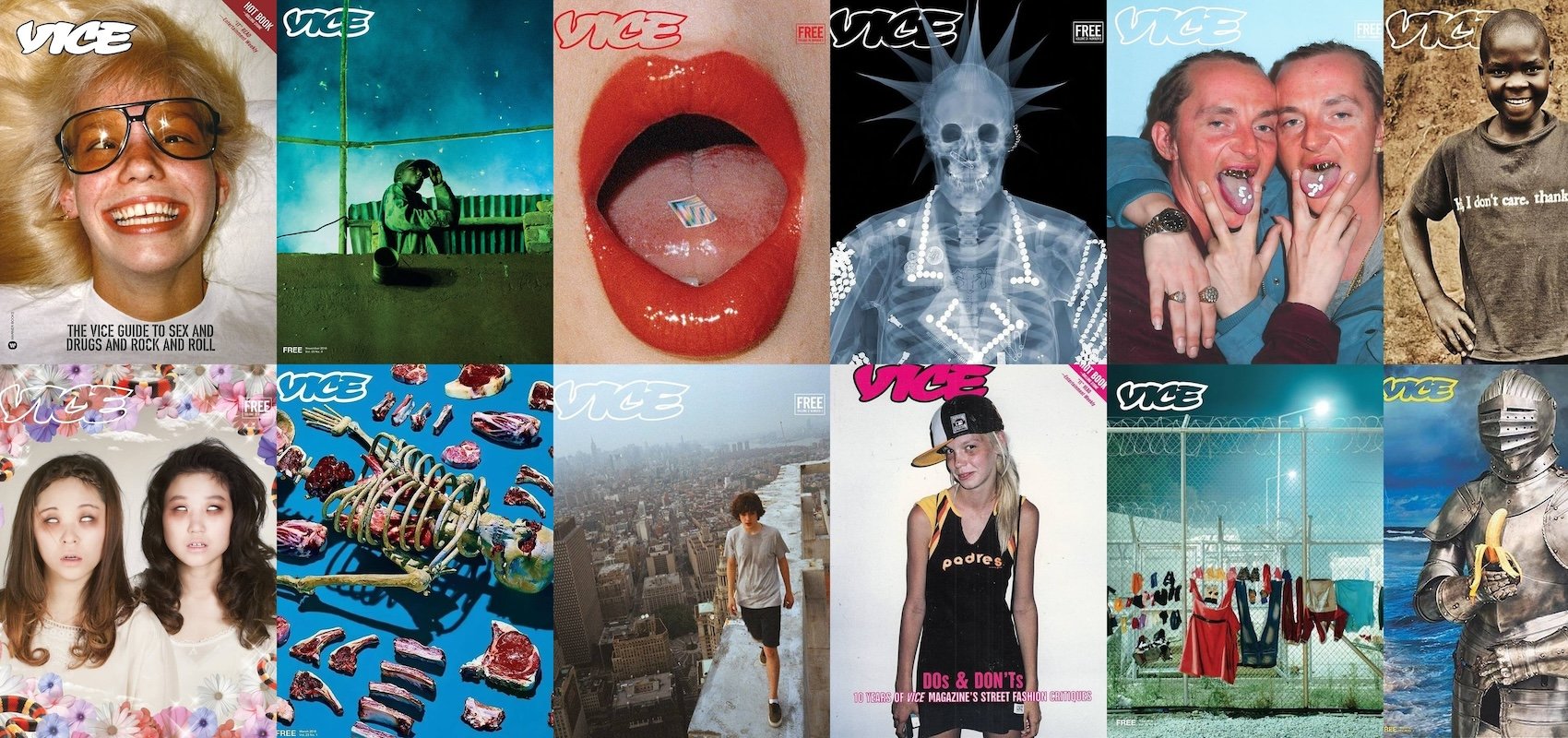
But Goad’s most important disciple was Gavin McInnes, cofounder of Vice, the magazine that defined millennial hipsterism’s aesthetic and cultural energy. Referring to his work at Vice, AdBusters described McInnes as “one of hipsterdom’s primary architects.” This is true, but the blueprint he used was drawn up by Goad.
Vice was founded in Montreal in 1994. Originally called the Voice of Montreal, it was a multicultural magazine published by two Haitians and funded by the Canadian government under a program meant to provide opportunities for welfare recipients. Suroosh Alvi, a Pakistani-Canadian drug-addicted welfare recipient, was recruited as its first editor. He brought in McInnes, who was also receiving welfare benefits. They quickly separated from their publishers and changed the magazine’s name to Vice, in an indication of their transgressive intent. McInnes set the tone. The magazine was ostentatiously politically incorrect, anti-feminist, and anti-anti-racist. As McInnes has said, ANSWER Me! “was the impetus for VICE MEDIA’s early fearless attitude.” Vice embraced white masculinity as a sign of authenticity.
It thereby established the pattern for millennial hipsterism more generally. As Mark Greif, a founding editor of n+1, has noted, “hipster values exalt political reaction, masquerading as rebellion, behind the mask of ‘vice.’” Hipster vice gave people oppositional energy “by going back to the imagination of the trailer park, and of Merle Haggard, as somehow embodying the kind of ritual power which you too can have access to—of a lower-class, a white ‘outlaw’ Other.” Significantly, this power was masculine. The stereotypical markers of hipster culture—shaving implements, work boots, whisky—are male-coded. Greif lamented “male domination of the [hipster] category.” But that was essential to its appeal. If the future was female, hipster fashion looked to the past.
The point here is not that every resident of Brooklyn was a closet reactionary. But Greif accurately describes the meaning and power of the cultural markers they were adopting.
Now, it might seem strange for a Canadian government–funded multicultural magazine intended to provide opportunities for people on welfare benefits to turn out right-wing. But Vice’s trajectory makes more sense when we understand that it was a response to rising diversity. Vice embraced a whiteness that was no longer hegemonic and so could seem countercultural. The journalist John Leland described the dynamic in his book Hip: “In cities that are now ‘majority-minority,’ . . . whiteness is no longer the baseline, something taken for granted; it’s something to be explored, turned sideways, debated for its currency.”
In 2009, a panel at the New School in New York City hosted by n+1 addressed the question, “What Was the Hipster?” In his report on the proceedings, Greif describes how the hipsters announced a return of whiteness to the diverse city:
The uncanny thing about the early-period white hipsters is that symbolically, in their clothes, styles, and music and attitudes, they seemed to announce that whiteness was flowing back in. Unconsciously, they wore what they were in structural terms—because for reasons mysterious to the participants, those things suddenly seemed cool.
Greif was right. Hipsters were the shock troops of gentrification, whites returning to places they once had fled. But Greif did not quite explain why, in this context, whiteness became cool. Why shouldn’t millennial hipsters have drawn on black modes and manners, as the white hipsters of Mailer’s day had done?
There is a simple explanation: the passage of the Civil Rights Act in 1964. That and corresponding legal changes removed the legal disadvantages once faced by blacks. Indeed, blacks became able to benefit from affirmative action, whereas their poor white and redneck counterparts could not. Supporting this legal change was a cultural consensus that presented rural whites as backward and bigoted, the enemies of progress. Meanwhile, criticism of blacks was limited by the strictures of political correctness.
Over time, these developments effected a transference of countercultural energy. The specific form of cool that blacks had once enjoyed, by virtue of the prejudice and legal disadvantages they faced, increasingly flowed to rural and working-class whites—whoever wasn’t down with the diversity machine. Just as white literati once adopted black modes and manners in an effort to seem avant-garde, black cultural figures took on the trappings of whiteness. Kanye West donned flannel shirts. Beyoncé released a country album. Kamala Harris handed out camo hats—but couldn’t match the outlaw appeal of the Trump campaign. Trumpism, like hipsterism before it, was a response to a dynamic first understood by the troubled, troubling figure of Jim Goad.



YOU MIGHT ALSO LIKE
Timothée Chalamet Is Right About Art (ft. Suzy Weiss)
In this episode, co-founder and reporter for the Free Press, Suzy Weiss, joins Virginia and Germán to…
Trump’s Civilizational Project
Secretary of State Marco Rubio spoke at the recent Munich Security Conference. Last year, Vice President JD…
Helene Schjerfbeck’s Defiant Paintbrush
Helene Schjerfbeck (1862–1946) did not go gentle into that good night. In 1944, war still raging, the…
