
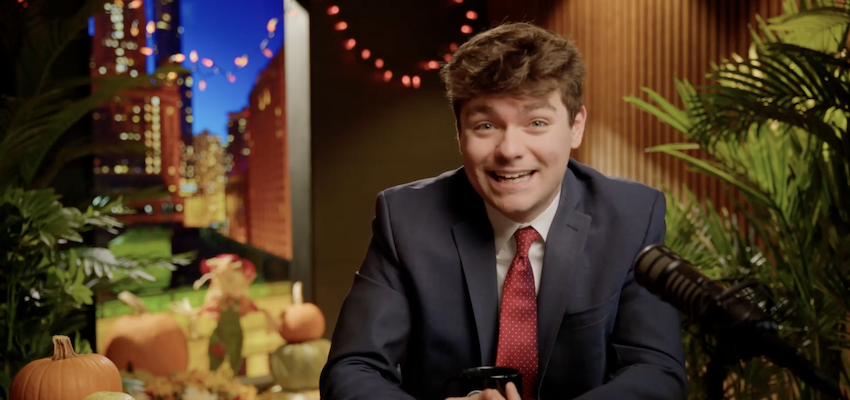
I was teaching an undergraduate colloquium on critical theory at the University of Notre Dame when the news broke of Tucker Carlson’s interview with Nick Fuentes. The timing was interesting because the colloquium’s final document for discussion was a 2023 Hedgehog Review essay by Malloy Owen. Owen traces the fascinating migration of critical theory—a family of philosophies often associated with the left—to the right of the political spectrum. Even a superficial glance at contemporary political discourse indicates the plausibility of this thesis. The rhetoric birthed by critical theory (“It is all about power,” “Established institutions are ineradicably corrupt and need to be torn down,” and “Everything you have been told is a lie”) is obviously no longer a monopoly of the left.
Owen mentions Carlson, although it may be generous to attribute his Fuentes interview to intellectual commitments. The gig media economy favors pundits who are prepared to transgress boundaries; their exchange had no real intellectual substance. The two men commiserated with each other over how they had been victimized by establishment conspiracies, and Carlson avoided anything approaching a question that might have challenged Fuentes’s well-documented views on the Jews and on Hitler. Indeed, even Fuentes’s claim to be a fan of Stalin merited no exploration. The interview was all very therapeutic and hardly a replay of Chomsky vs. Foucault. Yet it also revealed how some on the right are indulging in the same critical theoretical games as those on the left.
In 2021, at the height of the critical race theory controversy, I wrote on the topic for First Things. The reactions from other Christians were swift, extreme, and predictable: I was a racist, too evil or too stupid to understand CRT, and therefore to be anathematized. There was even a report of one Presbyterian minister threatening one of his congregants for merely linking to my article on Facebook. My rejection of CRT apparently rendered me guilty of supporting the allegedly systemic racism of the status quo, as if rejecting the use of gasoline as the appropriate liquid for extinguishing a fire rendered me complicit in arson.
I argued that Christians who embraced CRT rhetoric were committing themselves to a form of social criticism that would make them impotent in the face of LGBTQ radicalism, gender theory, and the like. It was the critical part, not the race part, that concerned me most. CRT, like other members of the critical theory family, involves a basic anti-humanism. At root it rejects the idea of human nature as a given, essential foundation for morality and human relationships. Post-structuralists are open about this, as Foucault’s famous debate with Chomsky illustrates. The early Frankfurt School was a little more coy. Being Hegelian Marxists, they projected utopian humanity into the future, though in practice this meant they could not articulate what it might look like. As Max Horkheimer said, “in regard to the essential kind of change at which the critical theory aims, there can be no corresponding concrete perception of it until it actually comes about.” In other words, critical theories, whether Foucaultian or Marxist, aim at the destabilization of the status quo with no substantial vision of what might replace it. They are practically anti-humanist.
Committed to such anti-humanism in the present, these approaches make “truth” a matter of taste, something with no transcendent, binding content. Carlson’s interview with Fuentes is a case in point. Its purpose was not denotative, driven by a desire to point to truth. It was connotative, with the purpose of creating a transgressive and iconoclastic vibe for the audience. Hence Carlson’s care not to challenge his guest about any of the views that had made him famous in the first place. And that vibe appeals to a fanbase made up of young men, not surprising in an era when that class has been so consistently maligned.
The vibe is also anti-human. Anyone who can speak about Jews—indeed, about any other member of the human race—as Fuentes does is anti-humanist, one who rejects the notion of humanity and the moral significance that such a concept involves. And when Carlson offers his guest a platform but no probing questions or substantial pushback, he himself is complicit in promoting this.
The usual suspects in the wider pundit world will no doubt be waxing eloquent about the evils of the right and the inroads of bigotry into the GOP. The whole debacle is a problem for the right, specifically the GOP, and indicates the growing influence of “groypers,” rightists who are as hardline as they are online. The usual erstwhile evangelical critics will surely be blaming it all on their fellow Christians who voted for Trump. But those pundits might themselves engage in some self-reflection, as the phenomenon is not a problem that can be explained using a simple right-left taxonomy. Anti-Semitism is a powerful force on the left but, unlike the response to Carlson’s interview with Fuentes, it has not been so loudly condemned on that wing of the spectrum. And the underlying problem is not anti-Semitism; it is the anti-humanism that pervades our culture and manifests itself most dramatically in racial identity politics. Critics of Carlson who have themselves previously denounced opponents of CRT as racists or used the preferred pronouns of male killers who happen to identify as women—in other words, critics who have themselves assumed key aspects of the nihilistic world of critical theory—might perhaps pause for a moment to ask if they themselves, and not ordinary Christians in the pew, are the ones really complicit in creating the cultural conditions that have made the likes of Carlson and Fuentes both possible, plausible, and popular.

YOU MIGHT ALSO LIKE
Will Trump’s Coalition Last? (ft. Joseph Prud’homme)
In the latest installment of the ongoing interview series with contributing editor Mark Bauerlein, Joseph Prud’homme joins…
War Without Limits?
Does the U.S.-Israel assault on Iran fill the criteria of Christian just war theory? A number of…
Lou Holtz and Our Lady on the Dome
Lou Holtz hated to lose at football. Texas A&M’s 35–10 victory over his Notre Dame team in…
