
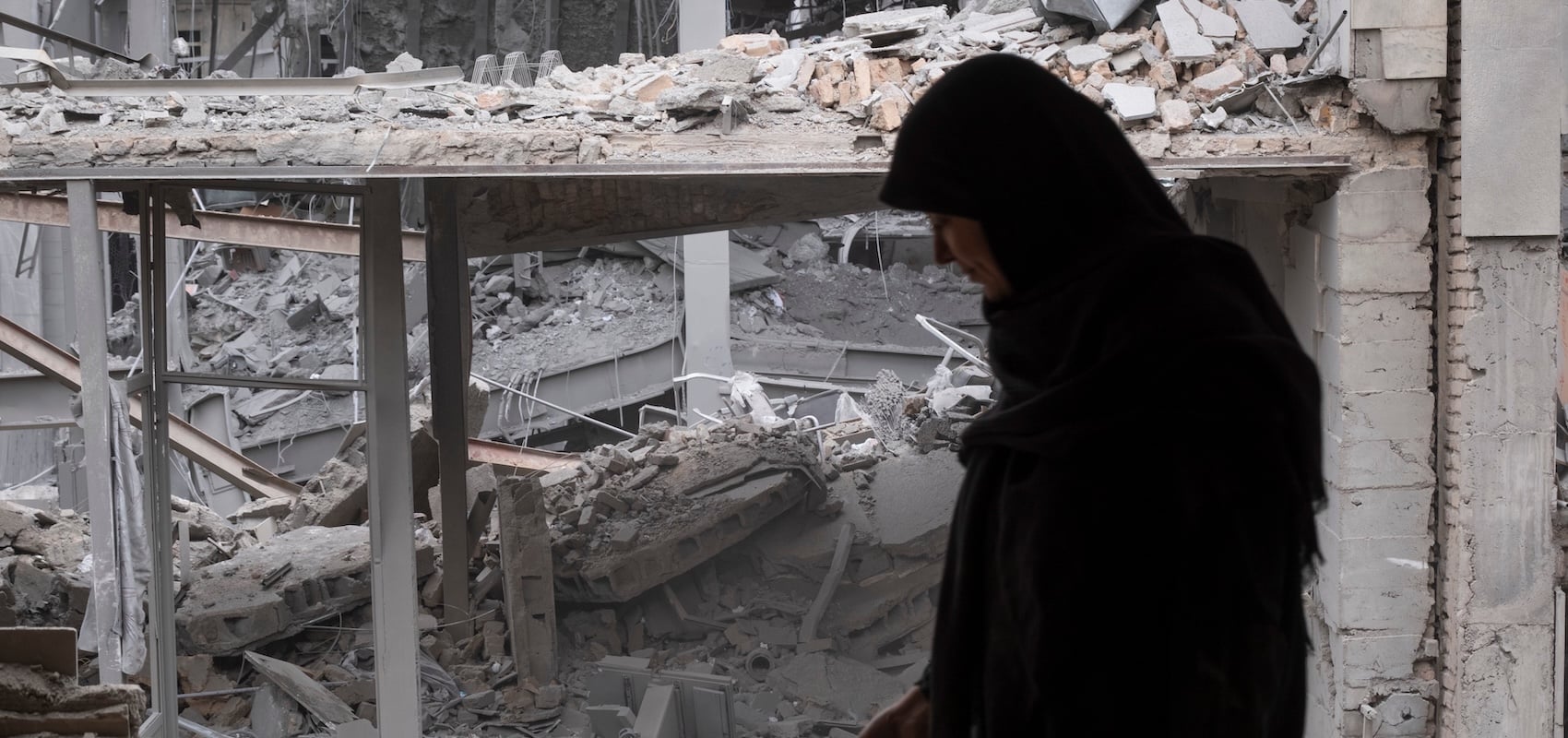
Nothing in human experience compares to the wars of the last 120 years. Their scope has grown as the world has shrunk. The international laws governing conduct in war have too often failed. Technology advances, and along with it war’s lethality and devastation. So war is bad. No one wants another war. Or rather, almost no one. More on that shortly. In the meantime, the question before us is whether the current U.S. and Israeli operations against Iran qualify as just. It’s a debatable matter. I believe they are. I understand the opposite view. But I also find it unpersuasive. Here’s why.
The United States and Israel didn’t start the current conflict. It’s merely the latest phase in a war that began in earnest forty-seven years ago; a methodical war of aggression pursued by Iran to erase Israel as a nation and defeat the United States as the world’s “Great Satan.” The Tehran regime now supports a global network of terrorist violence. In the process, since the 1979 Islamic Revolution, the same regime has murdered or sponsored the murder of scores of thousands of people, including many of its own citizens, the vast majority innocent of any wrongdoing.
It would be easy but inadequate to excuse today’s Iranian policies as vengeance for the 1953 Mossadegh Affair. In that year, at the height of the Cold War, Britain’s MI6 and the American CIA overthrew Iran’s democratically elected prime minister, Mohammed Mossadegh. In his place, they secured the pro-Western Reza Shah Pahlavi in power. For Britain, the goal was maintaining its control over Iranian oil. For the United States, the coup sought to prevent any Iranian drift toward the Soviet Union and any internal threat from Iran’s Tudeh (communist) Party. In the end, Mossadegh was imprisoned for three years and then held under house arrest for the remainder of his life. Several hundred pro- and anti-Mossadegh rioters died in the ensuing street violence.
So much for the past. The hatred animating today’s Islamic regime is far more intense, systematic, and expansive than mere revenge for an event more than seventy years ago. Mossadegh died in 1967. The 1979 revolution sidelined and repressed Mossadegh’s secular, nationalist allies, and his memory is treated with deep ambivalence. In practice, Tehran reviles anything non-Muslim. Its “tolerance” for internal, legally recognized minorities, including Catholics and other Christians, is little more than theater. It amounts to a kind of slow strangulation with distrust and oppressive constraints. The regime especially loathes what it sees as a godless West with its arrogance, licentious comforts, and obscene wealth. It has the same brutal zealotry, the same puritanical extremism, the same easy use of deceit, as the homicidal ideologies that preceded it in the last century.
Tehran has repeatedly lied in negotiations about its nuclear program. It continues to pursue nuclear weapons. This, despite years of pleading and pressure from the international community. It ignores both sanctions and financial enticements. It’s built an immense missile and drone capability, putting Europe and eventually the United States within range. It uses cluster weapons—banned by international law—against civilian populations. And if current military efforts against Iran prove anything, it’s the impressive scope and depth of the regime’s war preparations, the dispersal and hardening of key infrastructure, and the survival of many leadership cadres despite massive damage. A reasonable peace assuring mutual security has never been, and is not even now, on Tehran’s agenda. One doesn’t “make a deal,” a deal that’s sincere and lasting, with psychotics. Religious and political fanatics don’t stop. They won’t, because they can’t. Thus, the best one can hope for when dealing with mentally diseased zealots is preventing them from hurting others.
So, do the current combat operations qualify as morally legitimate means to that end? Again, the matter is debatable. The answer is complicated by at least two factors. First, U.S. and Israeli motives and goals finally diverge. For Israel, the Tehran regime is a proximate, enduring, existential threat that ultimately needs to be eliminated. For the United States, regime change would be a happy byproduct. But that’s not the purpose of the current operations. The goal is the destruction or heavy degrading of Iran’s nuclear weapon efforts, missile production capacity, and ability to sustain the violence of its proxies and terror networks.
The second factor is the nature of Donald Trump and his critics. Trump is a decisive, eccentric, unnerving leader prone to ugly narcissistic overstatement; a disrupter for both good and ill. Half the time, he should just stay silent. But that doesn’t automatically invalidate his actions. He has a morally grounded, highly competent secretary of state in Marco Rubio, an experienced, respected former senator who makes a strong case for the need and the legality of the ongoing Iran effort based on both the 1973 War Powers Resolution and the Constitution.
As for Trump’s critics: However credible their worries about the Iran operation may be—and there’s plenty to worry about—too many of them lost the moral high ground years ago. For the past decade, starting the night Trump was elected in 2016, his enemies inside and beyond the Democratic Party, including much of the mainstream media, have worked to both undermine his presidency and destroy him personally with impeachment, civil litigation, (dubious) criminal indictments and convictions, hysteria about “fascism,” lies like Russiagate, lockstep congressional obstruction, and rumors. And it continues today; this, after four years of Democratic presidencies overseeing a disastrous border collapse and twelve years of failure to constrain Iran—as the current conflict amply proves.
Christian faith obligates us to rule our actions with justice and prudence. It does not mandate inaction, stupidity, or naivete in defending ourselves and others. One of the iconic moments from the last century is burned into the brain of anyone alert to the lessons of history. It’s the 1938 newsreel clip of Britain’s prime minister, Neville Chamberlain, waving a piece of paper as the guarantee of “peace for our time.” His miraculous document is a copy of the Munich Agreement with the Third Reich.
We know how that story ends. We might profitably remember it today.
Photo by Morteza Nikoubazl/NurPhoto via AP

YOU MIGHT ALSO LIKE
Ethics of Rhetoric in Times of War
What we say matters. And the way we say it matters. This is especially true in times…
How the State Failed Noelia Castillo
On March 26, Noelia Castillo, a twenty-five-year-old Spanish woman, was killed by her doctors at her own…
The Mind’s Profane and Sacred Loves
The teachers you have make all the difference in your life. That they happened to come into…
