
Helene Schjerfbeck (1862–1946) did not go gentle into that good night. In 1944, war still raging, the eighty-two-year-old Finnish painter moved to the outskirts of Stockholm to avoid outbreaks of fighting at the urging of her caretaker and longtime art dealer, Gösta Stenman. Though dying of cancer and confined to a hotel room, Schjerfbeck refused to surrender to the sickbed, instead taking up the paintbrush to document her own decline. It was a striking act of defiance. Producing twenty shockingly bleak self-portraits over a span of two years, she quit just days before her death. The easel was still at her side.
Displayed at the end of Seeing Silence, an exhibition of more than fifty paintings by Schjerfbeck at New York’s Metropolitan Museum of Art, the final few are ghastly. In Self-Portrait (An Old Painter) (1945), for example, we see a barely legible face with dark gaping holes in the place of eyes, her skull hairless and misshapen. Her ears are strangely pointed like a demon’s, while a small dark circle denotes her mouth. The palette is muted, as if the color had drained out of her.
It is tempting to see these nightmarish works as a symptom of madness or despair, but Schjerfbeck was probably just being brutally honest (and perhaps darkly funny). Hardly a sentimentalist, she once declared that when artists “made themselves more beautiful” in self-portraits, it was “boring.” She must have looked and felt terrible, but rather than airbrush the truth, she used it to make her final statement as a modern painter.
While this punky sign-off may seem at odds with the rest of her oeuvre—which includes softly rendered, contemplative portraits of young women working or reading; naturalistic paintings of children; landscapes and still lifes—Seeing Silence shows she had long been quietly daring and experimental, defying artistic trends as well as her own physical and mental frailties.
Born to a Swedish-speaking family in Helsinki, Schjerfbeck was a child prodigy who won a scholarship at age seventeen to study in Paris. She spent time working in artists’ colonies in Brittany—where she met Jules Bastien-Lepage (who painted the Met’s popular Joan of Arc)—and Cornwall before teaching in Helsinki, and traveled across Europe to paint copies of old masters. First influenced by Naturalism then Symbolism, Schjerfbeck went on to forge her own form of pared-down modern painting in relative (though not total) isolation in Hyvinkää, the small town in Finland where she moved to look after her aging mother in 1902. Today she is beloved in Scandinavia, yet little known beyond it.
Finnish artists of her time were encouraged to choose patriotic subjects from their country’s history and mythology, to show support for independence. (Finland was under Swedish rule until 1809, and subsequently belonged to Imperial Russia until 1917.) Yet Schjerfbeck’s first entry to the Paris Salon was hardly a scene from the Kalevala, Finland’s national epic. Fête Juive (Sukkot, Feast of Tabernacles) (1883) depicts a contemporary Jewish father and daughter in a sukkah, a tent-like shelter constructed for the weeklong religious festival. Schjerfbeck used to walk through the Jewish neighborhoods of Helsinki as a child, and was likely aware of the pogroms that had taken place across Eastern Europe. Sitting with legs crossed, the man gazes off to the left, while his young daughter reclines beside him, smiling softly with her hands clasped, glancing at a smoking lantern in the foreground. Both figures appear deep in thought, a signature feature of her later portraits.
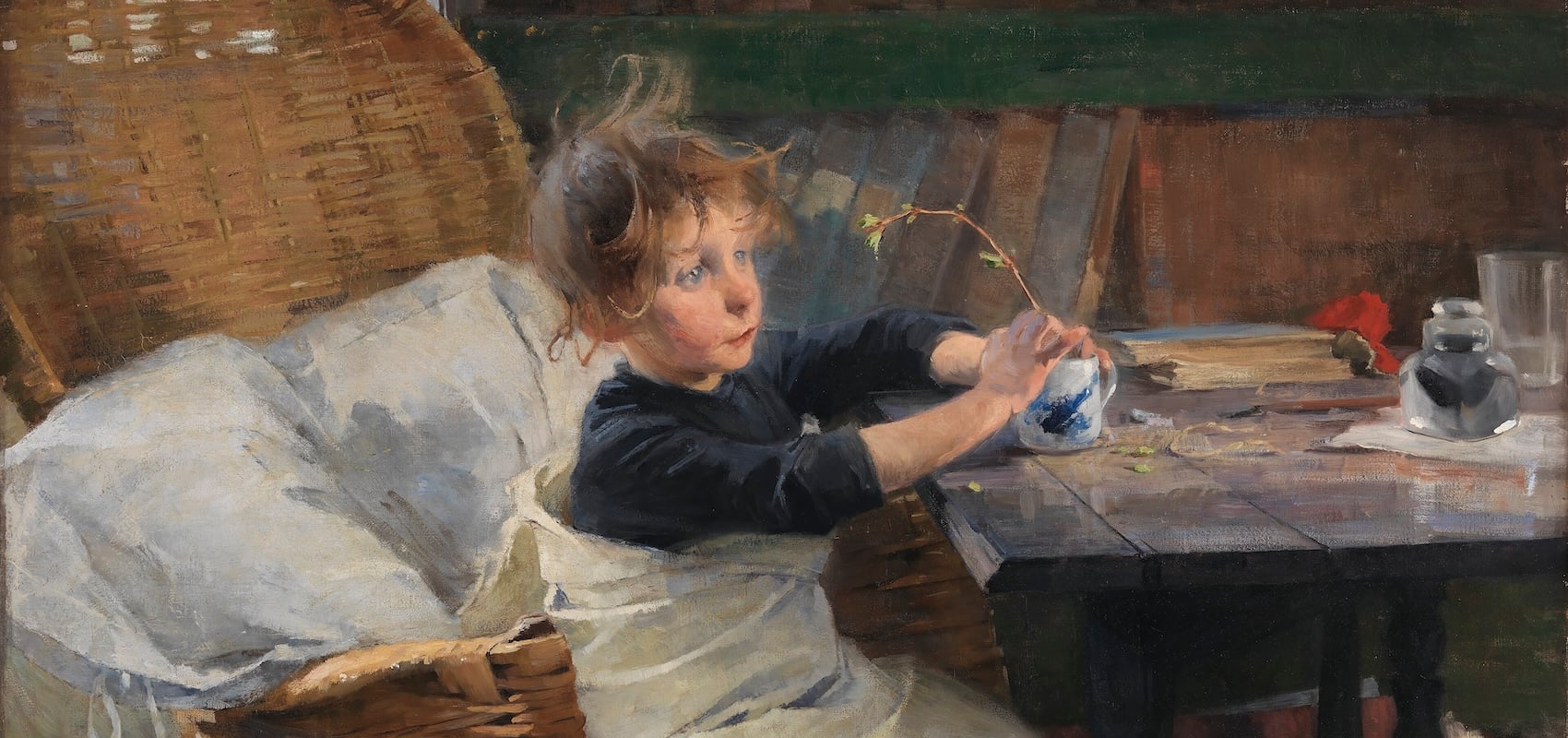
The Convalescent (1888), another Salon submission, shows a different sort of defiance. Here we see a flush-cheeked, tousled-haired young girl seated at a wooden dining table, the fabric swaddling marking her as an invalid. She arranges a sapling potted in a mug, her bright blue eyes fixed determinedly on the budding twig. A fellow female painter disparaged the work, calling it “noxious”; the ill child, she argued, looked far too robust to “stir the observer to pity.” She wanted proper Victorian sentimentalism, but Schjerfbeck preferred to capture a small but heroic act of resilience.
Two biographical events may lie behind its hopeful theme. Schjerfbeck was convalescing herself from heartbreak, having recently broken off an engagement to an unknown British artist; and, when she was four, a similar age to the child in the painting, she suffered a bad fall that left her permanently injured. There was a silver lining, however, as it was during her recovery that she first began to draw.
She suffered further shocks to the system. Finnish artist and writer Einar Reuter, who corresponded with her for decades and wrote her first biography, appears in two pensive portraits, and perhaps also in The Tapestry (1914–1916), a dreamlike painting of a man and woman, the former turned to face an island in the sea behind them (really a wall hanging), the latter’s head tilted to face him, her wistful features nearly effaced. Though twenty years Reuter’s senior, Schjerfbeck felt so deeply for him that in 1919, when she learned he was engaged, her mental state declined so severely she was hospitalized for three months.
Yet she never stopped painting. Indeed, she became increasingly daring, confident, and original, simplifying her work drastically and taking new risks with materials. She would apply and scrape away layers of paint, leaving gray patches that mimic the effect of aged Renaissance frescoes. She mixed mediums and simplified forms, arranging areas of flat color and keeping only enough detail to avoid total abstraction.
While the “death mask” series was her last great experiment, Self-Portrait, Black Background (1915), commissioned by the Finnish Art Society to hang in their boardroom, provides a better epitaph. Adopting El Greco’s palette of “white, black, yellow ochre and cinnabar,” she placed her head and shoulders against a flat black background inscribed with her name in a worn-looking typeface, a tub of paintbrushes behind her. Her pale eyebrows are raised as she looks down her nose past the viewer, her chin sharply outlined and her pink lips showing the faintest smirk. Here we hardly see a timid spinster, but rather a confident and mature artist, unafraid of appearing strident. It is almost as if she is daring the viewer to dismiss her.
Seeing Silence will be at the Metropolitan Museum of Art through April 5.
