
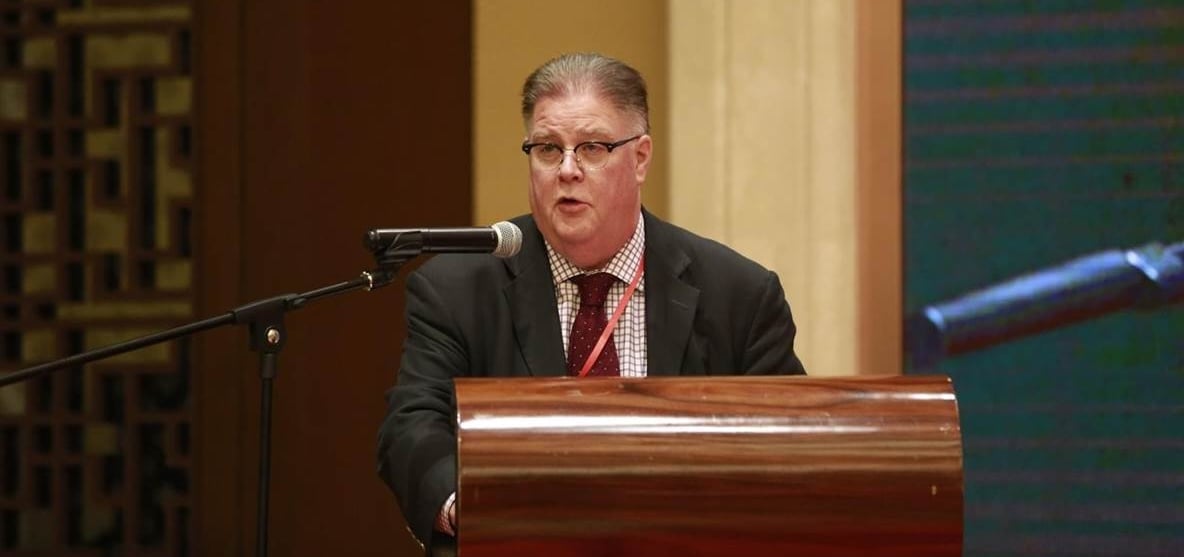
Two weeks ago, Prof. James Hankins gave his last lecture at Harvard before his departure to University of Florida’s Hamilton School for Classical and Civic Education. His final course, Western Intellectual History: Greco-Roman Antiquity, covered the pre-Socratics up to Augustine. The following semester, students would traditionally go on to enroll in Hankins’s Prehistory of Modern Thought course. Only this year, that class won’t be offered. It is, in fact, unlikely to be offered for quite some time, if ever again.
Hankins has been teaching at Harvard since 1985. He has written over twenty books and edited over fifty volumes with Harvard University Press’s I Tatti Renaissance Library, which he founded in 1998. It is the Loeb Classical Library equivalent for the Renaissance. He also recently published The Golden Thread: A History of the Western Tradition.
While Hankins’s scholarly specialty is the Renaissance, he believes knowledge of the history of philosophy is essential to understanding any individual philosophical work. Accordingly, his courses have impressed upon students the enduring importance of the two “poles” of Western thought: the Greek philosophical tradition and the Christian tradition. By situating philosophers between these poles, he demonstrated how they mutually shaped one another and sustained a millennia-long debate over their respective claims to primacy.
In his final class for the history of ancient philosophy, he provided a historical overview of the entire Western Tradition up to modernity. He concluded that the modern and contemporary omission of the Christian tradition is partly to blame for the soullessness of our age. He pointed out that no professor will take up the task of teaching this content at Harvard, as there are few to no professors left teaching Plato, Aristotle, Augustine, and Aquinas. (There are four courses that reference Plato being offered next semester, and 110 that reference sexuality.) Insofar as they are taught, it’s within thematic courses such as “Philosophy of Humor” or ultra-specific courses in the Philosophy department on a single work.
Where a century ago every student would have arrived at Harvard having already read the Western canon, students now enter with little to no background in the classics. Nevertheless, many hope to encounter the Western canon but find that there is a widening gap in the field. This is not solely the fault of Harvard; current hiring policies make it difficult for someone studying the ancients to differentiate himself in a millennia-long tradition of scholarship.
If Harvard is to compete for students who are attracted by the new “Great Books” colleges or programs such as the ones being offered at University of Florida (which Hankins will be joining), they must think seriously about this deficiency. Harvard has long spent its energy and resources on targeting opportunity hiring, focusing on the superficial aspects of a professor—such as race and gender—rather than competence and what needs to be taught. Harvard should focus on hiring the best professors who can teach the subjects that have been neglected, not on hiring another administrator to manage a subsection of the student course request process.
As Hankins leaves, Harvard loses not only one of the last professors in his field, but also a friend of the conservative student body. He advised conservative-leaning clubs, provided mentorship to conservative students, and even hosted a legendary wine seminar (for those of drinking age), educating young men in the ways of being a gentleman outside the classroom. One of his books, Virtue Politics: Soulcraft and Statecraft in Renaissance Italy, is one of the few contemporary books that gives a positive moral account of the Renaissance and argues that the ideas were actually useful for developing virtue. He explains that classical education works only if one has a virtuous teacher, since virtue is learned by studying under someone who is virtuous.
Prof. Hankins is one of these teachers, and his love for knowledge and his students can be seen in everything he does. Those teachers will always be in demand by students that still desire to learn the true history that built our university, country, and civilization.

YOU MIGHT ALSO LIKE
Why I Stay at Notre Dame
I have been associated with the University of Notre Dame since 1984, first as a graduate student…
What Virgil Teaches America (ft. Spencer Klavan)
In this episode, Spencer A. Klavan joins R. R. Reno on The Editor’s Desk to talk about…
The Porn Supremacy
Homo sum, humani nihil a me alienum puto, wrote Terence. “I am human, nothing that is human…
