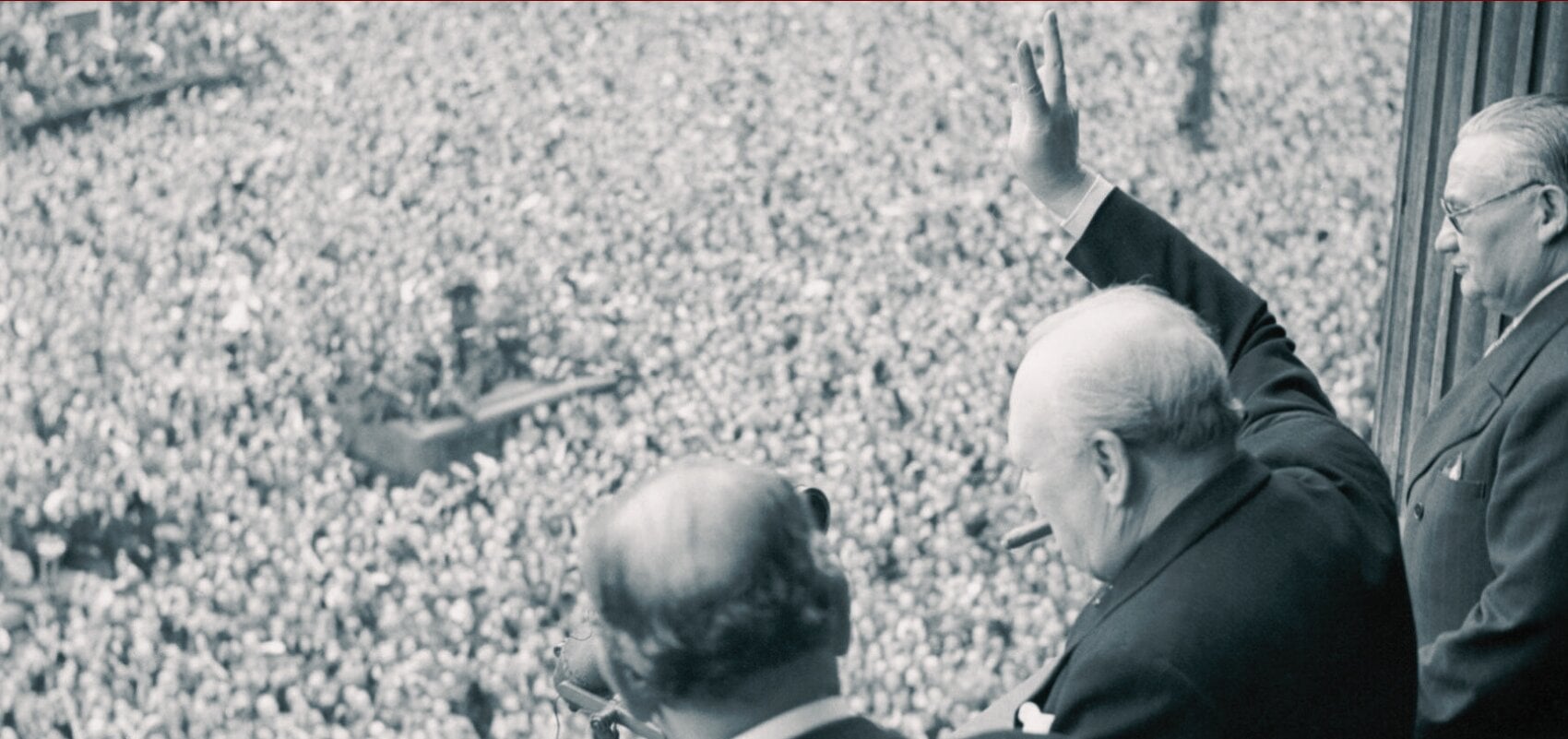
The debates of the past year or two surrounding the Second World War have exposed fault lines in American political culture. The war became a surprising issue in the 2024 presidential campaign when, in September of that year, Tucker Carlson’s interview of history podcaster Darryl Cooper was denounced by the Biden White House as a “sadistic insult to all Americans.” One might expect the most controversial thing to have been Cooper’s downplaying if not denial of the Holocaust. But the provocation that went viral, prompting denunciations from historians and journalists, was his judgment that Britain’s wartime prime minister, Winston Churchill, was the “chief villain of the Second World War”—instead of Adolf Hitler.
That was not the end of the debates over World War II, as a series of flare-ups continued to roil the right through 2025. What on earth is going on? Why should the disparagement of a long dead British leader be taken as an “insult to all Americans”? Why does this eighty-year-old conflict stir up such powerful emotion in Americans who—aside from the odd centenarian, who is likely not posting on X—did not fight in it? As Alec Ryrie observed in these pages (“The End of the Age of Hitler,” October 2024), World War II has become for postwar Americans and Europeans more or less what the Trojan War was for the Greeks, or the Bible once was for Christians. In our decadent post-Christian, post-everything era, many view the “Good War” as our “Paradise Lost, our epic of meanings and values, dominated by its endlessly fascinating central villain,” Adolf Hitler. In this epic, Winston Churchill is Hitler’s heroic opposite, and the British prime minister’s wartime speeches have “sunk into our collective consciousness like holy writ.”
There is clearly something to this theological explanation: We live in an age in which the only true religion is anti-Nazism. Because the German-Aryan chauvinist crimes of Hitler and the Nazis have tarnished racial or ethnic pride, even simple patriotism has become anathema to Western elites. The cry of “never again,” as R. R. Reno has argued, discredited the “strong gods” of the closed society. They have been replaced by the diversity-worshipping cosmopolitanism of Karl Popper’s “open society,” in which anything goes—except for traditional values and national borders. Renaud Camus proposed something similar with his idea of the “Second Career of Adolf Hitler.” The concepts or terms—race, ethnic origins, nationalism, populism—“that in any way came into contact with the phraseology of the Third Reich have become suspect, as are those who use them.” The fuzzy gods of the open society may not be “strong” in Reno’s sense, but we cross them at our peril.
Yet why must we still defer to the lessons of World War II? In the world we live in, which has seen continuous immigration, both legal and illegal, on a massive scale since the 1970s, why do centrists and conservatives still tiptoe around patriotism, populism, and basic border defense as if they were taboo? Why do conservatives howl in agony when anyone calls into question the moral perfection of Winston Churchill’s wartime premiership? Why the need to rebut any suggestion that anything might have been amiss with Allied policy in World War II?
The Churchill “finest hour” legend remains sacred to many Britons and Americans of a certain age. But for a younger generation, the Churchill myth fails to resonate. And why should it? After all, the main events of Churchill’s career—from Omdurman and the River War, to his party-switching from Tory to Liberal and back again, to Gallipoli, to his stint as Chancellor of the Exchequer and Britain’s return to the gold standard in 1925, to his “Wilderness Years” in opposition during the 1930s and his critique of Chamberlain’s appeasement policy after Munich, to his decision to fight on after the fall of France in 1940, to his punchless wartime shuttle diplomacy, which saw Britain sidelined by Washington and Moscow—have precious little to do with any contemporary issues facing Britain. The only exception to the rule of irrelevance is provided by his critical and now-seen-as-incendiary remarks on Islam in The River War.
Still less do Churchill’s preoccupations have to do with any issues concerning Americans today, unless we count his unapologetic pride in white “Anglo-Saxon” civilization (which is somehow never discussed by contemporary Churchill admirers, who prefer the post-racial Churchill of their imaginations). Indeed, Churchill’s career barely registers in U.S. history properly speaking, aside from his largely unsuccessful attempts to get Roosevelt to support British interests during the war and his famous “Iron Curtain” speech of 1946, in which he pleaded for greater U.S. involvement in Europe and the Near East. Even in these instances, the story is of Churchill’s asking Americans to adopt British imperial positions—to forego their own foreign policy traditions in favor of his.
Churchill devoted his career, after all, to serving the British empire—the same empire in armed rebellion against which this country was born, and an empire that, owing largely to the leverage applied by the U.S. government during and after World War II, no longer exists. Surely historically minded Americans can sympathize with Churchill’s predicament as a statesman. We can judge his refusal to make a deal with Hitler in 1940 as wise, even heroic, in the dire circumstances in which Britain found itself after a series of humiliating defeats. He did his best, and then the empire he served was kicked to the curb by ungrateful Yanks. But what does his story have to teach Americans today, other than perhaps that we might have been a bit more gracious while liquidating the empire he loved and sacrificed to defeat Nazi Germany?
If Churchill is not to be our lodestar, then perhaps his counterpart on our side of the Atlantic will serve. Franklin Delano Roosevelt is certainly an American figure. As a moral or spiritual exemplar, however, he is problematic, not least as the bully who browbeat Churchill at wartime conferences from Placentia Bay to Yalta, making the Briton “beg like Fala” (FDR’s dog) for a new dollar loan at Quebec in September 1944. American admirers of Churchill surely have a hard time getting past that. The difficulties with Roosevelt continue. Elected four times, Roosevelt might well have run a fifth time had he not died in office. His residence unto death in the White House motivated Americans to pass a constitutional amendment to ensure that the country would not experience another FDR. Even those on the left who admire his New Deal reforms recoil from FDR’s authoritarian methods and attempt to pack the Supreme Court to force through his agenda. On the right, Roosevelt has always been suspect for the same reasons, as well as for the fact that he tolerated the penetration of his government by Soviet spies and agents of influence, who oriented U.S. foreign policy in a pro-Soviet direction.
It is due to the pro-Soviet tendency of Allied policymaking that World War II is not remembered as an unalloyed moral triumph in countries like Poland, which was jointly invaded by Nazi Germany and the USSR in 1939, was conquered again and subjected to a hostile Soviet military occupation afterwards, and to this day has never received reparations from either Germany or Russia. Even the Nuremberg trials, that supposed triumph of justice that we are told represented the birth of the “rules-based international order,” were marred not only by the farcical Soviet prosecution of Nazi Germany for Stalin’s own Katyn Forest massacre, but by the forcible expulsion of twelve to fourteen million German civilians from their homes in Eastern Europe, most of them while the trials were taking place, with the full endorsement of the Allied powers.
We need not adjudicate every exception to the Good War legend. Americans rightly feel nothing but gratitude for men who sacrificed everything in the Allied victory. But can we not agree that a conflict that cost the lives of tens of millions of civilians on both sides, led to the incineration of hundreds of cities, thousands of factories, and millions of homes from Hamburg to Tokyo, and culminated in the largest act of ethnic cleansing in human history, is not the most fertile ground on which to seek the prophets of a new moral religion?
If exemplars of political wisdom and prudent governance with cross-partisan appeal are what we’re after, our nation’s history offers more promising heroes than either Churchill or FDR. Harry Truman and John F. Kennedy are still admired by Democrats and many Republicans, owing to their blend of moderate, principled domestic liberalism with patriotic Cold War firmness. Ronald Reagan has always enjoyed a following on the right for his hardline foreign policy vis-à-vis the USSR. He enjoys less popularity on the left, although Reagan, like Dwight Eisenhower and Richard Nixon, mostly accepted the political consensus on Roosevelt’s New Deal (less so the more aggressive welfare innovations of Lyndon Johnson’s Great Society), and is therefore generally well remembered by Americans in the political mainstream.
But none of these postwar presidents makes much sense as a model for our politics today. Truman’s most important legacy consists of the Truman Doctrine, NATO, the Korean War, and National Security Directive 68, born of that conflict. We can credit him with the creation of the U.S. national security state and America’s global security commitments, which still exist in altered form today, but from which more and more Americans want to move on. Kennedy became a martyr after his assassination in 1963. He made some great speeches suggesting that, had he lived, he might have scaled back the U.S. security state, possibly even curtailed the growing U.S. military commitment in Vietnam, while pushing through a progressive agenda on civil rights. But Kennedy’s actual record fell short in all these areas, and his successor, Lyndon Johnson, poisoned his legacy by plunging the U.S. into the Vietnam War, and divided the country still further with a Great Society welfare agenda, sold as an homage to Kennedy.
Reagan lowered Americans’ tax burden while crushing inflation by means of tighter monetary policy. He pushed the Soviet Union to the brink of collapse with ramped-up military spending, a strong dollar, cheaper oil, and support for the mujahideenfighting the Soviets in Afghanistan. These were impressive achievements, and it is easy to see why Reagan is still revered by Americans who remember the Cold War era. Younger Americans, however, have no memory of either the Soviet Union or the taxes and inflation of the late 1970s. They often find the Reagan legacy uninspiring. When they have opinions about Reagan, they are more likely to criticize his signing of the Immigration Reform and Control Act of 1986, a de facto amnesty that helped accelerate the mass illegal immigration that has transformed the country and turned Reagan’s California into a one-party state where his own Republicans are unelectable.
There is a more fundamental problem with using any of these Cold War presidents as a model for governance today: Their worldviews were premised on the existence of a global ideological conflict that no longer exists. Reagan’s plea to Mikhail Gorbachev to “tear down this wall” was inspiring in 1987 and turned out to have been prophetic when the Berlin Wall came down in 1989. But as a guide to Europe today, the sentiment is worse than irrelevant. The problem facing Germany and her Western European neighbors (especially since Angela Merkel offered her open-ended invitation to migrants from Syria and the greater Middle East in 2015) is the lack of border controls, which has left them exposed to mass migration, terrorism, crime, and related ills.
Reagan’s immediate successors are likewise largely unhelpful as guides. Though they may have moved on from Cold War rhetoric, all until Trump accepted the premise that the U.S. was, in Madeleine Albright’s words, the “indispensable nation,” obliged to take on nebulous global responsibilities, whether these were defined as the upholding of a “rules-based international order” or, more grandly, the imperative of “spreading democracy.” This presumption and its consequences have created today’s problems; more of the same will only make things worse.
Are there figures in American history who might give inspiration for today? Many critics of interventionist U.S. foreign policy, from anti-war leftists to paleoconservatives, have appreciated Eisenhower’s warning in his farewell address of January 1961 about the “military–industrial complex.” Eisenhower’s critique was well grounded, and yet his record in office was scarcely less interventionist than that of other Cold War presidents. On his watch, the U.S. brokered coups in Iran and Guatemala and meddled in French Indochina. Eisenhower’s decision to break Britain on the financial wheel in the Suez Crisis of 1956 was one of the haughtiest and ultimately most self-defeating U.S. moves of the early Cold War. (The main beneficiary, Egypt’s leader Gamal Abdel Nasser, repaid Eisenhower’s gift by becoming a lucrative and loyal Soviet client.) And of course Eisenhower took no measures to dismantle the military–industrial complex while he was in office.
President Trump and many of his supporters admire William McKinley and his successor, Theodore Roosevelt. Both combined a certain economic populism (McKinley’s aggressive tariffs, Roosevelt’s trust-busting) with muscular “national greatness” foreign policy. During their administrations, the U.S. expanded beyond North America for the first time, colonizing the Philippines and building the Panama Canal—still an important strategic artery. In other ways, however, this is a strange era for Trumpists to champion, as the 1890s and 1900s were a time of mass immigration that was almost as politically destabilizing as the wave that began with the Hart–Celler Act of 1965. The U.S. occupation of the Philippines after the Spanish–American War of 1898 epitomized just the kind of meddling in a country remote from U.S. interests that most Trump supporters disdain, sucking in 75,000 troops and costing 4,200 American lives in an insurrection that lasted until 1901.
A more relevant example for our time is Calvin Coolidge. He was the president who signed into law the restrictive Johnson–Reed Act of 1924, which ended the first era of mass immigration and helped knit the country together. It is less well known that Coolidge (like most Republicans of his day) was a trade populist as well. The Fordney–McCumber Tariff lifted the average duty on dutiable imports to nearly 40 percent and gave the president authority to raise or lower it to balance trade deficits. By 1923, tariffs produced half a billion dollars annually in revenue, which helped the Coolidge administration pay down the country’s colossal First World War debts.
Coolidge’s foreign policy is also strikingly germane to our current circumstances, both in the problems he faced and in his response to them. Coolidge had to deal with the hangover from Woodrow Wilson’s crusade to make the world “safe for democracy.” The country was saddled with a $22 billion debt burden as well as the wartime expansion of the federal bureaucracy. The problem with the bureaucracy was not just a vast increase in size (to 526,000 employees) but a nascent national security state that used the Sedition Act of 1918 to justify intrusive domestic surveillance and censorship. In 1920, the electoral slogan of the Republican Harding–Coolidge ticket was “Return to Normalcy.” It resonated with voters who did not wish for foreign entanglements or a burdensome and meddlesome federal government.
In spite of Wilson’s dogged efforts, the U.S. Congress rejected his new League of Nations and the security obligations implied in the Versailles Treaty. Nevertheless, the German reparations problem and the constant efforts by Britain and France to wiggle out of their war debts to American banks ($4.6 billion and $3.5 billion, respectively) on grounds of wartime solidarity (the argument that they had entered the war sooner and sacrificed more lives than Americans) put pressure on Coolidge to involve the U.S. permanently in European affairs. With the exception of his signing of the idealistic Kellogg–Briand Pact of 1928, which invited signatories to renounce “war as an instrument of national policy,” Coolidge rejected this pressure, declaring that “we do not wish to become involved in the political controversies of others” and refusing to forgive war debts (“They hired the money, didn’t they?”).
There are useful parallels here. Trump inherited a national debt in the trillions, run up during the Cold War and the Global War on Terrorism. He is facing down trade partners and allies, demanding that they pay more, saying in effect, “They hired us to defend them, didn’t they?” Washington hosts a massive and immobile bureaucracy that is very much unloved by voters. Trump is trying to unwind old commitments to NATO and the U.N., and he rode to victory in part because ordinary Americans were exhausted by woke hectoring, which he promised to silence. “Make America Great Again” hits some of the same notes as “Return to Normalcy.”
It is Coolidge’s approach to Latin America, however, that supplies the most intriguing parallel. Although he refused to get the U.S. involved in European, Middle Eastern, African, or Asian border disputes, Coolidge reaffirmed the Platt Amendment, which accorded the U.S. great sway over Cuba. At the Pan-American Conference in Havana, held in January 1928, Coolidge proposed to send American engineers to help build “great arteries of inter-American communication for motor transport,” linking together North and South America. But even as he supported U.S. foreign investment, trade, and “cultural interchange,” Coolidge insisted that it was “not desirable that we should all attempt to be alike. . . . We should all be intent on maintaining our own institutions and customs, preserving the purity of our own language and literature, fostering the ideals of our own culture and society.”
The parallels to the Coolidge era are not perfect. “Silent Cal” was famously taciturn, whereas Trump is anything but. These personal qualities arguably explain why Trump’s use of U.S. military power abroad is far more assertive than that of Coolidge, who dramatically drew down American military spending. There’s also a divergence in fiscal policy. Trump’s comparative lack of spending restraint, compared to Coolidge’s tightfisted approach, is evident in his promise to return tariff revenue to taxpayers rather than use it to pay down some of our $38 trillion national debt.
Nonetheless, the similarities are striking. In response to eras of galloping, ill-defined, and expensive global commitments, Coolidge and Trump harken to George Washington’s exhortation in his farewell address not to “entangle our peace and prosperity” in European affairs, and to “steer clear of permanent alliances with any portion of the foreign world.” Both embraced, and updated, the Monroe Doctrine of 1823, which had warned foreign powers that any effort to meddle in the affairs of Central or South America would be viewed as “dangerous to our peace and safety.” (It is sometimes forgotten that Monroe, in the same speech, also vowed that American “policy in regard to Europe” was and would remain “not to interfere in the internal concerns of any of its powers.”)
In its recent National Security Strategy, the Trump administration proposed a “Trump corollary” to the Monroe Doctrine, by which Washington would “restore our preeminence in the Western Hemisphere” and “deny non-Hemispheric competitors the ability to position forces or other threatening capabilities.” These are not mere words: The Trump corollary was applied in the recent extraction of Nicolas Maduro from Venezuela. Dramatic though the operation was, it was hardly unprecedented, recalling the similar (though less efficient) arrest of Panama’s Manuel Noriega in 1990 and the small-scale “Banana Wars” of the Platt Amendment era, which began in 1898 and ended in 1934 when FDR repudiated Platt with the “Good Neighbor” doctrine.
The earlier “Monroe” interventions, like the Noriega and Maduro extractions, were decried by critics at home and abroad as “American imperialism.” This they may have been, but unlike the open-ended U.S. military interventions in what we might call the “globalist era” (1941 to 2024), these interventions tend to be short and inexpensive and to serve core U.S. national interests. Nor do such uses of American military power necessarily imply U.S. territorial claims. Rather, as outlined in the “Trump corollary,” the idea is to enlist “regional champions” to promote U.S. goals such as controlling migration and the flow of drugs. The U.S. will encourage “our partner nations” (or those coerced into being partners) to “build up their domestic economies, while an economically stronger and more sophisticated Western Hemisphere becomes an increasingly attractive market for American commerce and investment.” The Trump administration seems to envision an updated version of Coolidge’s “great arteries of inter-American communication.”
The muscular assertion of U.S. military power in the Western Hemisphere, and Trump’s frank assertion of U.S. interests in the resources of Venezuela, Greenland, and even Canada, recalls “gunboat diplomacy” dating back to the earliest days of U.S. foreign policy. In a letter to incoming president James Madison in 1809, outgoing president Thomas Jefferson wrote from Monticello that the U.S. should continue expanding west, north (into Canada), and south into “the Floridas” and Cuba, thus creating “an empire of liberty such as she has never surveyed since the creation.” “No constitution,” Jefferson reminded Madison—the man who had largely written the U.S. Constitution, influenced by his mentor Jefferson—“was ever before so well calculated as ours for extensive empire & self government.”
We should be cautious about embracing Jefferson’s idea of an empire of liberty. It too easily resembles the vain ambition to “make the world safe for democracy” and other projects that have undermined our republic and compromised America’s capacity for self-government. We should not suppose that our national inheritance is immaculate, or that the Founding Fathers (many of whom owned slaves) were infallible. Still, for patriotic Americans today, words of wisdom from our Founding Fathers must offer a more inspiring vision than the nebulous globalism of the “rules-based international order,” or whatever is left of the Second World War Hitler-as-Antichrist or Churchill-as-prophet religion. There is nothing wrong with admiring Churchill’s character and rhetoric, but surely we can admit that, sixty years after the formal dissolution of the British Empire and eighty years since its real eclipse, the cause he embodied is a relic. There is no need to continue worshipping it.
The American nation, by contrast, is still a going concern, and it is time we forego mythologies and give it our proper attention. Of course, times have changed. The U.S.’s role in the world is more extensive today than in Coolidge’s era, and certainly far more extensive than in the Founders’ time. Our political order has evolved, not least through the abolition of slavery and the expansion of the franchise to women and non-white citizens. For all our problems, our national wealth has increased geometrically, our prosperity is more broadly shared across the social spectrum, and our military power is almost infinitely greater. These factors may complicate the task of governance, which of necessity draws on the strengths of the moment to address its problems and challenges. But the reality of change does not make enduring principles obsolete, such as the idea, expressed by Washington, codified by Monroe, and now updated by Trump, that the U.S. should prioritize its own hemisphere over Europe, Africa, the Middle East, and Asia.
The Trump National Security Strategy nicely invokes America’s most venerable foreign policy tradition, albeit in a hard-nosed and slightly less eloquent style than that of the Founders. It is hardly perfect. It could use some rhetorical finesse, more talk of civilizational ideals (liberty, order, excellence, prosperity), and less talk of tangible and, one hopes, passing threats (fentanyl, human trafficking, terrorism). The doctrine’s critique of the antidemocratic and pro-censorship ethos of the European Union is more condescending than it need be. Certainly, the hypocrisy of unelected bureaucrats’ bleating about “democracy” even as they silence dissidents should be condemned, but we should not forget that this style of hectoring was imported from the United States. Fueling and prolonging the dangerous proxy war in Ukraine may not now serve, or ever have served, genuine U.S. national interests, but it was the Obama and Biden administrations that set it in motion in the first place. It is imperative that we exit this terrible war, but we cannot simply blame Europe and wash our hands of it. Even Europe’s ongoing economic collapse, lamented in the Trump National Security Strategy, though partly self-inflicted due to foolish energy policies leading to deindustrialization in Germany, was compounded by the draconian sanctions regime imposed on Russia, including the destruction of the Nord Stream pipeline. These economic poison pills for Europe were enthusiastically imposed and cheered on by Washington, whether or not the U.S. was directly involved in the Nord Stream sabotage.
There is a larger reason for American circumspection when we criticize European fecklessness. The demise of the British, French, Dutch, and Belgian empires after World War II left Europe bereft of confidence, pride, purpose, and energy. Note well: That demise was fully endorsed by Washington and often actively promoted by U.S. economic and diplomatic pressure. It is well and good to lament the consequences of Europe’s long and painful decline for Western civilization, but we should have some contrition for our own role in the debacle.
Perhaps we might consider a European corollary to the Monroe–Trump (“Donroe”) doctrine, which should apply equally to Britain, Canada, Australia, and New Zealand. Whether or not these countries are as central as they once were to U.S. interests in trade or security, they remain part of a shared English-speaking and broader European civilization—what is left of it, anyway. In this regard, Churchill was astute. Bonds run deep, and they should be cultivated.
Self-examination is also imperative. A nation cannot renew itself unless it grasps what it needs in order to be renewed. With the exception of Eastern European nations such as Poland and Hungary that, having suffered under Soviet hegemony, were partly inoculated against Western progressive fashions, English-speaking and most European countries have embraced the same suicidal path of demographic transformation through mass migration, exacerbated by generous welfare provisions and accelerated by falling birthrates. As with the eclipse of Europe’s empires, the Ukraine war, and hypocritical “democracy” cant, the open-borders mania was exported from the United States. We should acknowledge with contrition our own role in spreading this dire problem.
The U.S. has now undertaken the first serious steps to reverse mass migration into Western countries. In doing so, we are exercising civilizational leadership that is both appropriate and salutary. Perhaps in this fashion we can remain helpfully “entangled” in Europe and the British dominions, not directly or imperiously as in the Western Hemisphere, but by setting an example.
In a larger sense, our task is to establish a true empire of liberty at home, a thriving commonwealth in which law, life, property, and national borders are respected. In so doing, we may fulfill a more realistic version of John Winthrop’s “city on a hill,” helping the West overcome its malaise by renewing the American project in accord with our best national traditions—while avoiding the hectoring tone of Puritanism or progressivism. We need not save the world, or make it all “democratic,” to thrive and prosper. It is enough to be true to our better selves.