
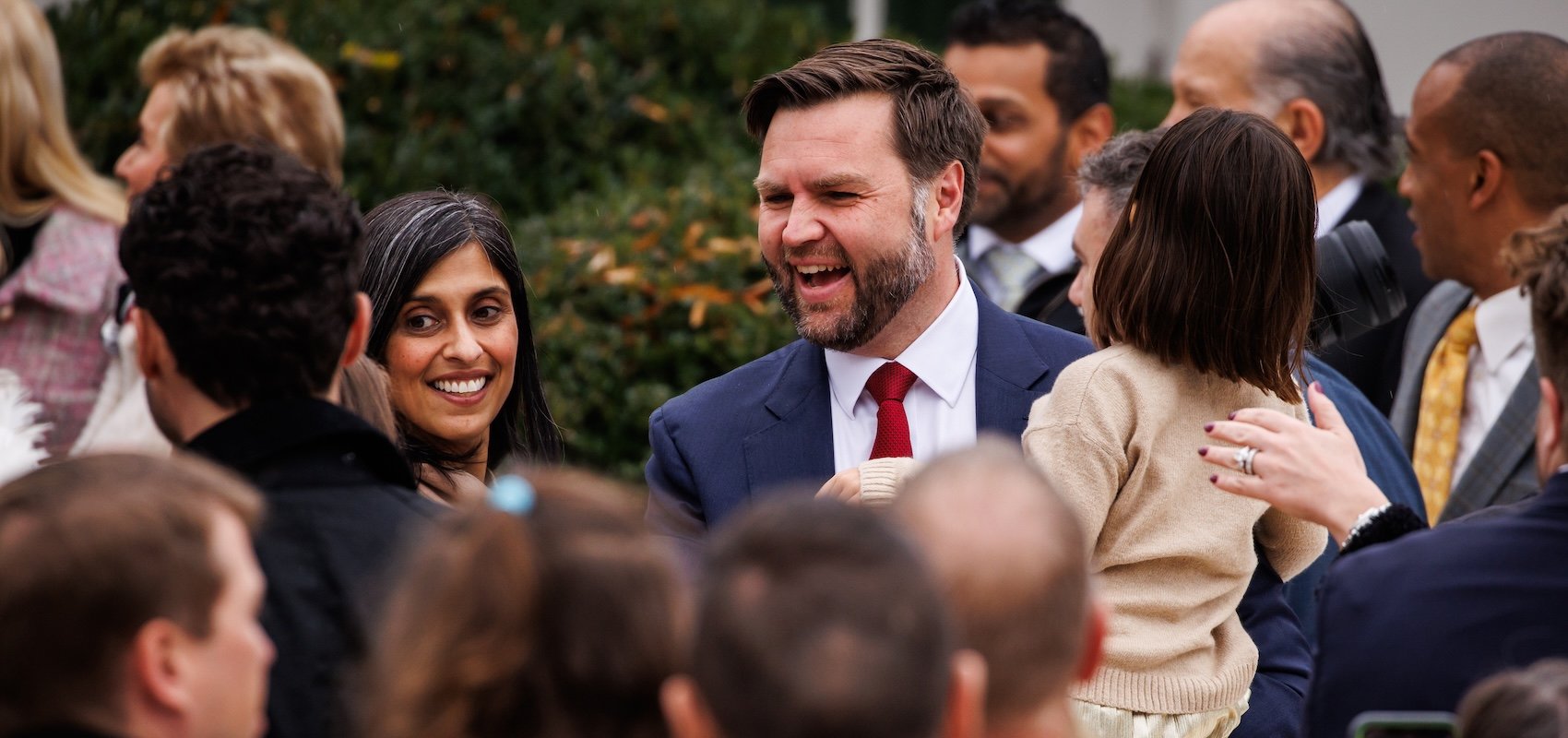
The U.S. birthrate has declined to record lows in recent years, well below population replacement rates. So the news that the vice president and second lady are having a fourth child is welcome—and significant—news indeed, for several reasons.
First, there is a great cultural importance to influential people having more children. Even in local communities, pregnancy can be “contagious” because humans are social animals. When one lives in a career-minded metropolis where couples having only one or two children (if any) is the norm, there can be intense pressure to fit in and focus on careers, nights out, travel, accumulation of goods, and so forth to avoid having children. Conversely, visit any thriving church community and observe how, when large families are the norm, people who join that community are more likely to have more children themselves.
The effect could very well work at scale. When our leaders (from statesmen to idolized celebrities) do not marry and have children, there is a message coming from the top that avoiding children is a behavior to be imitated. So when our most visible leaders make the choice to be open to life and welcome new children, there could be a meaningful cultural effect. JD Vance is the vice president, likely the next Republican candidate for president, and therefore the soon-to-be leader of the post-Trump GOP. Perhaps a public announcement welcoming a fourth child coming from one of the most prominent and powerful people in the country will start to change the cultural norm back to welcoming more children. As Katy Faust said in response to the news, “four is the new two.”
But there is another important takeaway from the Vance baby announcement. The Vance family draws a stark contrast to what the vice president has long lamented: a disturbing trend of a childless ruling class.
Back in 2021, before Vance ever held political office, he asked a politically incorrect but extremely important question: “Why have we let the Democrat Party become controlled by people who don’t have children? And why is this just a normal fact of American life? That the leaders of our country should be people who don’t have a personal and direct stake in it via their own offspring, via their own children and grandchildren?” Vance acknowledged that “a lot of people are unable to have kids for very complicated and important reasons,” but he was specifically addressing the effects of intentional childlessness. Healthy societies are led and governed by people who have a vested, generational interest in the common good, in the good of the society long after the leaders themselves are dead and gone. Isn’t it reasonable to worry about the long-term effects of choices made by governing elites who have no personal interest in what happens generations after they are gone?
Further, Vance expressed deep concern with the unnaturalness of an elite class who chooses not to have children. It is “not good. It’s not healthy. . . . Kids are the ultimate way that we find self-meaning in life, whether your own children, your grandchildren, your nieces and nephews.” There is something deeply wrong with a trend of adults (many of whom are married) consciously choosing not to have children. It is often a selfish choice, a choice to be unburdened by the difficult reality that your life is no longer your own when you are responsible for your children. Raising kids takes sacrifice. But this sacrifice is the most natural thing in the world, because it brings human life into the world and affirms that continuing human life in the world is good. And parenthood, when embraced well, cultivates a willingness to give up selfish tendencies for the good of others.
America needs good policy and capable politicians to put those policies into effect. But America also needs leaders who walk the walk. It is quite dangerous to have an elite class whose lives are so completely divorced from the good, ordinary, important things our citizens need to do to have a healthy nation. In Vance, we see a military veteran concerned about war, a man from a poor and dysfunctional family concerned with helping recover the American Dream, a religious convert, and a happily married man whose family is open to new life and many children.
There are serious political battles to be fought, and we need fighters up to the task. As a political realist, I acknowledge that I need my government leaders to be effective at their jobs more than I need them to be sincere or genuine or good in their personal lives. But in Vance, I am hopeful that America may have a statesman who can be both: a role model to normal workers and families as well as a capable and effective leader. No politician is perfect, but Vance’s life, his published writings, and his actions on the public stage make him feel much more like “one of us” than most contemporary politicians. I am hopeful that the rise of JD Vance may mark a turn toward elites who can not only govern but lead by example in their personal lives.
Sipa USA via AP

YOU MIGHT ALSO LIKE
Timothée Chalamet Is Right About Art (ft. Suzy Weiss)
In this episode, co-founder and reporter for the Free Press, Suzy Weiss, joins Virginia and Germán to…
Trump’s Civilizational Project
Secretary of State Marco Rubio spoke at the recent Munich Security Conference. Last year, Vice President JD…
The Real JD Vance (ft. Frank DeVito)
In the latest installment of the ongoing interview series with contributing editor Mark Bauerlein, Frank DeVito joins…
