
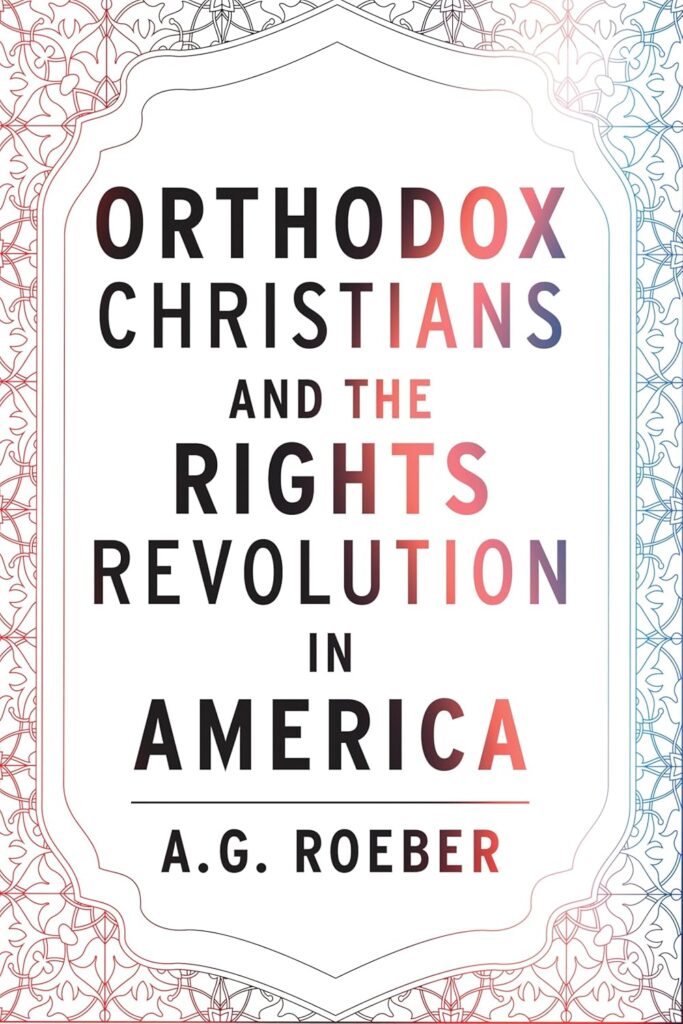
Orthodox Christians and the Rights Revolution in America
by a. g. roeber
fordham university, 336 pages, $40
America is awash in rights talk. Rights to life, liberty, property, and the pursuit of happiness permeate our Founding documents and our culture. Rights are in the air we breathe. But, traditionally, Orthodox Christianity hasn’t used that vocabulary. Rather, Orthodoxy emphasizes the need to deny ourselves and crucify our fallen wills and desires. A. G. Roeber wants to change that emphasis. Tracing rights talk back to the late Middle Ages, he argues that Orthodox Christians can and should reason about rights as other Americans do.
Roeber’s case is impressionistic, not systematic. Modern rights talk, he notes, is grounded in the imago Dei. And of course that concept is central to Orthodoxy: the understanding from Genesis 1:26–27 that God made each of us “in His own image” and “after [His] likeness.” That’s the unshakable ground of our human dignity and infinite worth. But Orthodox Christians have long regarded “individual rights” as an alien vocabulary that could sunder our oneness in the body of Christ. Analogously, Harvard Law professor Mary Ann Glendon famously warned that rights talk has flattened our moral discourse.
Roeber, however, is far more sanguine. We Orthodox Christians find ourselves in pluralistic societies with no established church. We cannot pretend that we still live in the Byzantine Empire. Our nation is founded on protecting men’s God-given inalienable rights, including freedoms of speech and religion. Rights talk, he suggests, could bring the Church up to date and into our context. As we confront modern concerns ranging from the laity’s role in church governance to gender and sexuality, we could engage in dialogue about competing rights. The error, he argues, is not in rights talk per se, but in divorcing rights from correlative duties. And as we learn more from critical biblical scholars and scientists about homosexuality and gender dysphoria, we could open our minds to new ways of seeing these questions.
Unfortunately, Roeber’s book cannot decide what kind of history to do: social, intellectual, or theological. And in waffling between descriptive and normative, traditional and modern, he puts the mind of the world level with or even above the mind of the Church.
Roeber’s book is part of a broader agenda. It appears in a series published by Fordham University’s Orthodox Christian Studies Center. As the book’s frontispiece proclaims, the series comprises books “that seek to bring Orthodox Christianity into an engagement with contemporary forms of thought.” That means applying “contemporary modes of thought” to update “Orthodox self-understandings” and apply these fresh perspectives to “cultural, political, economic, and ethical concerns.” The Fordham Center also publishes Public Orthodoxy, a progressive website that advocates liberalizing the Church’s approaches to same-sex relationships, transgenderism, and the roles of women in the church. In short, the Center is a progressive project seeking to assimilate the Church to the world, rather than other way around.
This book is no exception. Although it purports to be descriptive, its subtext is normative, portraying traditionalists as stuck in the past, dangerously “retreat[ing] from dialogue and honest engagement with the realities of a society.” Bishops, too, come in for plenty of criticism, because they have refused to defer to scientists and “expert[s] in subject matters ranging from birth and beginning of life to dietary restrictions to social justice.”
George Bernanos wrote: “The worst, the most corrupting lies are problems poorly stated.” Roeber begins from the wrong starting point, follows the wrong map, and so goes down the wrong path. His is not a theological history, so there is no standard of truth against which to judge progress. The result is a book that adopts the mindset of the world, not the phronema (mindset, worldview) of the Church Fathers.
For instance, chapter 5 strongly implies that the church’s governance has been too “magisterial and autocratic.” The hierarchy, Roeber suggests, should follow “constitutional and legal procedures” to protect seminary professors’ academic freedom. He portrays the Greek Archdiocese’s top hierarch as paranoid about “infect[ion] by American values he identified with Protestantism.” Instead of insisting on obedience, Roeber seems to argue, the hierarchy should embrace dialogue.
Here as elsewhere, Roeber’s starting point is neither the Holy Scriptures nor the Church Fathers, but a farrago of predominantly secular and heterodox sources smushed together. He discusses shockingly few primary sources from the Biblical and Patristic eras. For instance, one would have expected him to anchor a discussion of the beginning of life in the Patristic tradition, stretching all the way back to the Didache’s teaching against abortion in the late first century. Instead, chapter 6 gives us nearly twenty pages on Roe v. Wade, Dobbs, Obergefell, Mormon polygamy, and suffragettes, before a quick social history of Orthodox women over the last two centuries—but no Church Fathers.In short, Roeber takes the Enlightenment as a given and so uses the language of rights, social contract, and democracy, importing a Western, libertarian, individualist epistemology. Roeber’s idea of “dialogue” is less witness than infiltration.
Accepting the American view of rights leads Roeber to see “dilemmas of values versus rights” everywhere. For example, in discussing the sexes in chapter 7, Roeber starts off with a couple of pages reviewing the scriptural basis for recognizing humans as created male and female, not mutable or socially constructed. But he quickly puts up for grabs the traditional understanding of God as Father, Son, and Holy Spirit. He wants “discussion of the questions of sex and gender that question any aspect of received teaching.” Likewise, he asks Orthodox Chrisstians to view the struggle with gender dysphoria as like the struggle to walk the path toward theosis, “‘becoming’ the increasing likeness to God.” Glib analogies like these yield the Church’s firm foundation to the zeitgeist.
Roeber does not see how shades of terminology convey important conceptual differences. As he notes, the Orthodox Church has traditionally reasoned in terms of authority, prerogative, seniority, and conciliarity. Those terms make sense within the church’s hierarchical structure. “Rights,” by contrast, bring us into alien individualist soil. As Wesley Hohfeld has written, they denote correlative legal duties between individuals. But the Orthodox Church views us not as atomized individuals, but as persons in relationship. Rights talk often distracts from or even interferes with those relations. Plus, rights claims are insatiable. As Roeber concedes,people incessantly make “elastic and increasingly broad claims” of rights. But he fails to see that giving ground or meeting them halfway is no answer, especially when new rights claimants keep moving the goalposts further from the faith. One needs a normative framework, grounded in Scripture and tradition, to reject many novel claims and limit many others.
Roeber’s appeal to democracy misses the point. In resisting the hierarchy, American laity have asserted their rights to influence church government and control parish property, linking rights to democratic input. And Roeber praises such contemporary dialogue as protected free speech. But the Church is the body of Christ, much more a family than a democracy. The laity are not voters, and the people lack the charism of their bishop. True, one can vaguely analogize Orthodox concepts to rights and democracy, but those analogies obscure more than they reveal. For instance, the laity do play an important conciliar role in the Church, but not the one implied by secular concepts like democracy. It is the bishop who, in selecting and ordaining a man, proclaims him worthy—even if the ordination is complete only when the laity likewise respond that he is worthy. The laity can veto an ordination but cannot force it.
Rights talk is natural to Americans. And it may be simpatico with many varieties of Protestantism, given their epistemological individualism. But both Orthodox and Catholic Churches predate the Enlightenment and need to start from their own foundations. Starting there, we see the dangers of going down the rights road.
The foundation of the Church is not a social contract among atomized individuals but the body of Christ. We are ontologically brothers and sisters in Christ, parts of the same body, children of the same God. We were made to live in unity and brotherly love with one another and with all Creation. Only Adam and Eve’s disobedience and self-will distanced us from God, the giver of life, introducing sickness, sin, and death into the world.
Our wills are fallen away from God. The Fall clouds our minds with selfish desires. That individualism is diseased; we are called to heal our fallen human wills. It is by losing ourselves that we find our true selves. By bearing one another’s burdens, we fulfill the law of Christ, the law of love.
Notice how far that account is from Enlightenment individualism. The Enlightenment, microeconomics, and rights talk all rest on a Hobbesian or Lockean anthropology. The highest good is autonomy, choosing as consumers what we imagine will satisfy our fallen desires. Within that framework, it is odd to say that someone has a right to something, then to critique how he exercises that right. Who am I to judge how a rich man fails to help the poor? What could possibly be wrong with suicide?
By contrast, Christ teaches us to quell our self-will. We may not play God. Spiritual autonomy, far from the supreme good, is spiritually harmful. In the Lord’s Prayer, we say, “Thy will be done.” And in the Garden of Gethsemane, our Savior stands as an example to us all: “Nevertheless, not my will, but thine, be done.” The consumerist will that hesitates and chooses, St. Maximos the Confessor teaches, is an artifact of the Fall. To heal our wills, we must train ourselves to obey—hardly a fashionable virtue. Roeber never touches on any of this.
The implications are severe. Our time, talents, treasures, even our bodies and lives, aren’t truly our own. They belong to God. But rights talk obscures all that. We must live not as individuals, but as persons in community and relationship, not standing on our rights.
It is not enough to counterbalance rights with duties. Buying into modern rights vocabulary cedes too much ground to the will, to autonomy as the highest good. As Mark Movsesian has noted, most secular human rights claims are subjectivist, based on each person’s will—which is not the Orthodox understanding of the imago Dei. That subjectivity slights man’s calling to grow into whom we were made to be by taking up our crosses, denying our fallen wills, and following Christ.
That is not an easy calling, especially in a wealthy, post-Christian world. God’s providence has put us here, and we must be grateful for that as for all things. We must render unto Caesar our taxes, our obedience, and our allegiance as far as we can in good conscience. And, fortunately, our country’s freedoms of speech and religion and protection of private property make it legally easier to live according to conscience. Those are providential gifts.
But our culture often cuts the other way; that is the true danger. My brother is not my competition, but my life. Christianity demands far more of us than noninterference with others according to the Millian harm principle. As Dostoevsky famously argues throughout The Brothers Karamazov, I am indeed my brother’s keeper. Only Cain, the first murderer, pretended otherwise.
Rights talk exacerbates the cultural confusion, tempting us to confuse what is legal with what is morally and religiously right. Traditional Christians should take Roeber’s book as a cautionary tale. Our faith requires us to draw clear lines and not confuse secular vocabulary and concepts with the sacred ones that orient us. We can and should be good Americans. But we must be good Christians first.

YOU MIGHT ALSO LIKE
Protecting Kids Online Doesn’t Threaten Speech or Parental Rights
Two misconceptions have been circulating since last week’s landmark ruling in K.G.M. v. Meta et al., which…
Canada’s Offensive Secularism
On March 25, the Canadian House of Commons voted to repeal the good faith religious opinion defense…
What Drag Queens and Blackface Have in Common
My new book, The Desecration of Man, emerged from something I had noticed while researching questions of…
