
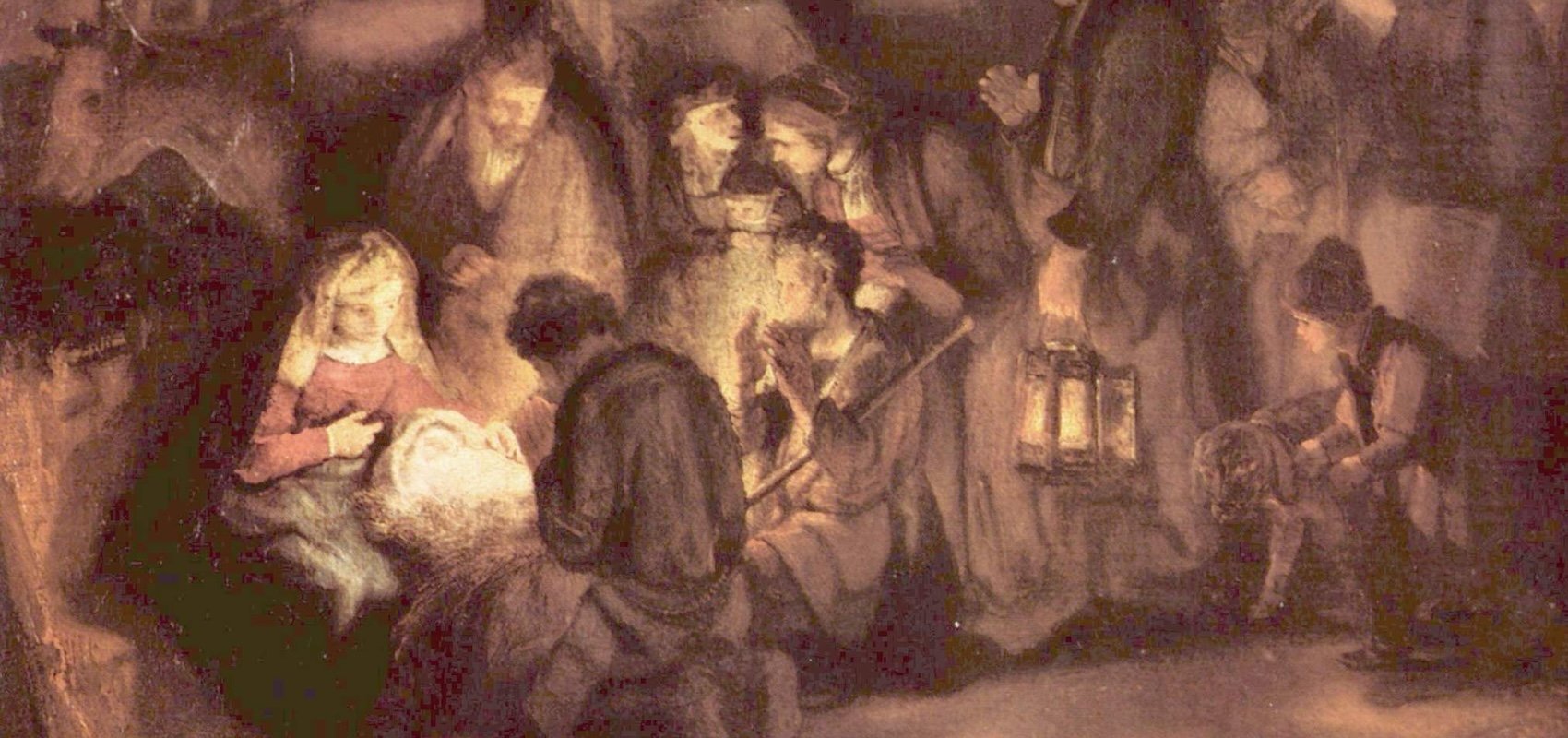
The Nativity of our Lord—born an infant, laid in a manger. It’s an utterly strange story: The Creator of all things takes the flesh of and lives as a newborn human child. Christmas songs often take up this bizarre conception. Consider Charles Wesley’s verse, from his hymn “Let Earth and Heaven Combine”: “Our God contracted to a span, / Incomprehensibly made man.” Or Christina Rossetti’s “In the Bleak Midwinter”: “Our God, Heaven cannot hold Him, nor earth sustain; / Heaven and earth shall flee away / when He comes to reign; / In the bleak midwinter a stable place sufficed / The Lord God Almighty, Jesus Christ.”
In recent times, this hymn tradition of wonder has turned the amazing statement into a principle: God likes “small things.” “God, immortal, invisible, / Love indestructible, / In frailty appears,” writes the popular British Christian musician Graham Kendrick. There is a subtle shift in conception here. Frailty is an attribute, not a person. And the attribute, then, in typical modern fashion, turns into a principle: Littleness—babies and stables—is like the law of gravity: It’s how God works. Indeed, we often hear that God not only works with “small things” but prefers them. God speaks in “the still small voice” (1 Kings 19:12), not just to Elijah, but to all of us and all the time, as so many sermons today tell us. The Universal Small Voice, the Universal Baby.
This is certainly a comforting notion. Most of us are basically nonentities on the stage of human history. It’s a condition of smallness that comes with being human: “What is man that thou art mindful of him?” (Ps. 8:4) Contemporary preachers quite like this principle on several counts. First, it’s an encouragement to the unexceptional or unsuccessful (most of us). God likes you just the way you are. Second, it encourages religious, moral, or political action. You may not be much, but like Gideon or the mustard seed, big things can come from small beginnings. Take heart and get involved! And third, the principle of divine preference for the small underwrites a certain kind of political action, one that labors on behalf of the poor and marginalized, the “small” in worldly economic terms. Now we know how to order our votes, policies, and protests!
In the 1970s, “small is beautiful” represented claims about what or how social relations work best. I am myself persuaded by many of these functionalist appreciations of the small. But today’s apotheosis of the small does not concern quotidian judgments about how to organize society on a human scale. It’s about cosmic moral values. Call it “nanotheology.” The term has been used around the edges of religious discussions on nanotechnology. But I think “nanotheology” has a better use, one that signifies a kind of ethical metaphysics in which God orders the whole of reality in a way that values the little over the big. By whatever name, it is a pervasive theology in our time.
The notion that there is a reciprocal patterning between the Baby Jesus and the shape of the world has its origin deep in the recesses of ancient Greek philosophy and pre-modern Christian thought. Drawing on ideas from Plato on the correspondences between the human soul and true reality (found in the Timaeus), Stoics later developed the idea that human beings were “microcosms” of Nature, a miniature pattern of natural processes. That idea captured the Christian imagination, buttressed by scriptural notions of human beings created “in the image of God.” Gregory of Nyssa called man “a small world within the great,” containing within himself all the parts of creation, material, rational, and spiritual. And Maximus the Confessor outlined the specific microcosmic vocation of humanity, fulfilled in Christ as the true Microcosm. All this was intricately elaborated by medieval and Renaissance natural philosophy and alchemy.
I find the microcosm–macrocosm paradigm helpful, even invigorating in its impulse to explore the world’s astounding coherence in God’s creative hands. But it is also potentially misleading when it becomes a grammar, let alone an ethical code for human life: The Baby-in-the-Manger Grand Principle is a human invention. Christmas celebrates this baby (lowercase “b”) in this manger, just one, whose personal name is Jesus. And only he. No other baby, no other manger, no other place. Not “smallness” as a category, but that particular “young child” in this particular “house” (one could say, “with a given address”) into which three men “enter,” who “see” the child with “Mary his mother” (Matt. 2:11).
This is not a microcosm, the cosmos writ small, but instead what one might call “goddity,” expressed in the quip of the British journalist William Norman Ewer from the early 1920s: “How odd of God to choose the Jews.” That “given address” raises an obvious question. Why would God be so peculiarly particular in a universe of infinite possibilities? How can this singular infant move history forward when justice can only function well according to comprehensive and impartial (which is to say impersonal) laws? Yet God does one thing, chooses one thing, orders one thing. Many other things, too! But they are not all the same. Not only that, but some differences, or even one difference, one thing (small though it seems), bears the weight of all the others, big, small, and medium. Here is God—just here, in this one and only Israel, this one and only Jesus, singled out from all other peoples, births, and infants. How odd!
The reality of the true God (versus a god of principles) is not about having Jesus confirm or valorize one’s insignificance. Hence the great and to some extent novel thirteenth-century Franciscan focus on the Nativity and its rustic setting—crèches and the rest—was not aimed at generating the order’s principles of humility and poverty. Rather, it put before us God’s choice for the “poor one,” Jesus. The motive for the Christian ideal of poverty was not about embodying a general divine principle in favor of the small. The embrace of poverty comes simply from following this particular God-Man Jesus of Nazareth, the “elect.” Our goddity, then, is also about following just this Jesus. “Baby Jesus” is Jesus as a baby, not the Baby, who happens to be presented as Jesus.
The difference is profound. Goddity evokes oddness rather than following logic. To be odd is literally “not to fit”—to stand apart from a pattern or reasonable presumptions about cause and effect. The way of the Cross, the call to the lowest seat, the command to forgive enemies and to turn the other cheek do not make sense. They cannot be deduced from one man Jesus, showing how he “fits” into the flow of the universe. They could not be derived from the grand schema of Nature, nor scanned in the panoply of the heavens. Natural theology may well seek to discern some coherence between Golgotha and the empty tomb. After all, the odd choice of God to become a human infant is not arbitrary in any divine fashion: It is who God is. And thus the world that God has made must somehow reflect the same “who.” But the order here is paramount: The world follows the oddity of Jesus, not the other way around. To embrace Smallness as a principle is not to follow, but to leave Jesus behind, to trade the person for a concept. By contrast, if there is a pattern to the world, it is itself always “odd,” the fact of “just this person.”
That is why it is impossible to apply Jesus’s smallness to the world—to the world of politics and economics and architecture and nanotechnology. Rather, the world is applied, as it were, to the Jewish infant of Bethlehem, to his and his parents’ specific prayers and devotions in the Temple of Israel, to his hidden life in Nazareth in a home of workers and family with their savory or banal meals passing down the throat on Shabbat or otherwise, to a journey into the desert for baptism and temptation, to his particular reading of the Scriptures of Israel, to his wandering and teaching in Galilee, to the calling of a few named disciples, each with their own history, and to his explicit end “under Pontius Pilate” and to the counting of three days to his rising—God’s odd choice for his own life is just where the world is going. It is a wrenching conformance. We do not apply Jesus to the world, but the world to him.
“God chose what is foolish in the world to shame the wise; God chose what is weak . . . low and despised” (1 Cor. 1:27–28). How would we know such a thing as this? Only because God did indeed choose to be born in Bethlehem, and to be despised and rejected (Isa. 53:3). And yet all the while to be God, the maker of all things, who “incomprehensibly made man.” Only because we have heard that God-Man’s voice, “Come, follow me!” (Matt. 19:21), and in doing so, we discover a world where everything, large and small alike, is wondrously odd and divinely touched. Even the hairs on our head (Luke 12:7).


YOU MIGHT ALSO LIKE
Via Crucis, 2026
The Way of the Cross—and the third, seventh, and ninth stations in particular—has been an especially appropriate…
Trump’s Civilizational Project
Secretary of State Marco Rubio spoke at the recent Munich Security Conference. Last year, Vice President JD…
How to Bring Back School Prayer
Though it was overshadowed by the reversal of Roe v. Wade the Friday before, the Supreme Court’s…
