
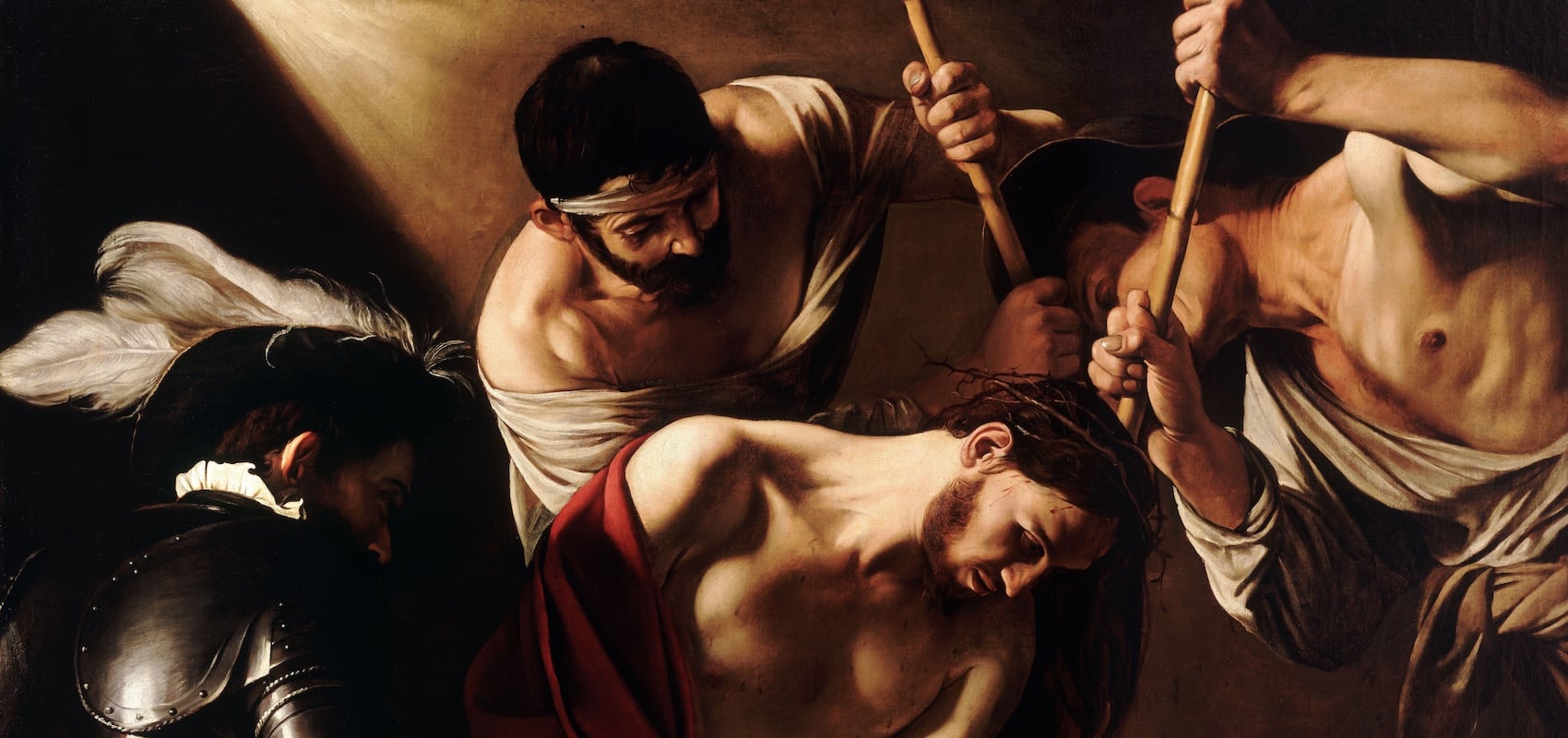
God is not mocked, Paul tells us (Gal. 6:7). Matthew’s Passion narrative (Matt. 27:27–44) suggests otherwise. Matthew tells us very little about Jesus’s physical sufferings. For him, the cross is mainly about man’s mockery of God.
Pilate knows Jesus is innocent but turns him over to his soldiers for scourging and crucifixion. Inside the Praetorium, a “whole cohort” of Roman soldiers—one-tenth of a legion, some six hundred men—relieves its boredom and discharges its spite by designing a mock coronation for the “King of the Jews.” They dress Jesus in a scarlet robe, crown him with thorns, place a reedy scepter in his hand, and kneel to acclaim him king. Then they reverse: They spit in contempt instead of kneeling in reverence, pull the scepter from Jesus’s hand to beat his crowned head, strip off the scarlet robe. They remove the veil of irony and reveal what they really think about this king and the arrogant Jews who persist against all reason in believing themselves the chosen of the earth. The Roman soldiers reveal what they really think about this odd, pathetic God who would choose the Jews.
At Golgotha, the mockery continues. Jesus’s enemies “blaspheme” him, shaking their heads and throwing his words back at him: “You who destroy the temple and rebuild it in three days, save yourself.” The chief priests and scribes echo the crowds: “Come on down from the cross and we will believe in You.” Even the brigands on the other crosses join in. Jews and Gentiles, governors and criminals, scribes and soldiers, and random passersby, all humanity joins in a single chorus of blasphemy.
Atheists blaspheme and giggle like schoolboys. They think themselves daring, subversive, deliciously cunning. But their mockery is utterly conventional. They can do no better than mimic blasphemies learned from the Gospels. Mocking God is not an invention of atheists. It’s what Jews did when their God came close, a burning too hot to endure. It’s what the religious Romans did in the presence of God.
More Pelagian than Pelagius, the modern world assures us we’re okay, and that when we quite understandably fail, we have the resources within ourselves to put things right. Whether it’s war, or poverty, or racial hatred, or disease and disfigurement, we can fix it with a few quick twists of the dial. Scripture has no patience with such mild optimism. The cross of Jesus is the crux of human history, the deep revelation of the human condition. At this crossroads, the Bible forces us to look evil in the face. The cross is a mirror that exposes us as specialists in destruction. History is a waste of toppled temples, smoldering cities, corpses heaped for burning. And when God the Creator, source of all good and all life, appears in human flesh, we beat him back with clubs and crosses and insults. Putting Jesus to death is the human project. This is what we do. We are far, far worse than we let ourselves imagine.
Left to ourselves, mockery would have the last word. God has a different project, and he won’t let us get away with ours. Matthew’s ironic Passion narrative reveals a God who twists mockery back on the mockers. Roman soldiers mock Jesus as “King of the Jews,” but as he dies, they confess, without irony, “Truly this was the Son of God” (Matt. 27:54). Soldiers offer Jesus gall and gamble for his clothing, and in so doing fulfill prophecies about David’s Son, who is indeed “King of the Jews” (Ps. 22:18; 69:21). Passersby “wag” their heads at the man who boasted about rebuilding the temple, just as, the prophets predicted, people would wag their heads in dismay at the temple ruins (Lam. 2:15; Jer. 18:16). Scribes of the law throw words from Psalm 69 at Jesus (Matt. 27:43), apparently unaware they repeat the words of David’s enemies and implicitly cast Jesus in the role of David. At every point, God turns mockery inside out to become truth.
God doesn’t simply bypass the human project of mockery and destruction. The gospel isn’t a new divine fiat, “Let there be peace. Let there be justice.” God puts himself in the way of our rage and ruin, offers his cheek to the smiters, and then humbly turns the other cheek, all to invert our project and transfigure it into his. God is not mocked precisely because God has been mocked. Left to ourselves, our contemptuous “No” would be our last word. Matthew’s Passion shows that the Father of Jesus transforms our “No” into his resounding, triumphant “Yes.”


YOU MIGHT ALSO LIKE
Andreessen vs. Augustine
Marc Andreessen, one of the most influential venture capitalists in the country, recently said in an interview…
The Donatist Comeback
My Lenten reading has included an interesting, if somewhat odd, book about the greatest of the Latin…
The Qur’an’s Christians
Hollywood released quite a few movies about Jesus in the 1960s and ’70s. Not all got rave…
