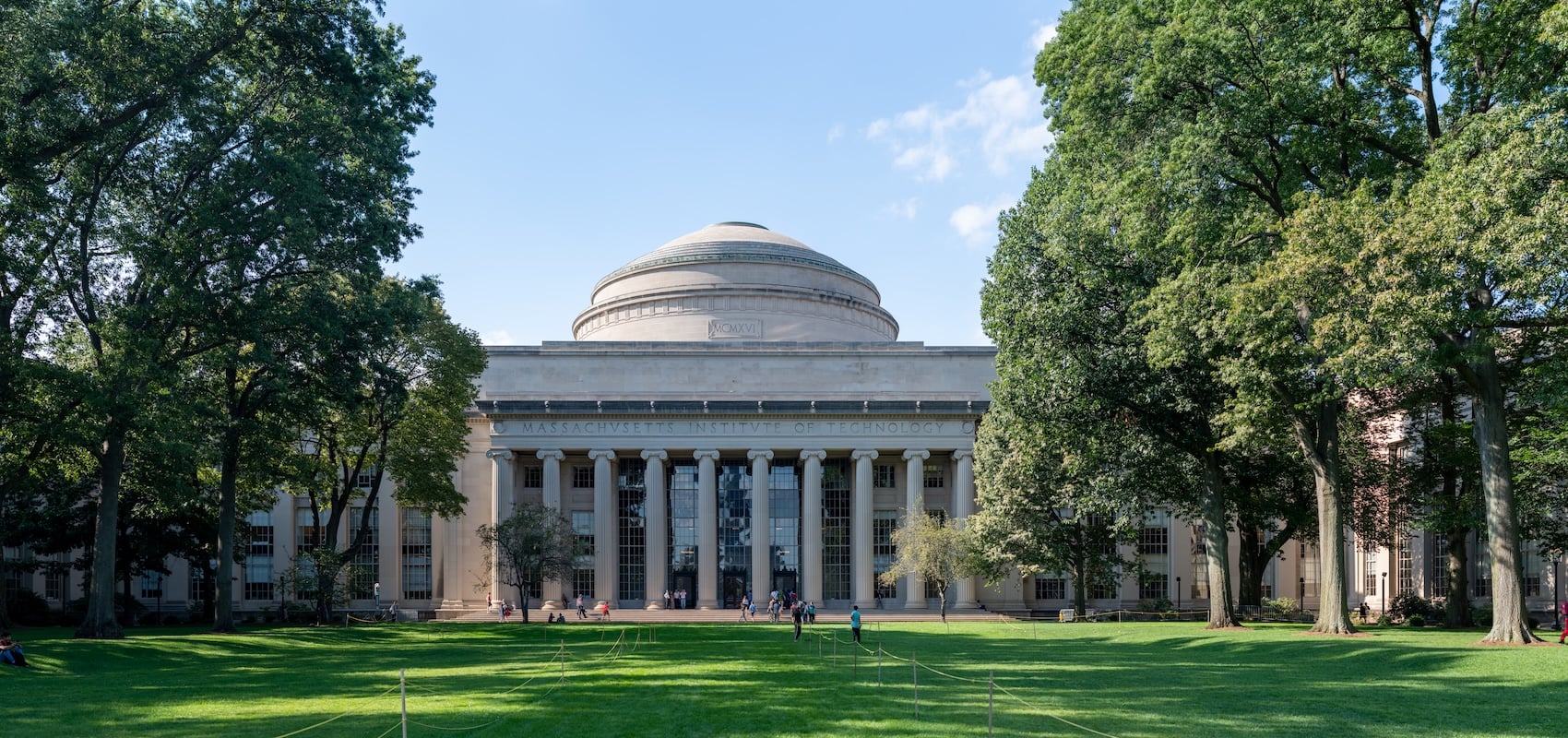
The pamphleteers are hard to miss. They stand in front of the big doors of Lobby 7, MIT’s main entrance, waving, preaching, and flagging down passersby with all the urgency appropriate to their task: saving young souls. Most students stream past, smiling politely, avoiding eye contact, and chuckling once they’re out of earshot. Some, feeling momentarily clever, stop to argue, hoping to outfox the proselytizer with a paradox about omnipotence and evil. Only occasionally does someone stop and listen. Fewer still will show up to a church, temple, or mosque.
When I arrived at MIT, I was among the indifferent passersby. After three years here, I’m not so sure.
The stereotype of the elite campus, on which faith survives mostly as an object of satire or neglect, is instantly recognizable. Thirty-five percent of American college students report having never attended religious services; just 17 percent attend “about weekly” or more. The pattern is especially pronounced at MIT, where a majority of students identify as atheist or agnostic. Those who speak openly about their religion or spirituality are even fewer. In a political science seminar I took last year, the professor asked us to list our most dearly held identities, ordered by importance, and then share them aloud. Not one person in a class of fifty listed a religious or spiritual affiliation.
At first glance, it seems that secularism has hardened here into scientism, the belief that science tells us everything knowable, and perhaps everything worth knowing, about the world. We are led to feel that we have two options—blind submission to faith or adherence to the scientific method—and that by virtue of our attending a serious technical school, we have chosen the latter. Religion belongs to a different sort of person—certainly not the sort who sits in this room. I am told that in the mid-to-late 2000s, to profess faith openly, or draw on it in class, was to invite cocked eyebrows and hallway snickers. Better to cite the theories of Marx than the Gospel of Mark. The Secular Society, a student organization active at the time, devoted itself to “help[ing] . . . members develop skills in counterapologetics and navigating life without religion.” The secularists winkingly invited you to “hang out with the best goddamned group on campus.”
But I’ve seen new sensibilities quietly assert themselves on campus. I, and other students, have come to regard the old intellectual posture—the reflexive insistence that religion is not just false but entirely valueless, something to be argued out of existence—as a fundamentalism in its own right, a mirror image of the religious dogmatism it claims to oppose.
People have been whispering about a religious revival among young Americans. The numbers do not bear it out consistently; the growth appears uneven and concentrated in a few pockets, largely among men. And yet something has undeniably loosened. For the last five years, key measures of religiosity in the United States have held steady after decades of sharp decline. MIT, then, is a revealing test case. How does faith survive, and perhaps even thicken, at an institution that seems maximally resistant to religious and spiritual belief? And what might the answer suggest about its prospects elsewhere?
I grew up an agnostic. I never managed to hold on to the Hinduism that suffused my early childhood: the elaborate ceremonial pujas, the statues of deities garlanded with marigolds and sandalwood paste. In science class, I found what I thought was firmer footing. I’d jump up at five in the morning, dunk my head in the sink to fake a shower for my mom, and sit down in front of my laptop to watch science lectures before elementary school. After class, I’d stuff caterpillars into my pockets and raise them in my room. This was the way to make the world orderly and intelligible, I thought. I expected MIT to arouse and amplify my devotion to scientific naturalism and empiricism, and in many ways it did. But it also pressed me to consider that science might be just one important, yet incomplete, way of knowing the whole.
The shift at MIT is underground and unobtrusive: a low, persistent stirring that reveals itself only if you look for it. It is there—in overfull Shabbat dinners; in prayer meetings tucked between problem sets; in faculty members like Ian Hutchinson and Daniel Hastings, who speak without embarrassment about what, or who, ultimately commands their allegiance. Campus groups like Cru (one of twelve active Christian organizations at MIT), Hillel, and the Office of Religious, Spiritual, and Ethical Life see record interest. A steady stream of believers address packed rooms, standing before blackboards still dusted with equations. Francis Collins, the former NIH director, spoke of being a Christian who accepts evolutionary origins. Auditoriums fill for film screenings—The Case for Christ, God’s Not Dead—and seminar tables are strewn with notes scribbled from Ross Douthat’s Believe. At the Addir Fellows Program, MIT’s interfaith initiative, small groups of five to eight students of various faiths, alongside questioners, meet weekly to wrestle with where we came from, how life should be lived while we’re here, and where we go when we die. In some corners, the campus feels briefly, improbably enchanted.
College has always been a place where fundamental questions feel urgent, even if they don’t get definitive answers. But today, religious and spiritual faculty and students at MIT sense that the overt hostility of the New Atheist moment has given way to a more peaceable accommodation, and for some, even abiding interest. In a telling sign, that once formidable Secular Society appears to be inactive, replaced by organizations such as Effective Altruism. Even the most skeptical secular rationalists feel compelled to organize around shared visions of the good, rather than shared animosity toward the godly.
What draws MIT students to religious and spiritual life varies. Some arrive as churchgoers looking for like-minded classmates. Some are lonely, having moved far from home to join the corporate rat race. As one student put it, MIT is a “unique place for strong faith to be established just because of how stressful it is here.” For me, it was the difficulty of speaking coherently of human meanings and purposes, while noticing that my believing peers could, without embarrassment, appeal to human dignity and recognize human depravity. I wanted something of the clarity and aptness of their moral and metaphysical views. What unites us is a rejection of the premise that faith and science must meet in a fated duel, one emerging victorious, the other dismissed with dishonor.
The religious and spiritual students of MIT take science seriously, lingering over proofs, arguing over error bars, staying up late debating models. Because science takes up so much of MIT students’ attention, we are at once especially susceptible to scientism and well positioned to sense its limits.
The case made by religious and spiritual organizations at MIT begins from intuitions most students already share. The world science discloses is not fundamentally arbitrary but marked by striking regularity and structure; it is governed by laws graspable by the human mind and stable across time and space. As Anthony, a freshman studying Nuclear Science and Engineering, says: “Everything somehow balances itself in a perfect way—you’ve got the electrostatic force that pushes the nucleus apart, but you’ve got this other force that’s way stronger that keeps atoms together.” The way in which polypeptides fold, DNA weaves and winds, and our cellular machinery hums in tight synchrony, appears ordered and harmonious to an implausibly precise degree—any small adjustment, any dialing-up of this gravitational constant or dialing-down of that stellar element, and everything would fall apart. Evolution may explain the mechanism by which species emerge over time, but it cannot explain what animates the process in the first place, or how it culminates in beings who seem distinct not merely in degree but in kind. Milin is a junior majoring in computer science, and a big skeptic. She reports that she would “have trouble believing [in God] even if [she] were struck by lightning twice in a row”—and yet she admits that “humans are special in some way that is kind of unexplainable.”
At the very least, the nature of things revealed by modern science provokes awe, the sense of standing before something vast and mysterious that transcends our understanding. It’s the feeling that drew many of us to our fields in the first place. “The heavens declare the glory of God,” the Psalmist writes; “day after day they pour forth speech.” Awe may not compel belief; it can be written off mechanistically as chemical accident or hunter-gatherer residue. But for many, the scope and power of awe invite questions that exceed the usual MIT vocabulary. Milin says she “get[s] blown away by all the ‘accidents’ that had to happen for us to be here right now exactly like this. It’s just, statistically, so unlikely.” Can we really call it “luck” and leave it there? Does the sheer unlikeliness of it all point beyond itself?
For students asking these questions, science can become a prayer, a means of discerning the divine fingerprint on the world. Anthony quotes the astronomer Johannes Kepler: “Science is thinking God’s thoughts after Him.” Some find it strange that the leading lights of the scientific revolution—Kepler, Copernicus, Galileo, Bacon, Newton—believed in a Creator. But should we be surprised that an audacious soul, beholding a world orderly enough to study, and possessing a mind capable of understanding it, intuited that there exists some sacred well of order beneath it all?
Many MIT students are attracted to this conclusion, but when pressed, they retreat into impersonal deism: acceptance of a God who may exist, but does not interfere with our world or our science. My biblically minded peers sometimes urge them to treat faith as a hypothesis to be tested over time. Take its claims—even the most outrageous ones—seriously, and see what happens! Do your habits change? Do your relationships take on new grace? Do you encounter a presence beyond yourself that feels personal, attentive, interested in your fate? That’s St. Paul’s advice: “Test everything; hold fast to what is good.”
What surprises MIT students most, I think, is the humility displayed by faithful scientists. A person serious about the scientific method and a person of faith will both admit that because our intellects are fallible, our understanding of the whole will always be partial. This semester, a student group hosted a talk on whether the Genesis creation account is compatible with science. The speaker said that when she encounters an apparent contradiction between Scripture and science, she assumes that she has “either misunderstood Scripture, misunderstood nature, or both.” If evidence conclusively shows the universe to be billions of years old, she is moved toward reading Genesis less literally and more allegorically, not toward abandoning science or God. She observes that new scientific data about our origins do not require renouncing theological claims, “as many MIT students, accustomed to the black-and-white thinking of engineering, assume.” In both scientific and spiritual inquiry, we try to make sense of all the evidence available to us, revising our judgments about what is plausible and reasonable without claiming perfect certainty. In that sense, the enterprises of faithful reflection and scientific inquiry are far more alike than they first appear.
The most striking argument for religion notes that even science rests on an unprovable trust. Belief in the results of science presupposes confidence in the reliability of our own reason. If the outside world is all dancing quarks and vibrating atoms and rotating molecules, yet we take ourselves to be capable of freely understanding and judging it in a reliable and stable way, then our minds must somehow stand in a peculiar relation to reality, radically different from the objects they study: little islands of order in a world otherwise given over to flux. Michael, a second-year graduate student, concedes that “there could be some sort of quantum thing we don’t fully understand yet” that explains why our minds are unique in their capacity to comprehend reality. But many of my peers can’t quite make that scientific leap of faith; they hit a limit. They, like me, start to consider that we might have souls not made of matter, mysterious things that might outlast our physical bodies.
As for me, I cannot yet say where I stand. But I find myself drawn to a vision of the human person that refuses reduction to material realities: a creature at once fallen and infinitely dignified, called not merely to achievement but to love, and dependent on grace. And I sense a realization growing among my peers. We do not treat science as the enemy of religious reflection. We honor science and proceed patiently from its insights to questions that science cannot answer on its own. The religious and spiritual students of MIT grasp the limits of scientism precisely because we take science seriously. We see that it cannot bear the full weight of a human life.
Image by Mys 721tx, licensed via Creative Commons. Image cropped.