
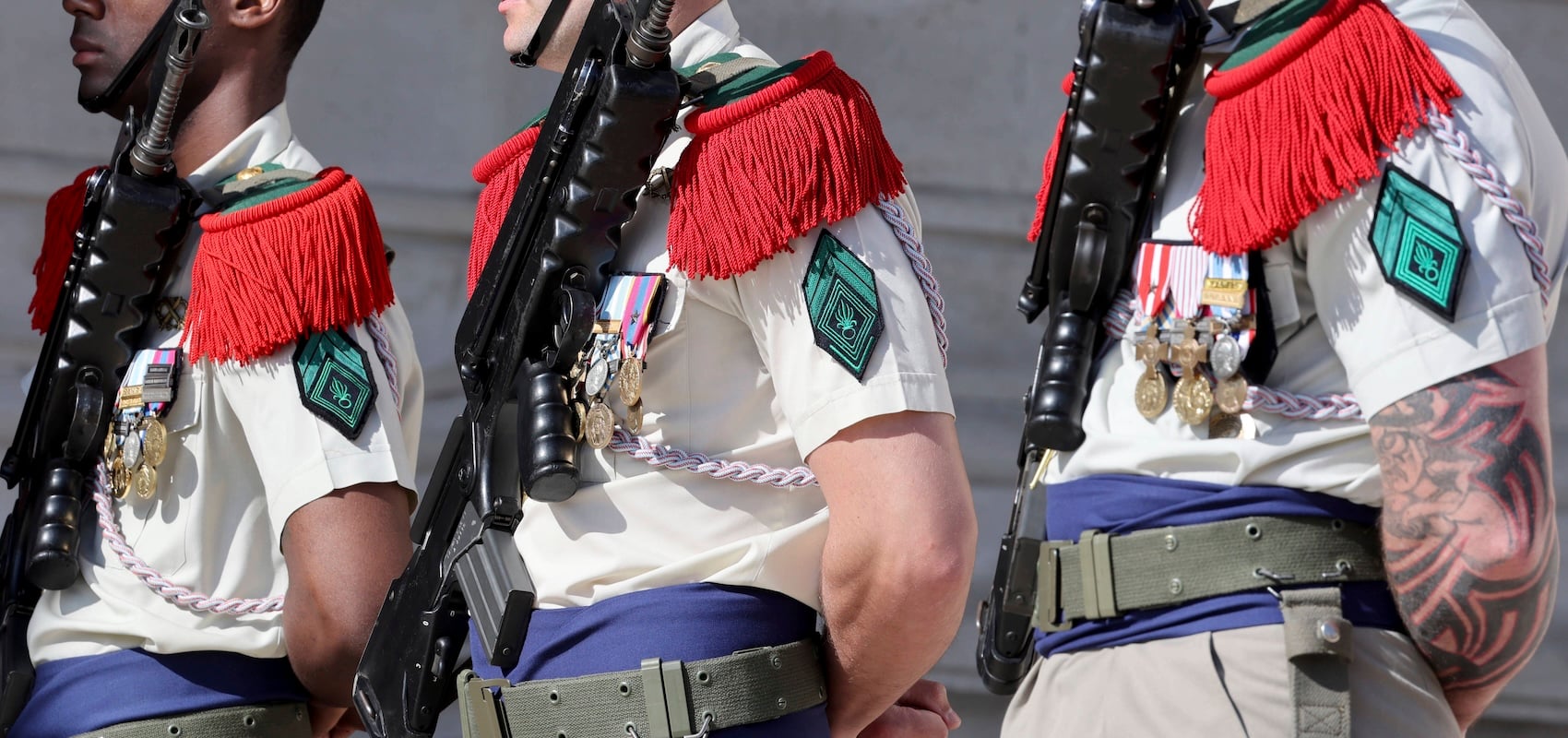
The Monastery of the Damned:
From the Ivy League to the French Foreign Legion
by nicholas tobias
amplify books, 432 pages, $30
Nicholas Tobias (a pseudonym) had already finished a master’s degree in history at Oxford and was wrapping up another terminal master’s at Princeton when he was disillusioned by the entitlement and naivete he saw in his fellow students. The only impressive person in the program was an engineering officer from the U.S. Army whose physical fitness, gratitude, and humility stood out. Tobias wondered if military life would provide him the opportunity to “snatch that ‘life of life’ that Lord Byron described in the introduction to his Corsair.” Then he remembered the Australian army captain he had met at Oxford whose service in the French Foreign Legion seemed to have made him a man who, as Kipling put it, “walks as though he owned himself / And hogs his bristles short.”
So Tobias, in search of manhood, flew to France to join its Foreign Legion. He hoped it “would forge me into a man in a world increasingly made up of mere males, who lived meekly and in terror of their womenfolk.”
On one of his first nights in the legion, Tobias listened in his bunk as fellow recruits—a southern Frenchman, an enormous black man from Mali, and an Arab from the Maghreb—talked for hours of “life’s more appropriate questions.” The Frenchman doubted the existence of God while the African and Arab protested, the first insisting on the reality of spirits in his Malian experience and “the chubby Arab” pointing to his enjoyment of sexual union between man and woman as proof of God’s existence. Tobias observed that this conversation was “not noticeably less intelligent or informed” than those among his former colleagues at Princeton.
Tobias soon found that the art of theft is critical to good soldiering because it teaches some of the larger arts of warfare. Legionnaires in training were not given toilet paper yet were compelled to be sanitary, and they were allowed to smoke but not able to buy cigarettes. Thus the need to become a “passable” thief. The lessons were salutary: how to do reconnaissance before a robbery, just as a good soldier must reconnoiter enemy positions before launching an attack; and, like a good thief, how to avoid detection by the enemy until the last possible moment.
The daily military routine could be monotonous. But the legion, and all good militaries, have sound reasons for what we find oppressive. “By teaching and instilling routines that we can recreate almost anywhere, militaries teach us how to adapt to almost any circumstance.” No matter how bad things become, habits can always sweeten the situation or at least make it more bearable. For soldiers, then, “habit is the gift of heaven.”
One habit mandated in the legion is daily physical training before dawn, including running for five to twelve miles. For Tobias this was a treat: To observe the dawn skies was to experience “beauties and marvels” beyond the reach of most civilians. Running became a morning rite for him as obligatory as brushing his teeth. While he ran, he would pray the rosary: mixing the rosary with wonder and memories “becomes for me a crossroad of time where the past, each moment, and the future unveil themselves to me.”
In 2009 Tobias’s legion unit did a tour in Afghanistan that taught him both military and political realism. Tobias had mastered Caesar’s Gallic Wars in Latin and compared them to NATO attempts to “pacify” an alien culture. He concluded that the NATO approach was doomed to failure. As he thought about Caesar’s bloody and thoroughgoing suppression of the Veneti revolt, it occurred to him that “until we could terrorize our would-be ‘terrorists,’ and so long as we tried to conduct warfare according to seemingly random selections from post-Christian bourgeois morality,” their efforts were hopeless. Terrorists would not be terrorized into stopping their terrorism.
Tobias also concluded that NATO’s use of local translators guaranteed disaster. The NATO forces had no real knowledge of cultural and political realities outside of what their translators chose to tell them, and the translators were often cousins or brothers of the local enemies. No wonder their positions were often compromised and sorties ineffective.
Their translators’ favorite American products included Jack Daniel’s and pornography. They hid the alcohol but took no pains to hide their smut. “On one memorable occasion, a cheeky translator, having draped the open pages of a pornographic magazine across his chest, berated me about Western decadence and asserted that he had no respect for ‘Western culture.’” Tobias found that in Western efforts to win hearts and minds, decadence and consumerism were most successful.
For months a barefoot Turkish boy in Afghan employ begged Tobias every day for his running shoes. When the shoe soles had nearly been worn off, Tobias finally turned them over to the lad, proud of having helped a local. But the next time he saw the boy, he was barefoot again and complained that he didn’t like the shoes. When he probed to learn more of local culture, Tobias figured that wearing his shoes might have subjected the boy to beatings or worse. Upsetting local norms “brings the ire of the powerful upon the weakest.” Western pity and altruism unrestrained by reason and religion can be dangerous.
Tobias’s time in the legion taught him both the ubiquity of hierarchies and their necessity. In the West, he came to see, hierarchy is also everywhere but kept hidden “under burkas of egalitarian prejudices” and “easy-going pretenses of levelling individualism.” In the legion, however, he came to appreciate “the importance of hierarchy, to respect its limits, and to understand its necessity for the best possible shaping and regulation of human mores and conduct.”
Following an honorable discharge from the legion, Tobias completed his doctoral studies at Princeton and served as an officer in the U.S. Army as a ranger and then jumpmaster in the 82nd Airborne Division.
Tobias’s book is a beautifully written story of his two years in the Foreign Legion. It is an elegant testament that young males are still becoming men and that the martial life can be a means of grace. Tobias concludes that it gave him new motivation to find “the good, beautiful, and true in earthly existence’s ‘brief crack of light between two eternities,’ eternities whose realities will necessarily surprise us.”
Final note to readers: The author chose a pseudonym because he continues to work in risky international situations where his identity and background might compromise others.
Image by Alain ROBERT/SIPA
