
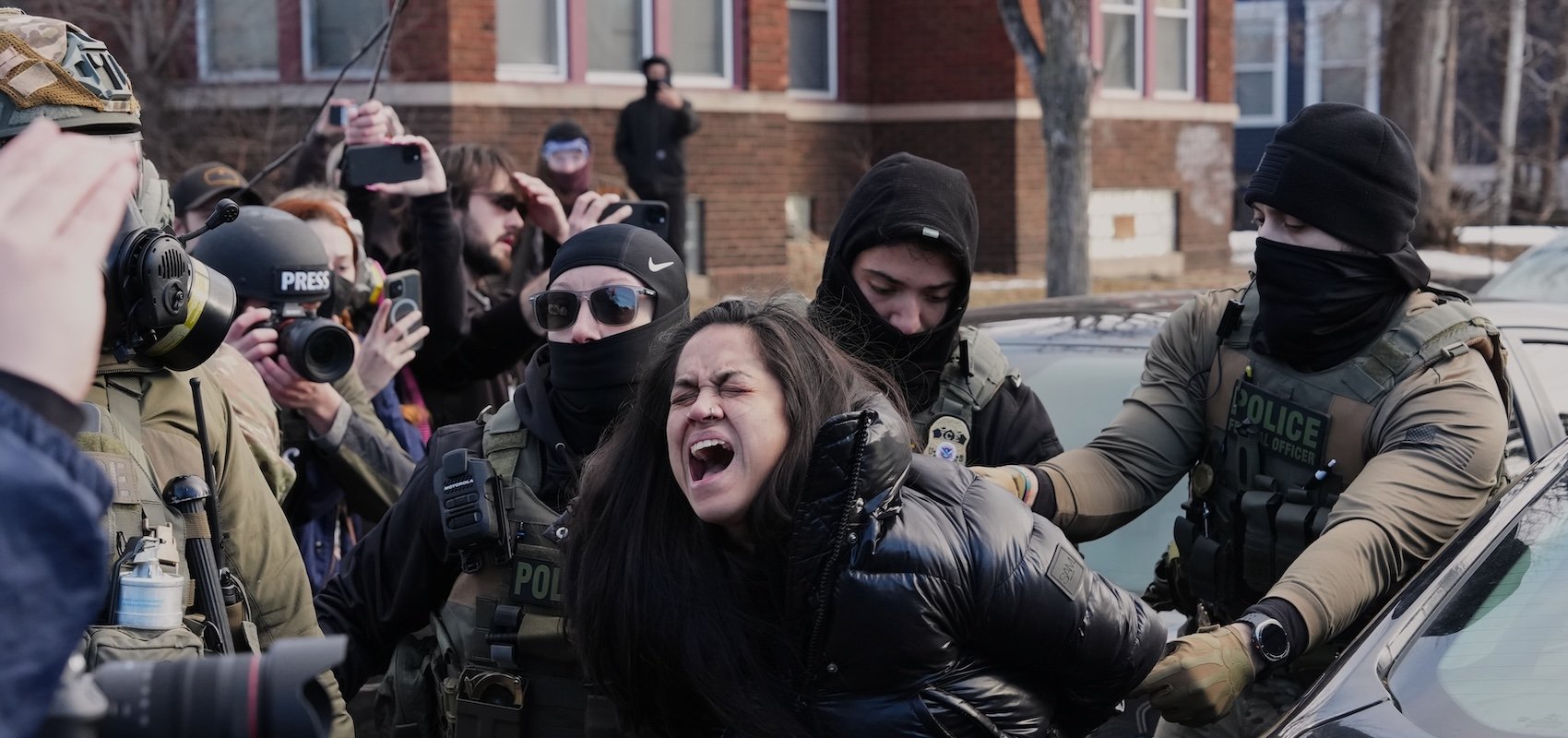
Recent reports and images from Minneapolis reminded me of Little Rock in 1957, where attempts were made to nullify the Supreme Court’s effort to impose a new regime of racial equality. Something similar is afoot in Minneapolis and other blue cities. But this time, the goal is to nullify the immigration enforcement pursued by the Trump administration.
On May 17, 1954, The U.S. Supreme Court issued Brown v. Board of Education, a historic decision striking down the “separate but equal” doctrine that allowed for white-only and black-only schools. The decision created an uproar in the South. In Little Rock, the school superintendent sought to conform to the Court’s decision, working out a plan for integration. Local resistance hardened. Community groups organized, promising to turn out protesters to prevent black students from entering white schools. It all came to a head in September 1957. White protesters created an atmosphere of intimidation. Arkansas Governor Orval Faubus expressed sympathy for their efforts to prevent integration. President Dwight Eisenhower ordered federal troops to escort nine black students into Little Rock’s Central High School as a white mob shouted insults and skirmished with the authorities.
The organized resistance to racial integration was not limited to Little Rock. In the 1960s, Boston public school administrators disobeyed orders to develop a plan to integrate the city’s schools. By the early 1970s, courts became involved and judges imposed a busing plan. Protests ensued, often devolving into riots and fights between white and black students.
The famous battles over civil rights concerned a fundamental principle of justice, the rights due to all citizens. However, they were also tests of America’s rule of law. Those who opposed integration ignored court decisions, civil rights legislation, and administrative rulings to ensure that the decisions and laws were put into force. Some went into the streets to reverse the results produced by our system of government. The goal was to so befoul the public square with bitterness and rancor that officials would back down.
The organized resistance to Immigration and Customs Enforcement (ICE) in Minneapolis follows the pattern of Little Rock. There was no internet in the 1950s. Community groups organized with leaflets and meetings. Today, the organizing is done on Signal, an app with secure privacy protections. Immigrant rights organizations take the lead. They form group chats. Participants monitor ICE movements, calling for protesters to assemble at a moment’s notice. Their objective is simple: to foment resistance and prevent the federal government from enforcing immigration laws in their city.
Writing for the Free Press, Olivia Reingold reports on anti-ICE activities in Minneapolis. A nonprofit leader told her that “the average participants in these Signal groups are church members, retirees, and parents.” In other words, they’re “really mainstream normies.” The same could have been said of those who opposed integration in Little Rock. It was certainly true of parents who rioted in opposition to busing in Boston.
The activists in Minneapolis may be “mainstream normies,” but they are insisting that the duly elected Donald Trump has no authority in their neighborhoods. Reingold reports a telling chant: “Whose streets? Our streets. Whose streets? Our streets.” I can imagine white Boston parents echoing the chant as they insulted police officers and threw refuse at them, behavior very much in evidence in Minneapolis.
Some uphold the right of the Trump administration to enforce America’s immigration laws, while criticizing the unseemly zeal and unnecessary use of force. Plenty of moderates did the same during the uproars over racial integration. Constrained as he was by respect for the rule of law, Orval Faubus himself tried to find a way to make at least a show of integration in Arkansas, until it became evident that voters would punish him severely. The same is true for the mayors of Minneapolis, Portland, New York, and other blue cities. Political survival requires them to denounce the Trump administration and side with the proponents of nullification.
Reingold quotes Thomas Brophy, an ICE official: “As a United States citizen, you don’t have the luxury to pick and choose which laws you want to follow and when you want to follow them.” Our history suggests otherwise. There are times when mobs rule. Many look back on the Boston busing plan as misguided, and after the 1970s, mandatory busing fell out of favor. To a great degree, the white Boston parents won that battle. The uproar was politically damaging to the civil rights cause. Judges became more circumspect, and federal government retreated.
Will the progressive white “normies” in Minneapolis (and they are almost all white) succeed after the fashion of white Boston parents? Can they prevent the executive branch of the federal government from enforcing in their cities the laws that they reject?
I think not. The Trump administration’s policies of border enforcement and deportation emerge from an electoral mandate. Promising to close the border and deport illegal aliens has been a central element of Trump’s political success. For this reason, the organized resistance to ICE in Minneapolis and elsewhere is counter-majoritarian. Which means that the success or failure of efforts to nullify American immigration law will be settled in the court of public opinion, not in our nation’s courtrooms.
AP Photo/Adam Gray


YOU MIGHT ALSO LIKE
Turned Away on Palm Sunday
In politics, diplomacy, war, or pretty much any field of human interaction, one must contend not only…
Timothée Chalamet Is Right About Art (ft. Suzy Weiss)
In this episode, co-founder and reporter for the Free Press, Suzy Weiss, joins Virginia and Germán to…
A Medieval Pilgrimage in Modern Assisi
When you go to the hilltop town of Assisi, you’re immediately struck by how medieval it is:…
