
Returning to Sydney in late October after my family trip to Poland was an unsettling experience. It was the first time I had ever returned home and not felt like I was home at all. Poland was where my family was from, but it wasn’t my family’s home anymore. Sitting in the back seat of my ride from the airport to my apartment, I gazed at the Sydney light I recognized, light I knew, but it didn’t warm me anymore. The architecture of the place was there, the buildings and billboards and roads I had known, but it felt somehow deeply separate from me.
Ever since, nothing has made the discomfort of not belonging go away. Living in Sydney, it was an inescapable sadness. It was so pervasive that even though I still found joy in family life and work, I started to wonder if I was suffering from depression.
A friend explained that my trip had likely activated “intergenerational trauma,” which made sense—after all, I had retraced my grandmother’s journey during the Holocaust, visited where she hid, stood in an open place where the remains of scores of my family members and over 400,000 other people were mixed ashes under the soles of my feet.
I was soon to learn that my “intergenerational trauma” was activated less by the place I had visited than the place I was returning to. Two years of continuous exposure to anti-Semitism in my daily Australian life had eroded my sense of safety, freedom, and opportunity. I had returned to the place my passport had been issued, a place I had always proudly loved, and it no longer felt like home. This was not my personal mental health issue. I was sensing something that existed outside myself, something real.
On Sunday afternoon, we lit the candles for the first night of Chanukah at my sister’s place in Bondi Junction. It was my niece’s sixth birthday party. The little girls sang along with prayers and songs of light and miracles. As the birthday girl kindled the holiday lights, I felt happy in my heart.
On my way to the car afterward, I heard the sirens—two or three emergency vehicles, traveling at speed a street away. My daughters, seven and nine, wondered what was going on.
A strawberry-haired Irish man across the road approached us. “I don’t know where you’re taking the girls,” he said, “but stay away from the beach. There’s a shooter.”
My nine-year-old trembled. The seven-year-old said, “That’s scary.”
As we got into the car, I started to receive a flurry of text messages. News was spreading through the Jewish community—news that would take officials hours to admit to the public: The target of the shooting was the Chanukah celebration at Bondi Beach.
As we drove, two ambulances, a black police jeep, and an unmarked white SUV with sirens on sped down Syd Einfeld Drive in the opposite direction, coming from St. Vincent’s Hospital.
I dictated a text message to my daughters’ father, letting him know that we were safe and on our way to him as planned. As we rounded the corner toward Centennial Park, more ambulances sped in the opposite direction, this time from Prince of Wales Hospital.
My ex-husband called us back. He’d been swimming laps at Bondi Beach that afternoon. He told us he was safe too and would get home not long after us.
As we parked the car near his place, the number of security guards outside the Jewish nursing home quadrupled before our eyes. Volunteer guards began to appear from nowhere, donning their uniform shirts as they rushed toward their posts.
After my ex-husband arrived, he confirmed the devastating news: The shooting had indeed been an anti-Semitic attack. Many people had been killed. My daughters wanted to lock all the windows and doors so we could be safe from the evil outside.
I hugged my daughters close, and we lit the candles with them a second time. We told them that no matter what people say or do, we must always be proud of who we are, and we must always continue to be ourselves no matter who tries to make us feel afraid.
The next day I dragged myself through a fully booked clinic. I tried to maintain focus on my patients as within me the grief I felt shuffled with disturbing flashes of disconnection and denial. Around 8 p.m., unable to bear the dissonance any longer, I got in my car and drove to Bondi Beach.
From the south, Campbell Parade was closed at the first roundabout. The usually busy shops and restaurants were shuttered. A southerly blew the light drizzle into a floaty haze.
I headed for the water, down the concrete steps, then the pathway to the promenade. I remembered all the other times I had come down there at night—talking with a friend on the sand, kissing a date in the moonlight, running with the girls to my car through rain as we shared a useless umbrella—but I struggled to find the peace I had felt at those times.
I realized that tonight I was not visiting Bondi Beach for the place. I was there for another reason. It was the same reason I had gone to Poland: a desire to understand an evil thing that had happened—the very same evil, in fact.
I approached the police line next to the lifeguard tower. I saw belongings that had been abandoned by people running for their lives the day before: beach towels, flip-flops, a bicycle with two helmets and a baby seat on the back. Closer to the police line were tubs full of lost property: shoes, a folded pram, beach bags. What is it about the hand of evil and piles of belongings?
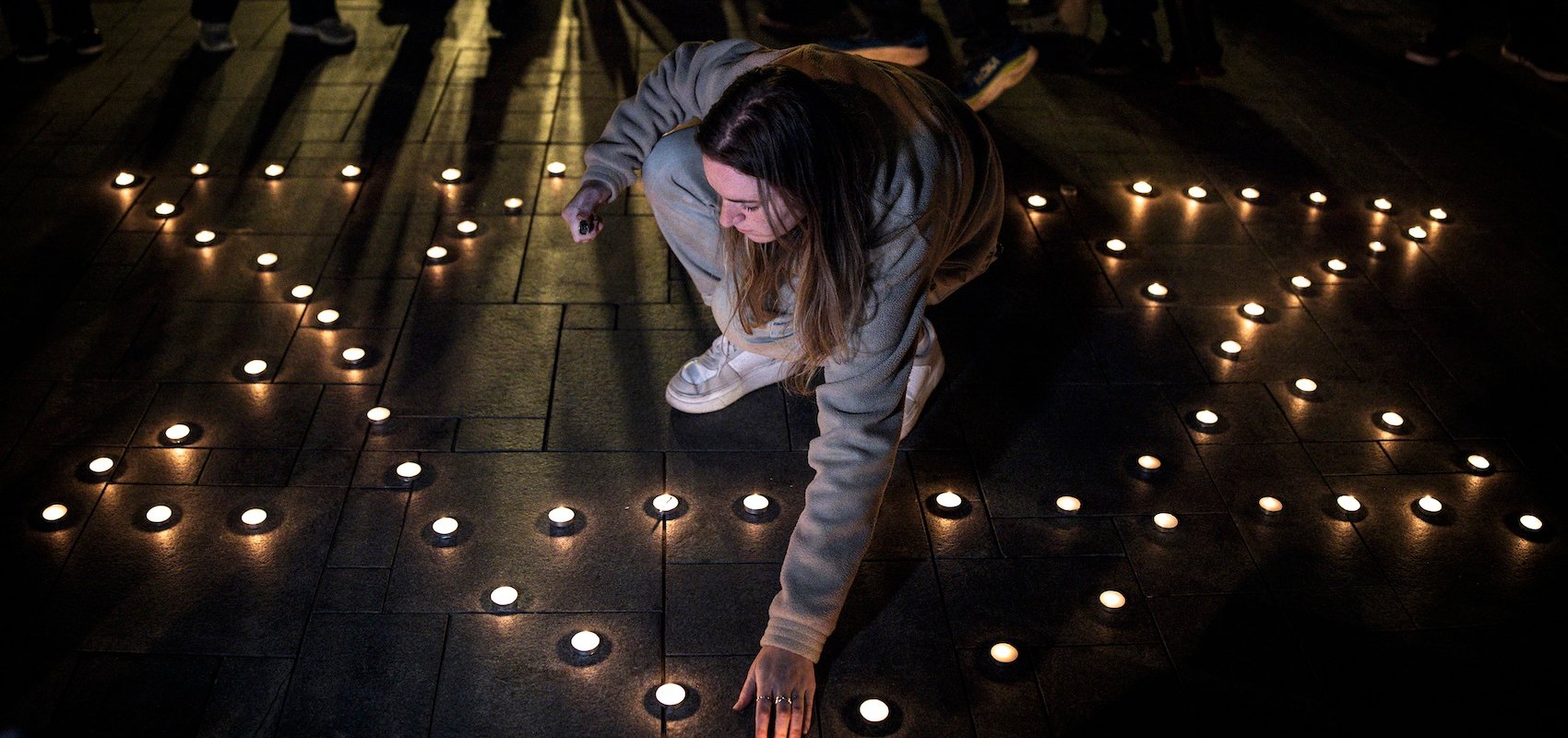
Next to the police line were floral tributes and candles. I stood, out of place among hoodies and shorts in my black work dress, shivering from the cold or sadness—I’m not sure which. I prayed.
As my feet trod the path back to the road, the same path I had walked countless times, the landscape morphed to become the path of remembrance I had walked two months earlier through the center of Belzec death camp. What has happened, I thought. What has happened to my home?
Image by JOHN WESSELS via Getty Images.

YOU MIGHT ALSO LIKE
Turned Away on Palm Sunday
In politics, diplomacy, war, or pretty much any field of human interaction, one must contend not only…
Timothée Chalamet Is Right About Art (ft. Suzy Weiss)
In this episode, co-founder and reporter for the Free Press, Suzy Weiss, joins Virginia and Germán to…
A Medieval Pilgrimage in Modern Assisi
When you go to the hilltop town of Assisi, you’re immediately struck by how medieval it is:…
