
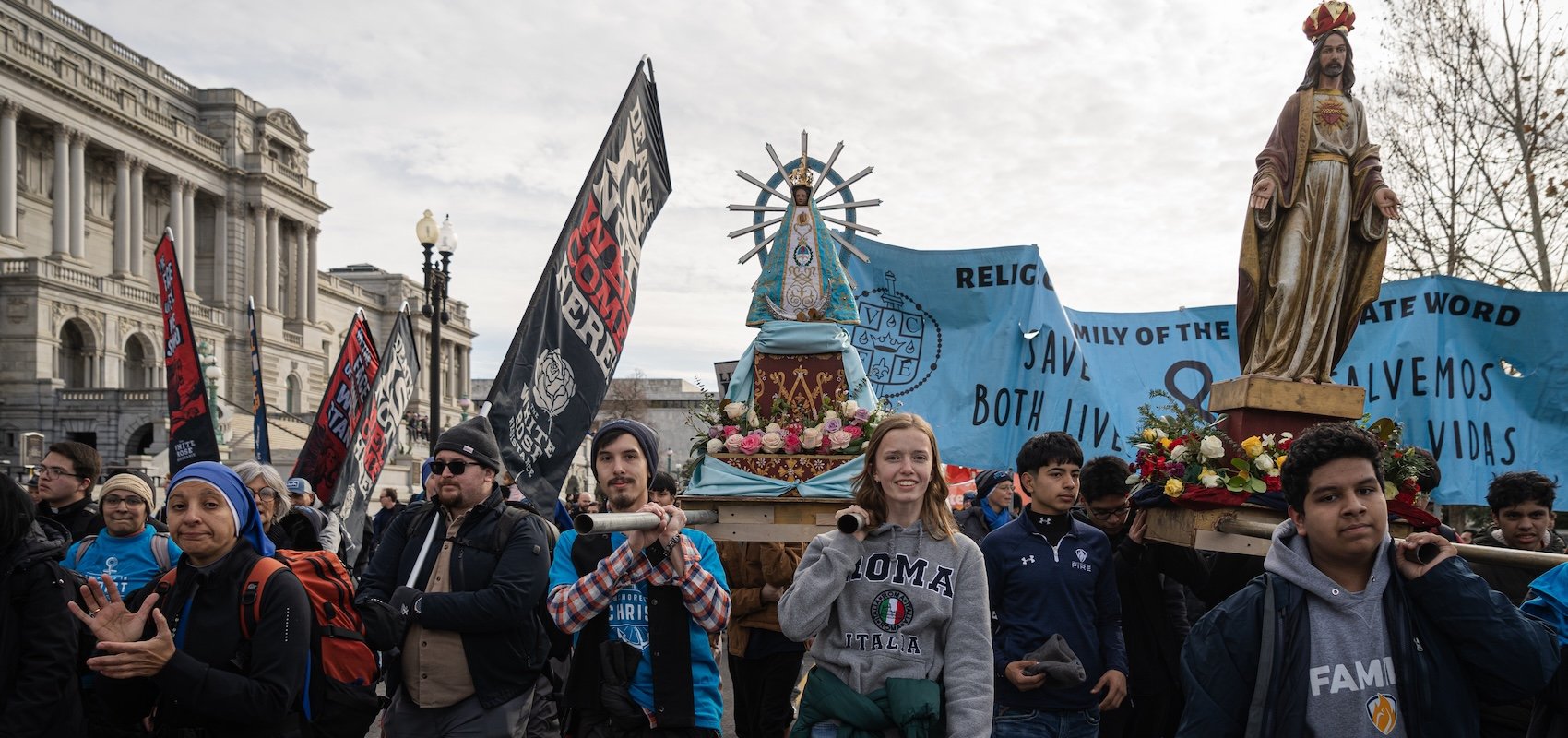
It was a brisk early morning when I set off from the John Jay Institute last Friday to attend the March for Life in Washington, D.C. Having just spent the last year closely following the daily politics of the capital, I was grateful for the opportunity to be able to simply participate in the festivities, and to do so with several compatriots who had never attended the march before.
The John Jay fellows program consists of reading some of the great works of Western literature as well as weekly excursions to places where culture and Christianity are colliding. So for that reason, I found myself driving to D.C. with a couple of Catholics to witness one of the largest gatherings of self-professed Christians in the world.
The March for Life is a welcome respite from the gloomy culture of death, which persists in the West even after the overturn of Roe v. Wade in 2022. If the continual need to stand for life wasn’t obvious before, the subsequent defeats of the pro-life position in state ballot initiatives across the country has driven the point home. And abortion is just one of several life issues currently being debated by the public. Just a few weeks ago, both New York and Illinois approved the decriminalization of some forms of assisted suicide despite the sobering accounts of deaths of despair emerging from our northern neighbor. And then there is just the sheer numbers: In Canada, one out of twenty deaths in 2023 was caused by medical assistance in dying (MAiD).
When I arrived at the march, people appeared to be in high spirits, and I relished seeing the array of matching hats denoting a particular Catholic liberal arts college or Protestant university. Several of my companions expressed surprise at the numbers of people who had traversed this continental nation of ours to celebrate and express their support for the blessing of human existence. They also noted the calmness and orderliness present at such a large event, as well as its relative apoliticalness.
I’ve always reflected on the ecumenical nature of the march. The Christian Flag, designed in the late nineteenth century, is often seen flying alongside the Holy See’s coat of arms. That’s not to say there weren’t the usual rabble-rousers present at the event. One individual felt the need to lambast the Catholic laity with a sign that read, “How many popes are in heaven? Nun!” Another gentleman informed the crowd of the damnation of the papists as smiling priests glided by.
Yet it’s difficult to not feel hopeful about the future unity of Christianity when you see the Eastern Orthodox bishops standing alongside their Roman collared brethren and Protestant brothers. This year’s theme, “Life Is a Gift,” reminded me of the many blessings that come from unity in mission across denominations.
For my part, I thought the march felt a bit diminished from last year when pro-lifers were still celebrating election victories. Such is the nature of politics that activism diminishes as success proliferates. And there is no doubt a lot to celebrate on the pro-life front, such as the administration’s recent ban on the use of fetal tissue from elective abortions in research funded by the Department of Health and Human Services.
This work was duly noted by the marchers in the form of an enthusiastic welcome for Vice President JD Vance, who gave his second address as a sitting vice president before the march began. “[The March for Life] is about whether we will remain a civilization under God, or whether we ultimately return to the paganism that dominated the past,” the vice president said, appearing to reference Louise Perry’s First Things article “We Are Repaganizing,” published in 2023.
It was thrilling to learn that Vance had apparently read an article I had helped proofread when I worked at this magazine, but the real treat of the speech was the vice president’s discussion of the importance of home ownership for young people. Having covered the Secretary of Housing and Urban Development’s confirmation hearing where the housing crisis was discussed in stark relief, I was encouraged to hear Vance confront the problem of his own accord.
One does not have to scour the internet far to read headlines like, “In just 15 years, the average U.S. homebuyer went from 39 to 59 years old,” or “First-time Home Buyers are Older Than Ever.” I’ve witnessed the crisis firsthand. Hardworking, competent young people I know have moved to cities for work only to be locked out of the kind of housing opportunities their parents and grandparents enjoyed at their ages. Vance also addressed the “elephant in the room,” namely the regulation of the abortifacient mifepristone, which at least one heckler had brought up during his speech.
“I want you to know that I hear you, and that I understand there will inevitably be debates within this movement,” the vice president said, adding that there was still work to be done to make the pro-life vision for the country a reality. After the speeches concluded, we got on our way for the walk to the Capitol building, buoyed with the greetings of longtime friends recognizing each other from across the street, some Orthodox chanting, and, of course, Catholic prayers.
The following day, I attended the Cardinal O’Connor Conference on Life. The conference, named in honor of the late archbishop of New York, is an annual student-led pro-life event hosted at Georgetown University. Among his many accomplishments, John Cardinal O’Connor was awarded the Congressional Gold Medal in part for combatting anti-Semitism. He was also an ardent defender of life, ministering to AIDS patients in New York City and serving as a Navy chaplain in the Korean and Vietnam wars. This year’s conference was co-directed by Georgetown senior Elizabeth Pillsbury Oliver, who had also spoken at the March for Life the previous day.
Oliver told me that in light of the theme of this year’s march, it was important to emphasize protecting life at all its stages. “We want to help people realize that there is always hope, there is always joy possible in the world, and no matter how down someone might be, we want to lift them back up,” Oliver explained.
Indeed, at the conference I attended a lecture on in vitro fertilization presented by Emma Waters, a policy analyst at the Heritage Foundation, where she outlined the ethical dilemmas and lack of regulation of the industry in the United States.
Afterward, I listened to a talk about courage by Fr. Gregory Pine, O.P., who has become a bit of a media sensation thanks to his appearances on popular Catholic YouTube channels such as Pints With Aquinas. At the same time, Georgetown philosophy professor Fr. Stephen Fields, S.J., delivered a lecture to a packed chapel. It seems the issue of protecting life can bring even the Dominicans and Jesuits together. This year’s conference had the robust backing of its collegiate host, including the offices of the president and provost of Georgetown. The continued commitment to a principal Catholic concern was very much appreciated by Oliver.
“We are the largest pro-life student run conference in the nation, and we couldn’t do it, though, without the support of the administration, both their financial support as well as their organizational support. So we are incredibly grateful that Georgetown remains a pro-life university,” Oliver told me. This is in part due to the legacy of Manny Miranda, who with a group of prominent concerned alumni helped permanently deprive the pro-abortion club on the Catholic campus of tuition dollars in the 1990s.
For all the talk of the challenges of a post-Dobbs world, there still exists great unity among pro-lifers, and the work of defending the dignity of all humans is certainly continuing. We just need to continue to show up.
Sipa USA via AP

YOU MIGHT ALSO LIKE
A Win for Christian Counselors and Religious Liberty
In a resounding victory for religious liberty on Tuesday, the U.S. Supreme Court ruled 8–1 in Chiles…
What Drag Queens and Blackface Have in Common
My new book, The Desecration of Man, emerged from something I had noticed while researching questions of…
Turned Away on Palm Sunday
In politics, diplomacy, war, or pretty much any field of human interaction, one must contend not only…
