
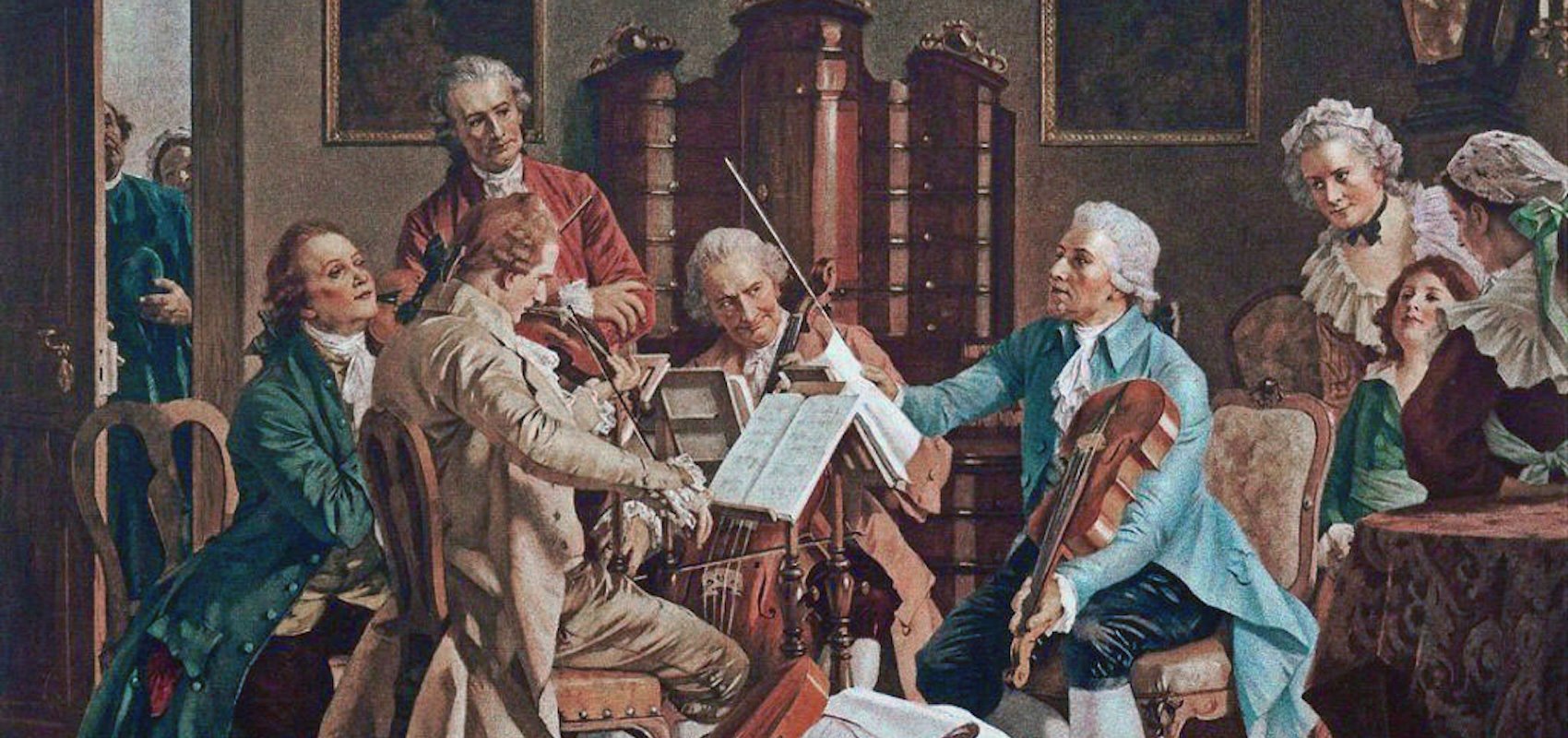
The Genius Myth:
The Dangerous Allure of Rebels, Monsters and Rule-Breakers
by helen lewis
penguin, 320 pages, $30
Writing early in 1810, diplomat and scholar Georg Griesinger gave the most detailed surviving account of the working methods of his recently deceased friend, the composer Joseph Haydn:
He was very strongly convinced in his heart that all human destiny is under God’s guiding hand, that God rewards the good and the evil, that all talents come from above. All his larger scores begin with the words In nomine Domini and end with Laus Deo or Soli Deo Gloria. “If my composing is not proceeding so well,” I heard him say, “I walk up and down the room with my rosary in my hand, say several Aves, and then ideas come to me again.”
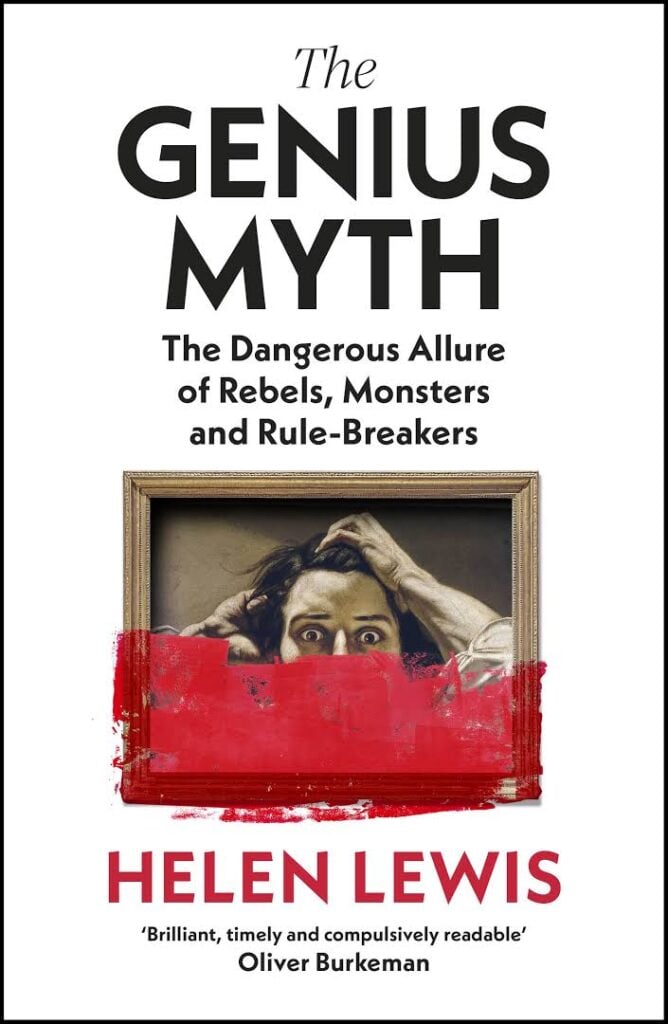
By any standard, Haydn possessed genius and—a very different thing—was recognized as a genius by his contemporaries. In his lifetime (which he spent almost entirely within 100 miles of Vienna), the reputation of his music spread across Europe. He received commissions from Spain and France, and when, late in life, he finally traveled to London, he was lionized. Critics spoke of his imaginative fire, Mozart addressed him as “Papa,” and his former pupil Beethoven knelt in public to kiss his hand.
You won’t find Haydn mentioned in the pages of Helen Lewis’s new book The Genius Myth, and not simply because Lewis shows almost no interest in the art to which I devote my own waking hours: Western classical music. That’s fair enough. Anyone dealing with a subject as vast as genius must be selective, and Lewis is aiming at a popular audience. (She has some interesting, if not particularly original, things to say about the Beatles.) The problem lies in Lewis’s subtitle: The Dangerous Allure of Rebels, Monsters and Rule-Breakers. Haydn’s career doesn’t fit that mold, or indeed many of the patterns of behavior that Lewis places in the foreground of her polemic.
There was no dazzling youthful breakthrough followed by decades of self-indulgent coasting. Haydn published his first truly revolutionary string quartets at the age of forty-two and is generally held to have written his best music in the two decades before his death at the age of seventy-seven. There was no oppressed wife patiently enabling the Great Man. (Haydn’s estranged wife derided his music and low social standing, though he supported her financially until her death.) His reputation was not the product of posthumous mythmaking. (It was fully formed within his lifetime.) Haydn upheld the social order, credited his gifts to God, and was widely described as a modest and compassionate man. He made generous provision for his servants in his will.
And so on. The same, or similar, could be said for a great number of pre-Romantic geniuses, though Lewis does quite a good job of winkling out the exceptions that serve her purpose. (Isaac Newton is the most notable, though Lewis finds further examples in Vasari’s Lives of the Artists, which she sees as a founding document of the Romantic cult of genius.) By singling out Haydn, of course, I’m cherry-picking. Having decided on the point I wish to prove, I’ve chosen the example best suited to prove it. But that seems as valid a way as any to approach a book that operates on essentially the same principle. Lewis believes that a reputation for genius gives social sanction to obnoxious behavior, and here’s a whole book of case studies, handpicked to reinforce that idea.
Anyone seeking a sustained or dispassionate interrogation of the nature of genius—the capacity of certain creative individuals to perceive and articulate something inaccessible to normal human understanding—will not find it here. Lewis opens with an exploration of “bardolatry” (the posthumous cult of William Shakespeare) and ends with the inevitable takedown of Elon Musk, and it’s hard to avoid the suspicion that the first is present primarily to enable the second. Certainly, anyone who believes that the current company at London’s Globe Theatre exists “to recreate the original performances as authentically as possible” can’t have seen much live Shakespeare there lately.
No matter: As early as the first page, a throwaway parenthesis warns us that Shakespeare was a “populist,” and Lewis’s preferred readers (she’s a writer for The Atlantic, having previously worked at the New Statesman) will know precisely what to read into that. Lewis isn’t here to examine the roots of what makes Shakespeare—or Newton, or Picasso, or Tolstoy, to name a few of her targets—matter, but to unravel why we think they matter, with the implication that they don’t, really, or at least not as much as we’ve been told they do. Her thesis is that familiar progressive Theory of Everything, that greatness is a socio-political construct, and she has a flair for the dismissive zinger. “Shakespeare might have started out writing for the groundlings, but he ended up working for the Warwickshire Tourist Board.”
Lewis acknowledges but sidesteps the Haydn problem, which she terms the “Austen Problem”: the countless geniuses of all eras who contradict her thesis by refusing to fall into the toxic stereotype. Her real beef (and it’s hard to disagree with her on this) is with the post-Romantic genius myth—the idea of Man as autonomous creator, a Promethean overthrower of norms, exempt from conventional morality. From Homer until the age of Haydn, creative humans acknowledged that their abilities were the gift of a higher power. The difficulties began when they started to regard those gifts as intrinsic to their own being. The ancient Greeks called it hubris; Catholics call it the sin of pride. At no point in history would either people have been surprised—as Lewis apparently is—that the upshot is “monsters, rebels and rule-breakers.”
Those sacred monsters, rather than the infinitely more complex question of the spirit that inspired them, are Lewis’s main subject, and they certainly make for an engrossing read. When you’re holding a hammer, the temptation is to see everything as a nail. But sometimes a nail really is a nail, and Lewis lands some satisfying hits. Her style is lucid, lively, and fun to read. She has a journalist’s nose for a good story and the same relish in retelling it. The chapter devoted to Richard Curtis’s 2019 film Yesterday (in which a failing musician wakes up in a parallel universe in which the Beatles never existed and promptly capitalizes on their back catalogue), and the largely forgotten screenplay with the same premise on which it turns out to have been based, is particularly juicy.
Lewis rifles enjoyably through the soiled laundry of famous men: Isaac Newton’s academic rivalries, Tolstoy’s emotional cruelty. Forgotten, supportive wives (like Tolstoy’s devoted Sofia) are brought out of the shadows and, in line with current thinking, are implied to be the true source of their husbands’ creativity. There are serious points about the distorting nature of the post-Romantic genius myth on scientific careers. That Thomas Edison had feet of clay is old news, but in the twenty-first century—when almost all serious scientific work is conducted collaboratively by large (often international) teams of researchers—the fact that the Nobel Prize continues to single out just one name seems unhelpful at best.
Overall, Lewis seems more at ease with science than with art, and she’s at her most compelling in the first section of the book, in which she anatomizes the nineteenth and twentieth centuries’ delusional attempts to measure and predict intellect—with results ranging from the ludicrous (the British high-IQ society Mensa instructed its members to wear yellow map pins in their lapels “as a ‘sign of genius’”) to the outright eugenicist. Generally, the results spoke for themselves. Lewis cites Victor Serebriakoff’s description of Mensa as “brain-proud Quarrelsome Underachievers Limited,” and she recounts the failure of the California-based Repository for Germinal Choice, more popularly known as the “Nobel sperm bank.”
In the end, one of the few Nobel laureates to leave a deposit in the bank was the physicist William Shockley, whose youthful Nobel Prize (Lewis suggests) was far from well earned, and whose conviction of his own genius gradually curdled into racial supremacism. Lewis presents him as an extreme case of “galaxy-brainedness”—the modern delusion (endemic in academia) that genius-level achievement in a specialized field automatically makes one an expert in all fields. (At the very least, Shockley sounds like he would be insufferable at breakfast. “What law of nature have you discovered?” he snapped, when a house guest contradicted him.)
That’s one of many cautionary tales in Lewis’s book. Her judgments are pointed and her arguments often persuasive, at least until her detachment slips. A modern parallel for Shockley’s “galaxy brain” delusions, she suggests, “might be a successful entrepreneur who succumbs to paranoia about the ‘woke mind virus.’” Well, yes. It might also be an experienced senior politician who has become so convinced of her own moral superiority that she dismisses potential voters as “deplorables.” Either would do; neither analogy is likely to persuade the unaligned.
These partisan asides are particularly frustrating because elsewhere Lewis is willing to examine the selective blindness of her own political tribe. A troubling, thoughtful chapter discusses the wokest-of-the-woke theater director Chris Goode, whose work was critically lauded in the left-wing press until his exposure as a pedophile in 2021. Lewis’s retelling throws into uncomfortable profile—without ever quite addressing—the far-from-mythical nature of genius itself: the ideas, insights, and artworks for which these messy and sometimes monstrous people are the conduit.
That’s the really thorny question, of course, and Lewis acknowledges that she’s avoiding it. She quotes Rebecca Solnit on the way that attacks on the “genius myth” are too often a means of avoiding the far harder task of grappling with the work and its implications: “I did a quick online search and found a long parade of people who pretended to care who did Thoreau’s laundry as a way of not having to care about Thoreau,” Solnit observes. “They thought of Thoreau as a balloon and the laundry was their pin.”
Lewis has a whole quiver of pins, and she’s not slow to use them. She’s a sparky writer, though you’re left with a depressing suspicion that her eloquence will equip a small army of midwit commentators and would-be debunkers with blog-ready debating points. She makes even her less credible arguments so quotably, and with such energy, that it can only be a matter of time before we start seeing them ripped from context and posted on social media with a triumphant “THIS.”
I’d like to think that this was not her intention, that The Genius Myth is not simply an extended argument ad hominem. It would be easier if Lewis appeared to admire—or even think very much—about the achievements of the individuals she demolishes so briskly. Ultimately, Anna Karenina is more interesting, and more important, than the question of whether Tolstoy’s private life would comply with twenty-first-century campus ethics. Lewis, it seems, disagrees. “In my view,” she deadpans, “James Joyce had one big idea—what if novels, but harder to read.” She dismisses most of Picasso’s mature output and sees in Les Demoiselles d’Avignon only “piglike pink figures with distorted faces.” All good, facile knockabout.
Yet people still grapple with Ulysses and gaze, shaken, at Guernica. Shakespeare’s plays and Haydn’s symphonies may owe their enduring relevance to accidents, social factors, and fashions. But at the core of their appeal is an essence that many people, over many years, have found to contain meaning, beauty, and truth—however they choose to define those qualities. That’s no myth. Audiences have agency, and creative reputations are not—have never been—solely what the Patriarchy, the Establishment, or Big Tech (choose your bugbear) says they are. Otherwise, the music of Arnold Schoenberg would be more popular than Beyoncé. As Ringo Starr once put it: “I think the main point of the situation is that those pieces of plastic we did are still some of the finest pieces of plastic around.” The Genius Myth is an entertaining, eye-opening, and sometimes infuriating read. But ultimately it’s beside the point.


YOU MIGHT ALSO LIKE
Pitch for a Catholic Novel
Imagine a middle-aged white man in good clothes waiting for a morning train at a station of…
Canada’s Offensive Secularism
On March 25, the Canadian House of Commons voted to repeal the good faith religious opinion defense…
Disclosure in Modern Poetry (ft. Glenn Arbery)
In this episode, Glenn C. Arbery joins R. R. Reno on The Editor’s Desk to talk about…
