On January 24, 2025, Mukhtar Mohamed Shariff was sentenced to seventeen years in prison for his role in a $250 million fraud scheme. Along with other members of the Dar Al-Farooq mosque in Bloomington, Minnesota, he had charged the government for hundreds of thousands of meals for children that were never served. President Donald Trump cited the scheme in March 2026 as he announced a task force dedicated to rooting out fraud in social-service programs.
Trump told reporters that the problem was concentrated in blue states and “heavily, heavily, heavily Democrat.” But the decisions that enabled the Dar Al-Farooq fraud, made over the course of decades, were bipartisan. The scandal reflects not only on Democratic governance but on the so-called faith-based initiatives associated with George W. Bush.
Sometimes recalled as an attempt at heavy-handed theocracy, faith-based initiatives were in fact an attempt to make government more nimble, effective, and pluralistic. Since World War II, the federal government has administered almost none of its domestic programs, relying instead on states, businesses, and established nonprofits. It enlisted religious groups in this system of “government by proxy,” but these tended to be large, established players such as Catholic Charities. The point of faith-based initiatives was to make federal funding accessible to smaller groups, including those run by churches.
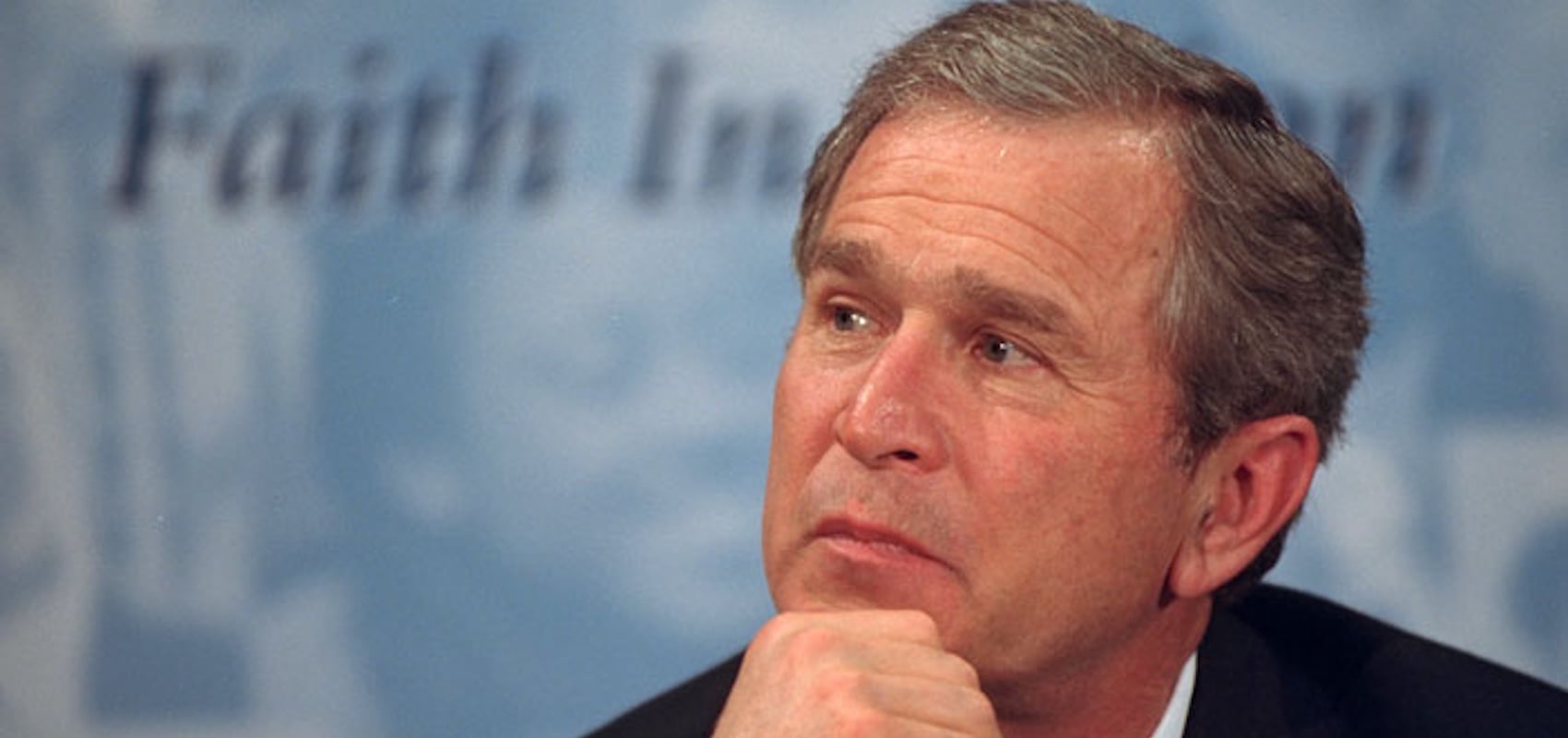
Both parties supported the idea. Bush gave the first speech of his presidential campaign on July 22, 1999, at a Methodist church in Minneapolis. Speaking to an audience of inner-city clergymen, he denounced belief in small government as a “destructive mindset.” In its place, he proposed collaboration between the government and faith-based and community organizations to deliver social services. Uncle Sam would join hands with “Methodists or Mormons or Muslims, or good people of no faith at all.”
Two months earlier, speaking at a Salvation Army rehab center in Atlanta, Vice President Al Gore had rejected the “dead-end debate” between “hollow secularism or right-wing religion.” Presenting himself as a unifying figure, he praised the ability of “faith- and values-based organizations” to work with the government.
Both men were building on an idea that had taken hold during Bill Clinton’s presidency. Between 1996 and 1998, Clinton signed four different “charitable choice” laws, which made it easier for smaller faith-based and community organizations to receive federal funds. These initiatives, which promoted the idea that private actors should provide social services, fit with the vision of the National Performance Review, better known as the “Reinventing Government” initiative. This initiative shrank the size of the federal workforce, but it did not reduce federal spending. It simply increased reliance on outside contractors.
But Bush went far beyond these efforts. He made faith-based initiatives a centerpiece of his campaign, a way to distinguish himself from both the hard-nosed right and the secular left. And he continued to stress them after entering office. He created an Office of Faith-Based and Community Initiatives, headed by the political scientist John J. DiIulio.
By championing faith-based initiatives in this way, Bush associated government by proxy with all-American values such as pluralism, religious faith, and entrepreneurial resourcefulness. He thus made the most serious attempt before or since to legitimate a system of government that operates with very little constitutional warrant or democratic accountability.
The need for such a legitimation narrative was obvious. The national debt had tripled over the course of Ronald Reagan’s presidency, and the federal government had only grown. It was hard to take the GOP seriously as a small-government party. And if the federal workforce seemed large, it was dwarfed by the number of people employed in the complex business of government by proxy. By 2006, DiIulio noted, for every one federal employee, there were nearly seven people working for outside groups paid mostly or entirely by federal funds to administer federal programs.
If federal bureaucrats seemed unaccountable to voters, issuing new rules and regulations without even having to vote, the same was even more true of government by proxy. While using taxpayer funds, these new entities avoided the constraints placed on government. There was no way to argue that this arrangement respected popular sovereignty. So the promoters of faith-based initiatives hit on another warrant: market logic. As DiIulio recounted in a book about his experience in the Bush White House, the ideal recipient of government funds would “outperform its nonprofit market competition over time, even if only by producing the same civic results at a smaller human and financial cost.”
Another source of legitimacy was to be found in the faith-based initiatives’ celebration of diversity. DiIulio understood the United States as “a godly republic defined by religious diversity.” This view was informed by his youth in Philadelphia, where Italian priests rubbed shoulders with Pentecostal ministers. By ensuring that federal funds extended to every corner of American society, faith-based initiatives would grant government by proxy a kind of representative legitimacy. Government largesse would go to everyone, and it would be administered by all kinds of organizations.
By DiIulio’s own account, Bush’s faith-based program had little effect on the allocation of federal funds. Its true significance lay in the way it sought to reconcile Americans to their actually existing system of government. And it is precisely on those grounds that it must now be judged a failure. The Minnesota fraud case is a demonstration of the drawbacks that can attend disbursement of government funds to private actors. But it is also an extreme case. More common problems are the growth of nonprofits that, though not fraudulent, nonetheless have a perverse incentive to perpetuate and even increase the problems they exist to solve, because only thereby can they increase their federal funding. Religious institutions face a particular temptation to become docile before the government on which they depend.
Even for true believers, doubts have crept in. In 2014, DiIulio published Bring Back the Bureaucrats, a book denouncing what he had come to call “leviathan by proxy” and insisting that government funds could be more responsibly and efficiently spent by actual government employees. The idea that the intermixing of the public and private spheres was a positive good had begun to fade. One problem was that no clear evidence ever arrived suggesting that small faith-based actors were more efficient than large-scale operations. The market logic did not hold.
Americans also turned out to be less interested in pluralism than the promoters of faith-based initiatives supposed. This fact was evident from the first days of Bush’s presidency, as secular groups and some Democrats attacked the program as a theocratic Trojan horse. The outcry would eventually find a strange echo on the right, as concerns over uncontrolled immigration and rising diversity helped turn immigration fraud in Minnesota into a national controversy. As the libertarian scholar Ilya Somin has written in summarizing a large body of research, “ethnic heterogeneity greatly reduces support for welfare state spending.” When it comes to the provision of social services, diversity is not our strength.
As American citizens dedicated to accountable government, and as religious people jealous of the integrity of our own institutions, we should seek to dismantle the nonprofit–industrial complex—by ending ill-advised interventions and by returning essential services to direct administration by the government. This task will not be easy. But it is better than giving a religious sheen to a form of government under which the American people are chafing.