
It was the Sunday of Epiphany, but we, a group of Protestant college kids tired from touring, didn’t know it. Not, at least, when we set out for Bethlehem late that afternoon on January 8, 2023.
As we traveled into Palestinian territory to visit Bethlehem, we stopped at the West Bank barrier to contemplate its manifold graffiti. Among crude representations of Donald Trump, declarations of “Free Palestine,” and paintings of young children encountering soldiers, one phrase graffitied in all-caps upon the barrier particularly caught my attention: “Rachel is weeping.” The phrase is taken from the prophecy of Jeremiah and famously quoted in relation to Herod’s murder of the innocents in Matthew’s Gospel: “A voice was heard in Ramah, weeping and loud lamentation, Rachel weeping for her children; she refused to be comforted, because they are no more” (2:18).
Rachel, the graffiti artist suggests, weeps still. Her weeping still transcends time and holds the figural significance given it by Matthew. Perhaps she weeps for her own murdered people. But more likely, at least by virtue of the graffiti being on the Palestinian side of the barrier, the graffiti artist contends that Rachel weeps for all murdered innocents, whether Palestinian or Israeli.
Whatever the case, Rachel’s mournfulness followed me into Bethlehem that gray January day. What’s more, Bethlehem, like Nazareth, the Jordan River, and many of the other famed sites we visited, did not possess the quaint and holy quality I hoped it would. I doubt Bethlehem felt quaint and holy to the Holy Family as they sought a place to stay or to the Magi as they, some time later, sought the mysterious child-king. Perhaps they felt, as I did, rather overwhelmed by the place. For the noises of traffic and of the Muslim call to prayer resounded through the streets, Christmas decorations blinked, souvenir shops beckoned from every corner, and people—whether tourists like ourselves or Palestinians in hijabs or keffiyehs—swarmed everywhere.
As we made our way in the darkening evening through the crowded Manger Square and even more crowded Church of the Nativity, my own mind, too, was crowded with doubt and uneasiness. Upon entering the church through its low door—the “door of humility”—and descending further into the Grotto of the Nativity, I felt that typical Protestant distaste at the finery I saw, and I felt a surge, too, of that rationalistic skepticism common to Protestants and all moderns: Is tradition trustworthy in this matter?
The place has been honored by Christians since the second century as Christ’s birthplace. It is therefore the oldest site of continuous Christian worship in the world—over a thousand years older than my own church tradition and the skepticism that too often accompanies it. Helena, the mother of Constantine, likely encouraged her son to commission the church after her pilgrimage to the Holy Land. Supervised by Bishop Makarios of Jerusalem under Constantine’s orders, construction began in A.D. 326, around a year after the Council of Nicaea. Today it represents a sort of common ground between the Orthodox, Catholic, Armenian Christians, and others who worship there.
In the grotto, Christ’s birthplace is covered in marble and marked with a fourteen-point silver star engraved with the words “Hic de Virgine Maria Jesus Christus natus est” (“Here Jesus Christ was born to the Virgin Mary”). The nearby manger is likewise covered in marble and decorated with various candles, lamps, and hangings.
I did not appreciate the marvelous simplicity of that little word “hic”: Here Jesus Christ was born. At the time, I reckoned that whatever the place might have been had long since been buried under stone and jewels and artwork. As classicist and biblical scholar E. M. Blaiklock put it in his book Eight Days in Israel, Christ’s birthplace seemed to me to be “hung and cluttered with all the tinsel of man’s devotions.” And my own heart was cluttered with skepticism and fatigue.
But now, as I look back upon that Epiphany Sunday, I do so with the awe that I ought to have felt in the grotto.
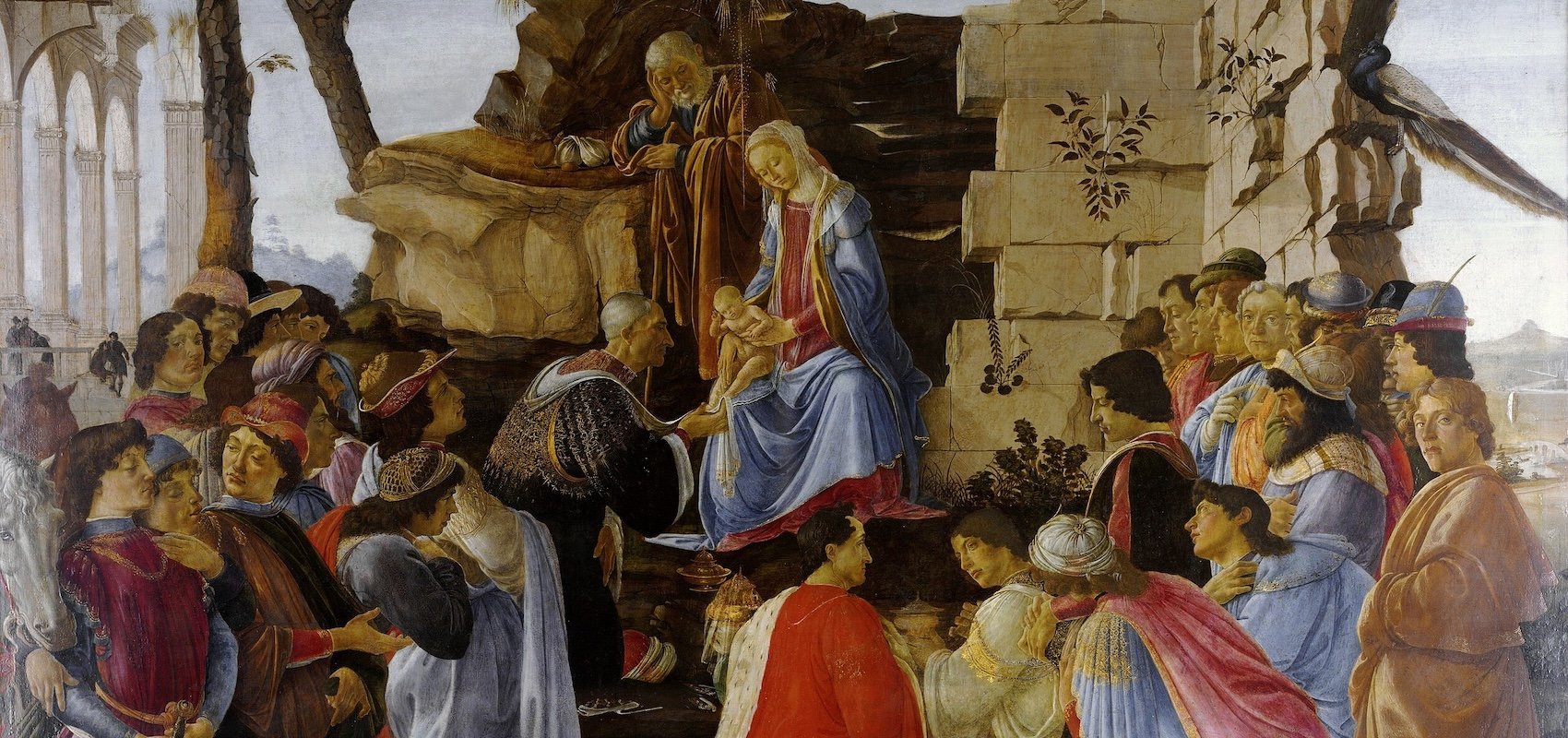
For little did I appreciate the rarity of the opportunity to visit the tension-riddled Holy Land, which in a few months after our visit would descend into war following the October 7 massacre. Little did I realize the great significance of standing before Christ’s birthplace as tourists from my own country and many others milled about me, talking in hushed tones of languages I hardly recognized, yearning for their chance to stand before the star or manger. Little did I comprehend that Providence had allowed us Gentiles to arrive at Christ’s birthplace on the same Sunday that the church celebrates Christ’s first Gentile worshippers, the Magi. And little did I connect the Magi’s generosity of great finery—gold, frankincense, and myrrh—with the same worshipful spirit that has encouraged Christians throughout the centuries to decorate and honor that most honorable place of Christ’s birth.
I did not have the humility to do so.
My experience of Epiphany in Bethlehem did not impart any large-scale lessons or grand mysteries to me, but my memory of it has, over time, come to manifest to my mind the meaning of Epiphany. I see, now, that centuries later the nations are still coming to him and to the place of his birth. And they are kneeling before him, with that humility that I, too, am still learning.
In Anglican priest-poet Malcolm Guite’s sonnet on Epiphany, he writes of our connection with the Magi:
But when these three arrive they bring us with them,
Gentiles like us, their wisdom might be ours . . .
They did not know his name but still they sought him,
They came from otherwhere but still they found;
In temples they found those who sold and bought him,
But in the filthy stable, hallowed ground.
Their courage gives our questing hearts a voice
To seek, to find, to worship, to rejoice.
The revelation of Christ to the Magi represents, too, his revelation to us. With them, we are invited to seek, to kneel, and to rejoice. The Herods of the world still reign: The heaviness imparted by the West Bank barrier and its reminder of Rachel’s weeping did not disappear from my heart as I stopped in the Grotto of the Nativity, nor has it disappeared as I have reflected on that day. The innocents of the world are still murdered, mutilated, bombed. But in the grotto shines that star that has already put to shame and will finally overpower every Herod and every evil: God in his mercy is beckoning worshippers to his “hallowed ground,” both in Bethlehem and to the ends of the earth.
