
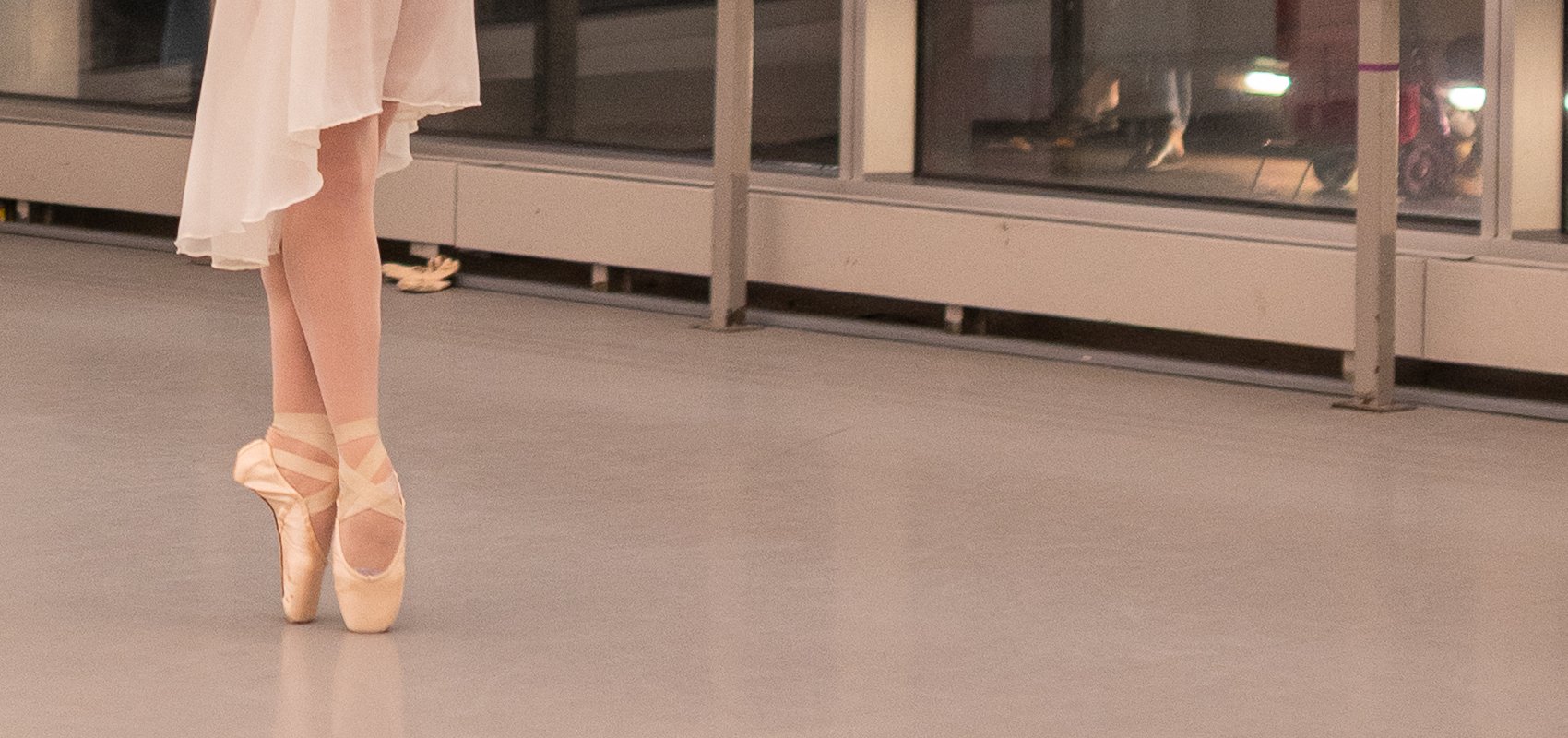
This fall, Arthouse2B, in partnership with Ballet Hartford, hosted a performance named “Ballet and the Theology Within” in New York City. The Big Apple is known for its ballet: New York City Ballet, American Ballet Theatre, Joffrey Ballet. But ballet and theology are not often paired together. Arthouse2B, a lively Catholic artistic community, was founded by artist Erin McAtee and ballerina Claire Kretzschmar out of a love for art and a recognition of the sacred nature of art.
The performance featured six excerpts from ballet pieces choreographed by Kretzschmar, former NYC Ballet soloist and director of Ballet Hartford. Kretzschmar explained that her choreography centers on faith. The centrality of the Catholic faith to her life pours into her artistic work—or, rather, comes alive in it.
Each piece was imbued with sacred symbolism. The first, for example, was set to a musical composition written for the thirteenth-century hymn Ave Verum Corpus, “Hail True Body.” The dance, Kretzschmar explained, was in honor of the Mother of God and sought, in its precision and grace, to communicate her beauty.
One of my favorite excerpts was titled “The Angel Solo from A Ceremony of Carols.” The dancer, as the Archangel Gabriel, carries the eternal message through the heavens to the Virgin Mary. The dancer did not wear pointe shoes (worn in most of the other pieces), but flat shoes, which Kretzschmar noted have a connection to strength. The dancer’s steps, precisely made, communicated angelic power and grace.
In my other favorite piece, titled “Procession from A Ceremony of Carols,” everything began in perfect silence. Three dancers, facing toward the opposite wall, remained still until notes began to trickle like water and, one by one, they stepped forward and curtseyed, as though toward an altar. They danced in harmony until the music brightened and they burst into individual dance. In the Church, we are all one in the body of Christ, but we retain our individuality.
Following the performance, the audience had the opportunity to ask Kretzschmar questions. “Do your pieces always have so much thought put into them and so much depth?” one person asked. Her response was interesting. “I put a lot of thought and intention into each one,” she replied, “but a lot of meaning comes of its own when the piece is performed.”
Theology is often understood, today, as an academic discipline, a field of study, something you go to school for and master. And yet, for the ancient Christians, the theologian was the one who did not just know about God but knew God. To be a theologian was to know the Really Real. Theology, then, is not just a corner of study, but the knowledge of the Really Real, the place from which all reality comes.
Ballet, like all art, is able to represent reality, to convey something unspeakable and otherworldly, to express the true nature of our lives. In that aspect, it is profoundly theological. It makes visible the invisible and reminds us that the other world is not at all far from our own.
But art has the ability to present and communicate a false reality, too. More and more, the recognition in our Western culture of the lines between good and bad art is slipping. In a world that increasingly conforms itself to a false image of reality, beautiful art has become more precious than perhaps ever before. It is a reminder, in the deepest sense, of what is real, what story we are a part of, who we are, where we are going.
Arthouse2B recognizes the sacred nature of art and our need for it. They are protecting and giving something that is not just a nice weekend event, but something transformative to performers and audience members alike. In the heart of New York City, they keep a lamp burning bright when many, from neglect, forgetfulness, or by intention, have gone out. They pour that light into the world and into hearts.

YOU MIGHT ALSO LIKE
Dimes Square: An Oral History (ft. Nick Allen)
In this episode, Sovereign House and Reign founder Nick Allen joins Virginia and Germán to discuss Dimes…
Admiration as Inspiration (ft. Elizabeth Corey)
In this episode, Elizabeth Corey joins R. R. Reno on The Editor’s Desk to talk about her…
Lyric as Disclosure
Back in 2014, my wife and I bought a house on six acres of land several miles…
