
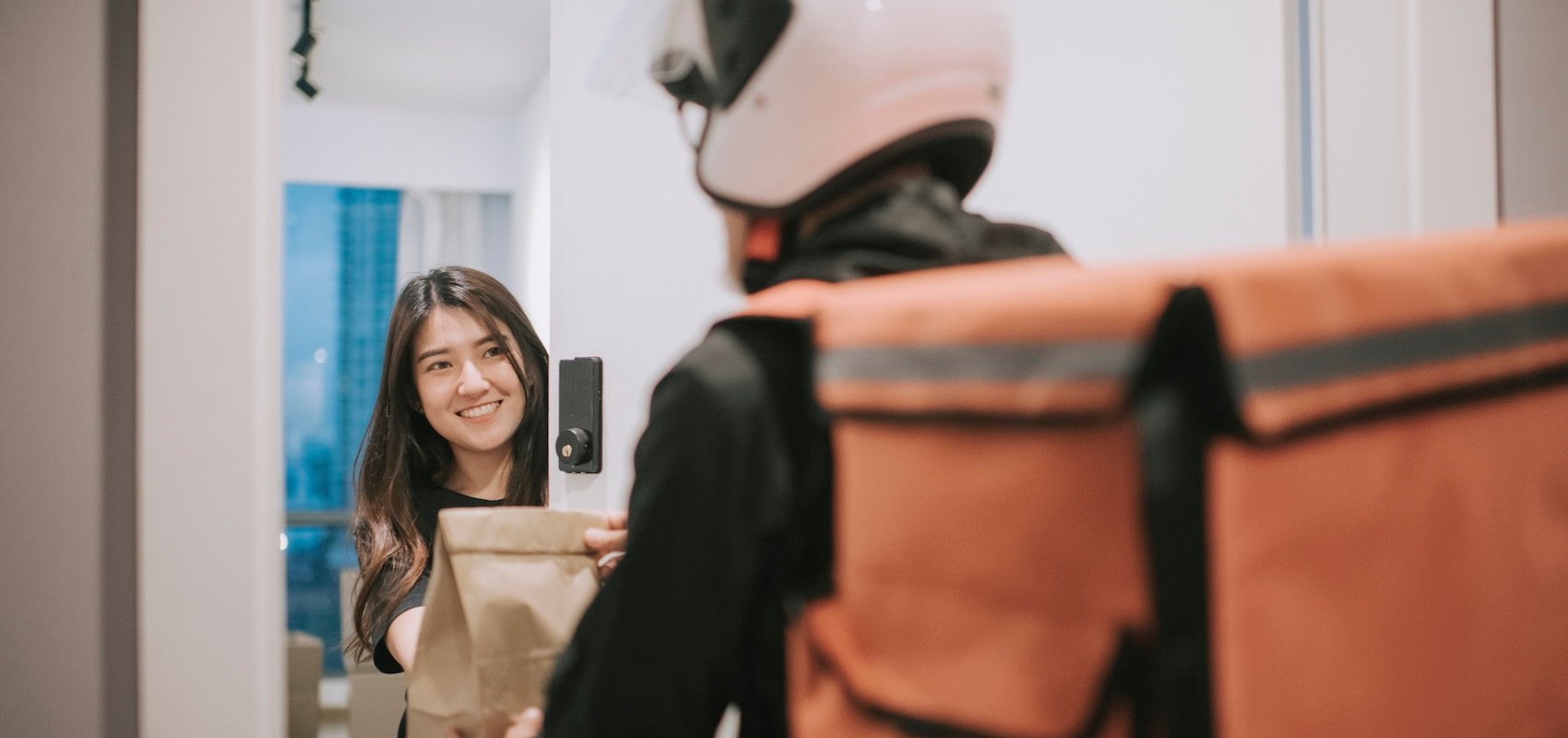
In a recent New York Times article entitled “Freedom With a Side of Guilt: How Food Delivery Is Reshaping Mealtime,” we learn that almost three out of four restaurant orders nationwide are delivered, rather than actually enjoyed in the restaurant. The author, Priya Krishna, interviews a young woman who spends $300 a week, roughly a third of her salary, on delivery. Another woman works as a sommelier but, nonetheless, has most of her food delivered at home. As we learn, “She no longer feels the social pressure she once did to meet friends for dinner.” It seems that most of those interviewed by the Times feel vaguely guilty about delivery drivers and the environment, but not, of course, enough to inconvenience themselves.
We also meet a couple from Atlanta, Kevin Caldwell and his husband, who spend about $700 a week to order in. They are, we are told, too busy raising their two young boys and working long hours to cook dinner. “His 4-year-old son doesn’t read yet, ‘but he can put together an order’ on the Chick-fil-A app, said Mr. Caldwell, 39.”
Well. It’s hard to know where to begin.
On the one hand, I too enjoy the occasional take-out dinner. When our daughter was young, every two weeks or so, we ordered pizza from our beloved neighborhood institution, V&T’s, on Manhattan’s Upper West Side. The same husky voice always answered the phone, and she always called me “honey.” In those days, we paid the delivery man in cash, and the pizza arrived piping hot.
On take-out night, I set the coffee table in the living room, rather than our apartment’s dining room table, but we still used candles and linen napkins. We sat on the floor, sometimes in our pajamas, and watched an old movie. It was a cozy, relaxing evening for all of us—a comforting family ritual.
But when I contemplate the lives described in this article—a steady diet of restaurant or fast-food cooking, ugly and environmentally ruinous plastic containers, the obscene waste of money, and, most importantly, the absence of companionship and ritual—I am, quite frankly, horrified. It is not far-fetched to trace a direct line from DoorDash to civilizational collapse.
I know nothing about Caldwell and his partner, but it is reasonable to wonder how they made their family. Did they order their babies online and have them delivered? Did they buy one woman’s egg and rent another’s womb? If so, they intentionally deprived their boys of a mother—the woman who fed the baby with her body in the womb, and who could have fed that baby with her milk outside the womb.
Now the fathers tell us they are too busy “raising two young boys” to cook. But, you see, cooking is raising their boys—feeding their children real food, teaching them how to cook, how to set the table, how to sit still and converse, how to wash the dishes. This is parenting 101. If they are failing to do this, they are certainly not “raising” their sons.
Not only has this couple, if my assumption is correct, willfully deprived their children of a mother. They have also failed at elemental parenting, in this case, the role traditionally filled by a—dare I say it—mother. Should we laugh or cry? One is tempted to call it child abuse.
We have long known that one of the most important factors in predicting the health, both mental and physical, of a child is whether she eats dinner together with her family. A lovingly prepared, healthy meal, eaten around a table with loved ones, while engaging in conversation, is the glue holding everything else together.
Thirty-six percent of American children are overweight. The number has tripled since the 1970s. Our food industry produces addictive non-foods, and our tech overlords create addictive social media. The average child spends forty-two to forty-nine hours a week on screens.
But the rot begins in the home. When a parent, or indeed anyone, says they have no time to cook because they are working long hours, we must advise them to rethink their lives. Their priorities are upside down. We do not eat to work. We work so that we may eat—in the most joyous fashion possible.
We are not machines who need fuel. We are human beings who require food and love, two separate needs but deeply intertwined. As a baby needs her mother for both food and love, so we need nourishing food cooked by loving hands. Food is love. A home without home-cooked food is no “home” at all.
If it is disastrous that we no longer cook or eat together at home, it is almost equally depressing that three out of four restaurant meals are not actually consumed on the premises. One of life’s great joys is getting dressed up and eating in a wonderful restaurant. Delicious food, careful service, and a room lit to make everyone appear beautiful. Sparkling conversation, witty repartee, romance, and glamour—all are made possible by the magic spell cast over guests in a really good restaurant.
Alas, over the past few decades, many restaurants, even those with superb food and high price tags, have abandoned their white tablecloths (metaphorical or actual), candles, and dress codes. They have opted for irony and hip vibes, for maximal cool and minimal ambiance. They are thus complicit in the problem, and one is increasingly likely to see Michelin starred food served to customers in sweatpants and baseball caps.
When the eating-out experience is no different from eating at home in one’s pajamas, it is hardly surprising that so many are choosing to order out. If we’re all going to look like slobs, I’d rather do that in the privacy of my own home without having to look at other people.
It was once customary to “dress for dinner,” even at home. Dinner was an occasion, an opportunity to come together to gossip, solve the world’s problems, or lament homework. And we began by thanking God for the blessings of his food. Gratitude to God, respect for each other; real food, real love.
As a society, we are sick in mind and sick in body. We are unhealthy and unhappy, fat and lonely. We have forgotten how to speak to each other and how to treat each other. None of this will be easy to fix, but it all begins at the dinner table. There is indeed a direct line from DoorDash to civilizational collapse. Good Lord, deliver us.
