
During the last year or so, I’ve worked on a memoir. The topic is my youth spent chasing rock-climbing dreams. At age eighteen, I went to Yosemite Valley rather than college. Those months fired a lifelong passion that has both bewitched and instructed me for decades. Here’s a snippet.
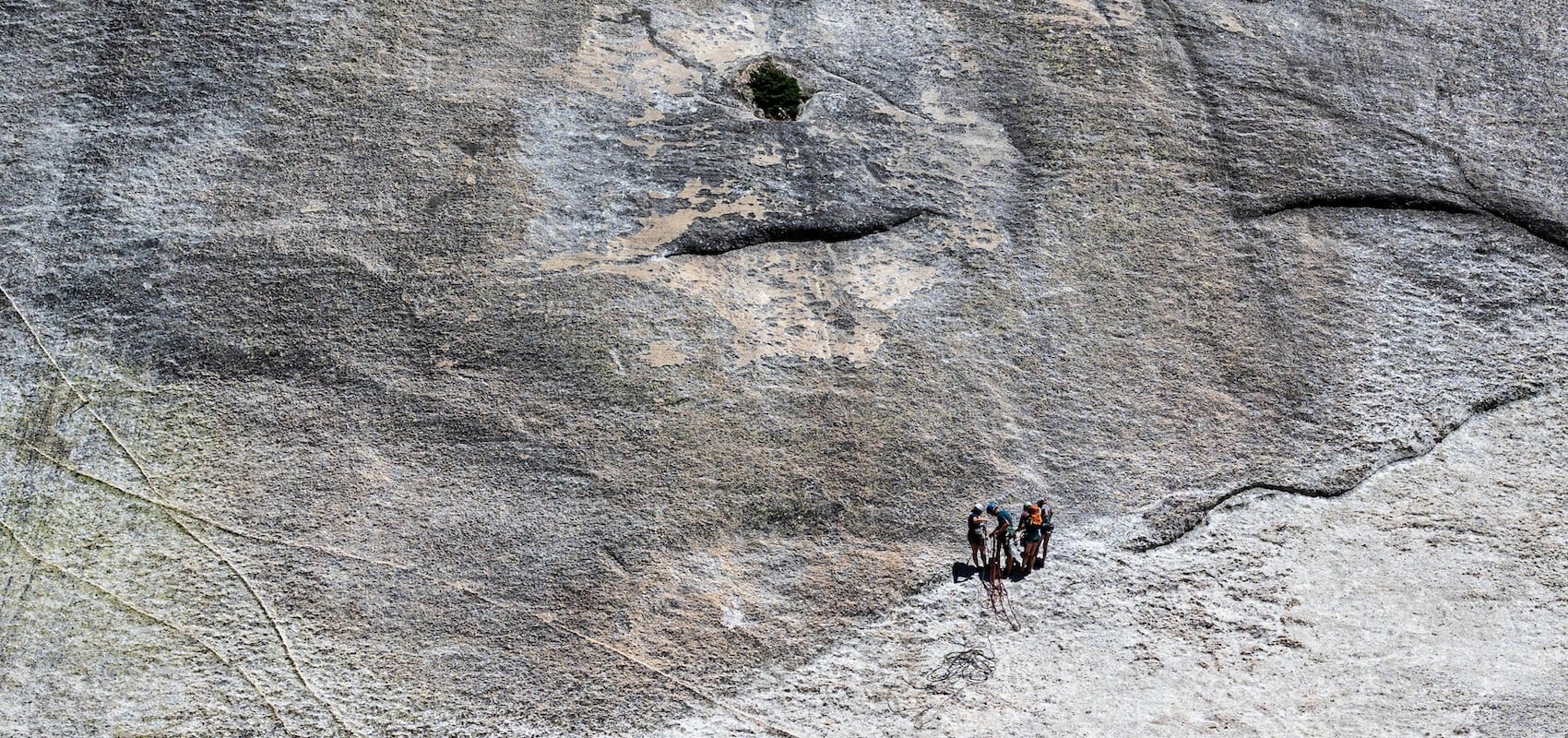
It’s our fourth day on the Pacific Ocean Wall, a technical route up the vertical face of El Capitan, Yosemite’s most imposing monolith. I can still see the events in my mind’s eye. We’re more than 2,000 feet above the valley floor. Dirk has led an A5 pitch. Charles is cleaning it as I hang from the belay, alone, the third man, waiting for the process to be completed so that I can jumar the free line up to the next belay. I’m wakened from my daydreaming by a scream. I look down and right, where another party has just begun a nearby climb. An ant-sized person is frantically running back and forth at the base. I hear more screams, this time for help. Charles stops cleaning and looks down. Dirk yells from the belay above, “What happened?” I reply, “I don’t know?” But in the next moment, as I recover from the initial shock, I do know.
The evident distress in the movements of the tiny figure far below conveys a clear message, as does the eventual arrival of others who assemble in the open patch of jagged boulders at the base. It does not require expert knowledge to recognize that a rescue is underway.
As we would learn when we completed the climb a few days later, my inferences were correct. On that terrible morning, Chris Robbins was jumaring a rope positioned across a sharp edge. It severed, and Robbins fell to his death.
While writing about this event, I reviewed my journal from spring 1979. I had composed an entry about our seven days on the Pacific Ocean Wall. In those brief notes, I made no mention of witnessing the death of Chris Robbins. I don’t think I wanted to remember. I had not known him. His death, though near for a moment, was far from my life.
Or so I thought, not understanding in those salad years of my youth the role death plays in climbing. For however imbued the three of us on the Pacific Ocean Wall may have been with a young man’s tacit belief in his own immortality, Charles, Dirk, and I were sensible of the dangers we were courting. It’s impossible to make your third or fourth hook move above a half-dozen copperhead placements without a profound sense of foreboding. Even the safest moments are tinctured with anxiety. You can be attached to a secure anchor, but when you are hanging on a vertical wall two thousand feet above the ground, you feel the pull of gravity, aware that, should something go wrong, you’re doomed.
Mortal danger repels us. We take great care when approaching the edge of a sheer cliff. We are rightly dubious about climbing to the top of a wobbly ladder. We want to live! The use of ropes and equipment in climbing answers to this fundamental desire. Safety measures play a central role in the art of climbing. You learn how to set up anchors, place gear, belay, and rappel.
And yet the question is obvious: Why take the risk at all? Why not remain satisfied with hiking beautiful mountain trails and scrambling up the easy slopes of hillsides?
The answer is mysterious: Mortal danger repels, but it also attracts. Some people like to drive fast on narrow mountain roads. They feel a sense of self-possession as they give their entire being to the task of driving. The prospect of veering off the road and plunging down the mountainside may not be uppermost in their minds, but they feel its possibility. Oddly, the feeling is not negative. It does not darken their experience behind the wheel. Rather, it enhances the powers of concentration that make them fully present to themselves, at one with the acts of accelerating, turning, braking, and re-accelerating. Danger breaks the grip of the past on our minds and drives away anxiety about the future. It brings the present into focus, and for this reason, peril excites a profound feeling of being alive.
This experience is precious, because in its fullest sense, life can be elusive. Often we do as others require, or we follow the herd, living a life not quite our own. Take my younger self. Truth be told, I had no coherent sense of who I was. But I figured I had time to sort things out, time to “find myself,” as people often say.
But more time—an open future—is both a blessing and curse. Of course we want more of life, not less. Yet the conviction that we have more time allows us to defer. Next year, after I complete this degree or gain this promotion, I’ll know what I really want to do with my life. Milestone reached, I’ll have a sense of who I am. Or so we imagine, for there’s always another hurdle, another milestone.
Death settles all questions. Once I have died, I will have been who I have been—and no one else. I won’t experience this completion, of course. Death is always over the horizon. And when it comes, there will no longer be a “me” to tally things up, to make sense of the whole. (Christianity and Judaism affirm the immortality of the soul, but the “summing up” is God’s judgment, not in our postmortem self-assessments.) Yet a presentiment of our end can cause us to stop short. The prospect of death can bring clarity. The ancient Romans cultivated the spiritual discipline of regular contemplation of one’s death. It went by the name of memento mori, “remember that you must die.” If we keep the reality of death before us, we are more likely to know what we truly desire, what we really believe, and what and whom we love most.
Climbers are not uniquely wise or self-aware. Like others, we fend off the reality of our impending death. When we talk about someone who died while climbing, we often reassure ourselves that we’d never have made his rookie mistakes. Or we simply think of other things, jawing back and forth in the campground. In our worst moments, climbers adopt a dismissive attitude, never outwardly articulated, but often inwardly felt: It was tactless of Chris Robbins to die, reminding us of our mortality!
Still, the mortal risk of climbing affects climbers, even as they pretend otherwise. It has an effect akin to that of memento mori, even if unconsciously felt. On many occasions, when I’ve been in a difficult spot, the element of danger has heightened my self-presence, as the demands of the moment bear down upon me. If things take a bad turn, I will die, not “they.” It’s not the case that “someone” must make the move or otherwise navigate the difficulties. I must do so.
In these difficult moments, I feel strongly my will to live. It’s not a generalized feeling. On the contrary, it’s highly focused, collapsing my sense of self into a singular task and purpose. Unlike so much of life, which bumps along without focus, I know in these exposed situations with adamantine clarity what I want, what I desire: to make the move! Fingers gripped on delicate holds; feet carefully positioned; mind thinking of nothing else. Time stops. My whole life is now concentrated in this moment. It’s a paradox: The darkness of death casts a strange light, the more brilliant the closer it comes. The risk—all consciousness of which has been banished from my mind by the urgency of the situation—heightens my sense of being alive.


YOU MIGHT ALSO LIKE
Godson
I doubt you’ll be a simple kind of manbut listen to the song. It’s a good plan.…
How Science Killed Materialism
At the beginning of the twentieth century, materialists could feel triumphant. The four preceding centuries had yielded…
A Clean, Well-Lighted Place with Wifi
As waiters glide across the room,espresso steams beside my bookon the small, round table.The low purl of…
