
The Trump administration’s recent military engagement with Venezuela and rhetoric with respect to Cuba, Colombia, Mexico, and Greenland mark a new bellicosity in foreign policy, and one at odds with the antiwar tenor of the president’s campaign rhetoric. In the case of Greenland, the aim is a frankly expansionist one of securing new territory for the U.S. What should a Christian think of all this?
Elsewhere, I have argued that President Trump’s intervention in Venezuela and threat to annex Greenland by force do not meet the conditions set out by just war doctrine. But in online Catholic circles, some have suggested that precedents from Christian history lend support to an expansionist foreign policy. Some point to the Crusades. Others suggest that the Catholic empires’ colonization of the New World shows that wars of conquest can be legitimate. Among those taking such a position is the popular podcaster Matt Walsh.
These arguments, however, are entirely without merit. Whatever one thinks of the Crusades and the history of the Catholic empires, they provide no theological or moral justification for actions like taking Greenland by either military force or the threat of it.
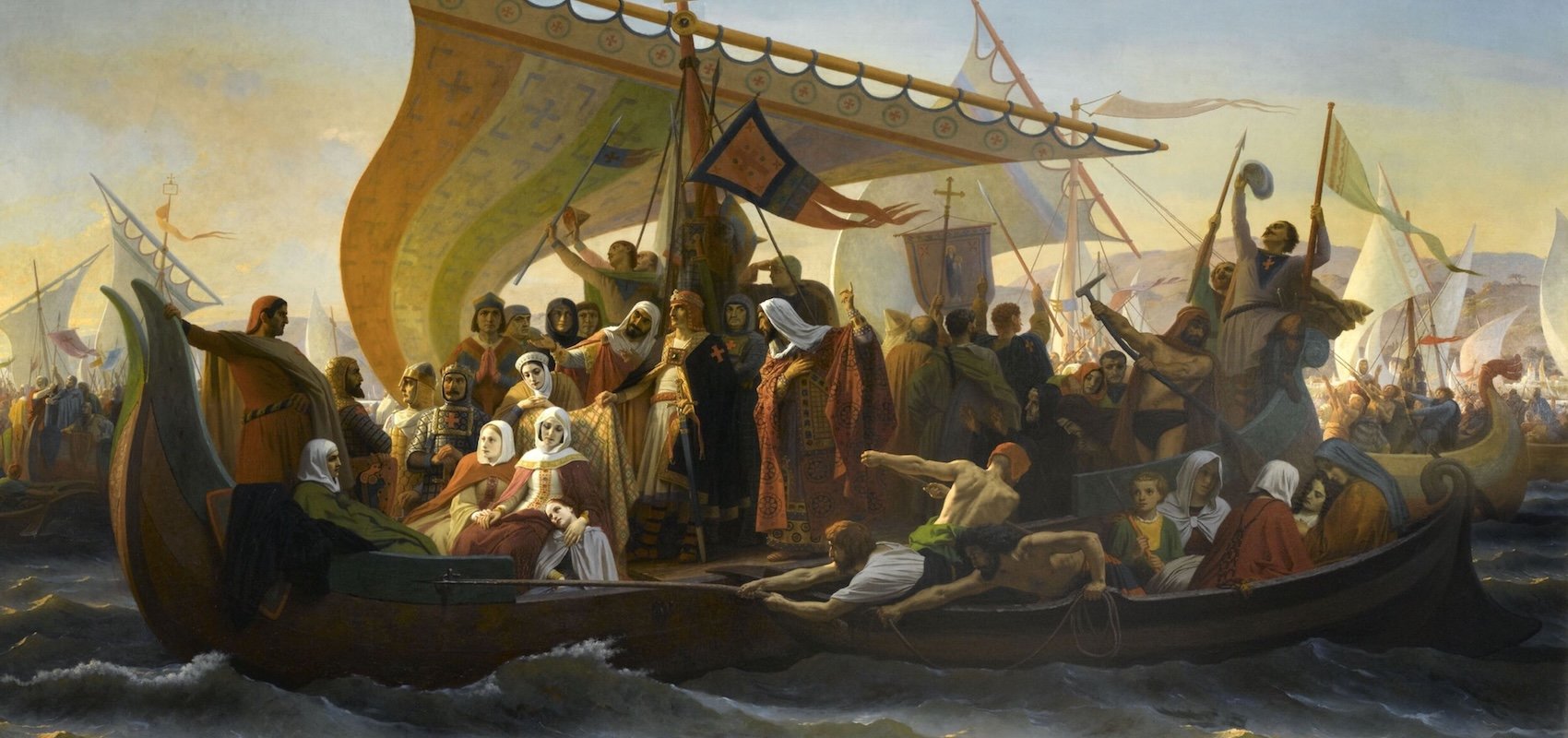
This is obvious enough in the case of the Crusades. The Crusades were military actions authorized by the pope for purposes such as recovering territory that had been unjustly taken by Muslim conquerors, protecting Christian pilgrims in the Holy Land, and suppressing heretical movements that endangered the social order. Notoriously, serious evils were sometimes committed during the Crusades. But as Catholic apologists often rightly point out, the extent to which this is the case has been somewhat exaggerated. Nor does it entail that the causes for which the Crusades were fought were always bad ones.
However, all of that is irrelevant to the question of whether it would be legitimate to take Greenland by force. Such an action would not involve the U.S. reclaiming something that once belonged to it, much less protecting pilgrims or suppressing heresy. Nor, of course, would it have papal authorization. The Crusades, therefore, provide no precedent at all for what the Trump administration may have in mind.
It might seem at first glance that the Spanish Empire’s colonization of the Americas affords a more plausible precedent. But it does not. The fact that the empire happened to be Catholic does not by itself prove anything. What matters is what the moral teaching of the Church had to say about the matter. As I have documented in the second chapter of my book All One in Christ, a series of popes from the sixteenth century onward vigorously condemned the harsh and unjust treatment of the American Indians, including their enslavement. The greatest Scholastic theologians of the day, such as Francisco de Vitoria and Bartolomé de las Casas, did the same. Their teaching was often ignored. But what should matter for Catholics is the teaching itself, not the bad example of those who ignored it.
Nor did the Church of the day or her theologians teach that taking another country’s territory by force was a legitimate cause for war. On the contrary, as Vitoria wrote in On the Law of War, “enlargement of empire cannot be a cause of just war. This proposition is too well known to require further proof.” The standard teaching of the Scholastics, following in the tradition of Augustine and Aquinas, holds that the only just cause for a nation to go to war is in response to harm inflicted by another nation. This by itself suffices to condemn as unjust any U.S. attempt to take Greenland by force.
Does this necessarily entail that Spanish colonization was in every way unjust? No. Where colonization is concerned, the Scholastic tradition came to draw an important distinction. On the one hand, there is territory that is already owned or occupied by a state or by a people who are organized in such a way that they may be regarded as an incipient state. For another nation to attempt to seize such territory by force would be unjust aggression. On the other hand, there is territory that is unclaimed by any state, is uncultivated and undeveloped, and sparsely populated by nomadic peoples without even any incipient central political organization. This sort of territory could—under certain circumstances—be colonized.
This too gives no support to any U.S. invasion of Greenland. Denmark has for centuries already had a claim over it (one long recognized by the U.S.). And even if it were given complete independence from Denmark, it would be considered an incipient state.
Then there are the reasons that Catholic theologians gave at the time of colonization for its purported legitimacy. Vitoria provides a classic treatment of these in his work On the American Indians. Some argued that the Holy Roman Emperor and the pope had legal jurisdiction over the whole world, and that the pope had given the New World to Spain (whose ruler, Charles I, was also the Holy Roman Emperor). Some argued that the American Indians had lost any right to the land because of their sins, or because of their refusal to become Christians.
Vitoria presented compelling objections against these and other arguments, but he held that there were also some cases where conquest could be legitimate. One such case would be if the American Indians had themselves shown aggression toward Spaniards who were simply exploring territory; or if they had positively tried to prevent the Spaniards from spreading the gospel; or if Indian rulers were gravely oppressing their own people, for example, by practicing human sacrifice. Obviously, though, neither the arguments Vitoria rejects nor those he accepts have any application to the Greenland situation, nor do the Trump administration’s own arguments in any way resemble them. Once again, we have nothing here that provides justification for a U.S. war to annex Greenland.
So, the claim that the history of the Catholic colonial powers provides a basis for defending a U.S. military action to seize Greenland is completely bogus. But there is one more argument that some commentators online have been trotting out.
The Old Testament famously describes ancient Israel’s conquest of Canaan. This, some argue, provides a model for a legitimate American conquest of Greenland. But the comparison is absurd. In the scriptural account, the ancient Israelites were not acting on their own authority. Rather, they were acting under divine authorization, mediated through prophets. And since God has authority over life and death that no human being has, he may command certain things that no human being could do on his own authority. Nothing like that applies today—and indeed has not applied for over two millennia, given that the Church teaches that no prophets have been sent since Jesus. The Trump administration in particular can hardly claim divine authorization for a Greenland invasion.
There is, then, no theological support to be found for such an attack. It would clearly violate the traditional natural law criteria of just war doctrine. U.S. seizure of Greenland by military force would be as manifestly unjust a war as any in recent memory.

YOU MIGHT ALSO LIKE
Turned Away on Palm Sunday
In politics, diplomacy, war, or pretty much any field of human interaction, one must contend not only…
A Medieval Pilgrimage in Modern Assisi
When you go to the hilltop town of Assisi, you’re immediately struck by how medieval it is:…
Trump’s Civilizational Project
Secretary of State Marco Rubio spoke at the recent Munich Security Conference. Last year, Vice President JD…
