
The heroic dimension of faith and discipleship was prominent in the early church. In his Life of Anthony, Athanasius drew upon many classical images of heroism. Indomitable as Achilles, St. Anthony is triumphant on the spiritual battlefield, defeating Satan’s assaults. Like Aeneas, the hero in Virgil’s epic, St. Anthony founds a city—a veritable metropolis of monks in the Egyptian desert. He defeats pagan philosophers in debate, too, echoing Socrates in his dialectical skill.
We read old hagiographies and find that, yes, the saints have fired the imaginations of Christians through the ages. Yet the notion of Christian heroism seems suspect in our time. According to Nietzsche, Judaism and Christianity destroyed the possibility of heroism. Biblical religion sponsored a “slave revolt” in morality, he asserted, an elevation of the meek and mediocre. In his account, Christianity champions life-denying weakness and servile submission, while treating life-affirming strength, self-assertion, and accomplishment as evil.
On its face, Nietzsche’s claim seems plausible. The words of Jesus in the Garden of Gethsemane express the Christian ideal of turning oneself over entirely to God: “Not my will, but thine, be done.” John the Baptist says, “He must increase; I must decrease.” In Life of Anthony, Athanasius is keen to remind his readers that the Christian hero owes everything to God. “It was clear,” he writes of the desert monk’s glorious achievements, “that it was not he who did this, but the Lord bringing his benevolence to effect through Anthony.”
Or compare Achilles with Abraham. The swift-footed Greek warrior is a man of action. His supreme excellence on the battlefield controls events. By contrast, the desert nomad is the paradigm of faithful obedience, even to the point of being willing to sacrifice his beloved son. True heroes magnify themselves, Nietzsche argues. They exert a will to power. Biblical religion encourages the opposite. It tells us that we should embrace self-sacrifice and self-denial for the sake of Christ.
But appearances can deceive. Heroic action and devoted obedience are not at cross-purposes. Rather, heroism, Christian or otherwise, arises from the spirit of love and devotion. (For the theologically minded, the mistaken opposition between heroism and obedience echoes the false opposition between grace and free will, but this is not the place to digress into that longstanding error.)
Let’s look more closely at Achilles. The dramatic action of the Iliad turns on the great warrior’s wounded honor, which occasions his petulant decision to retire from the battlefield. Agamemnon offers to make amends, piling wealth upon honors, promising to do more than compensate for any wrong. But appeals to Achilles’s self-interest, and even to his duties to his fellow Argives, do not avail. It is the death of Patroclus, his beloved friend, that rouses the soul of Achilles to heroic deeds. The Greek hero does not seek greatness or power or domination—he desires to avenge his friend’s death. And note well, this powerful desire is one of love’s demands.
I do not commend revenge. Our natural loves must be purified. My point is this: Contrary to the impression given by Nietzsche, strength and mastery are not self-generating qualities. Nobility of soul does not emerge out of innate potential, like an oak tree from an acorn. In the Song of Roland, the hero does not think, “Ah, I wish to do great deeds,” and then determine that a courageous stand against the Saracen infidels is just the ticket. Roland sacrifices himself in the great blast of his horn, but not to become a hero. Rather, he is a hero because he was a faithful servant to the end.
I do not dispute that some are motivated by the desire to dominate others. Being on top feeds the ego. And I do not dispute that some seek power for its own sake and others pursue wealth. But self-serving goals are not the supreme motives of the human heart. If they were, they would have kept Achilles on the battlefield, and the Gordon Gekkos of the world would be remembered as founders of great nations and movers of history. Without love, ambition and talent are impotent. Heroism requires transcendence. And the engine of transcendence is love, because love seeks to serve.
In medieval tradition, the knight errant is the paradigmatic hero. He leaves the comfort of his circle of comrades to do brave deeds. He rejects “safetyism.” But the heroic knight does not face danger in order to “prove himself” or win celebrity. In some poems, he seeks to bring honor to the noble lady whose love he hopes to be worthy of. In other poems, he is on a dangerous quest for an elusive and transcendent goal such as the Holy Grail.
In his wry and ironical commentary on the poetry of knights errant, Cervantes has Don Quixote pronounce, “A true knight must have a mistress.” The exploits of the deluded nobleman are comical, but his statement is correct. The hero must have a love interest. He must desire something, seek something, serve something. Without the pull of love, a strong and gifted man cannot escape the gravitational force of worldly calculations; he cannot overcome the instinct of self-preservation. Love incites risk-taking; it overthrows common sense. And the greater love’s passion, the more extreme are the measures we will take to serve the beloved. The man bewitched by the thought of colonizing Mars is far more likely to expend every resource to attain his goal than the man who calculates that such a deed will make him rich and famous. There are easier ways to gain renown.
Allow me to restate this truth in a different way. One mark of heroism is achievement. That word comes from the Latin phrase ad caput, “to bring to a head,” to bring to completion and fulfillment. The greatest achievements are remote and difficult, and if our motives are self-serving, we’ll arrive at a point at which the necessary sacrifices will begin to seem too much, too extreme, and too dangerous. The voice of me-centered thinking will whisper, “It’s not worth it.”
Love is otherwise: It is reckless. If the object of our love is great and the desire to serve its purposes is strong, then we will transcend calculations of self-interest. Love ignores today’s counsel to find a healthy “work-life balance.” Love drives us to test our limits. Love inflames. Its fire burns away the impulse to think first of ourselves. It can drive us to the rim of the world, as we reach toward something beyond the ordinary run of human achievement.
Enslaved by love’s desire, we court the possibility of failure. Many heroes in poetry and literature meet tragic ends. They do not find the Holy Grail. But we admire them for their ambition, and we see greatness in their having aimed so high. This view of greatness, as evident even in failure, is the deeper meaning of Tennyson’s famous line: “’Tis better to have loved and lost / Than never to have loved at all.”
And so, I return to St. Anthony and Christian heroism. Is there a love more ambitious than love of God? Can one aim higher than at sanctity? Far from undermining a culture of greatness, Christianity encourages heroism.
I want to come at this argument for Christian heroism in a different way, this time by returning to Nietzsche’s own words. Nietzsche worried that modern Western culture discouraged life-affirming heroism, and he was right to do so. Here is Nietzsche’s summary of our anti-heroic atmosphere: “We suspect that things will continue to go down, down, to become thinner, more good-natured, more prudent, more comfortable, more mediocre, more indifferent. . . .”
I share Nietzsche’s suspicion. But what, I ask, has made our culture thinner? What has eliminated the transcendent horizon? Whence comes the view that we are merely utility-maximizing animals, or that the noble ideals of our tradition are nothing more than masks for patriarchy, racial supremacy, and cultural imperialism? I will allow that we can debate the causes, but I daresay it would be absurd to assert that the flat and metaphysically vacant worldview of the twenty-first century has arisen because men have gone to monasteries to devote themselves to ascetic purification and ceaseless prayer.
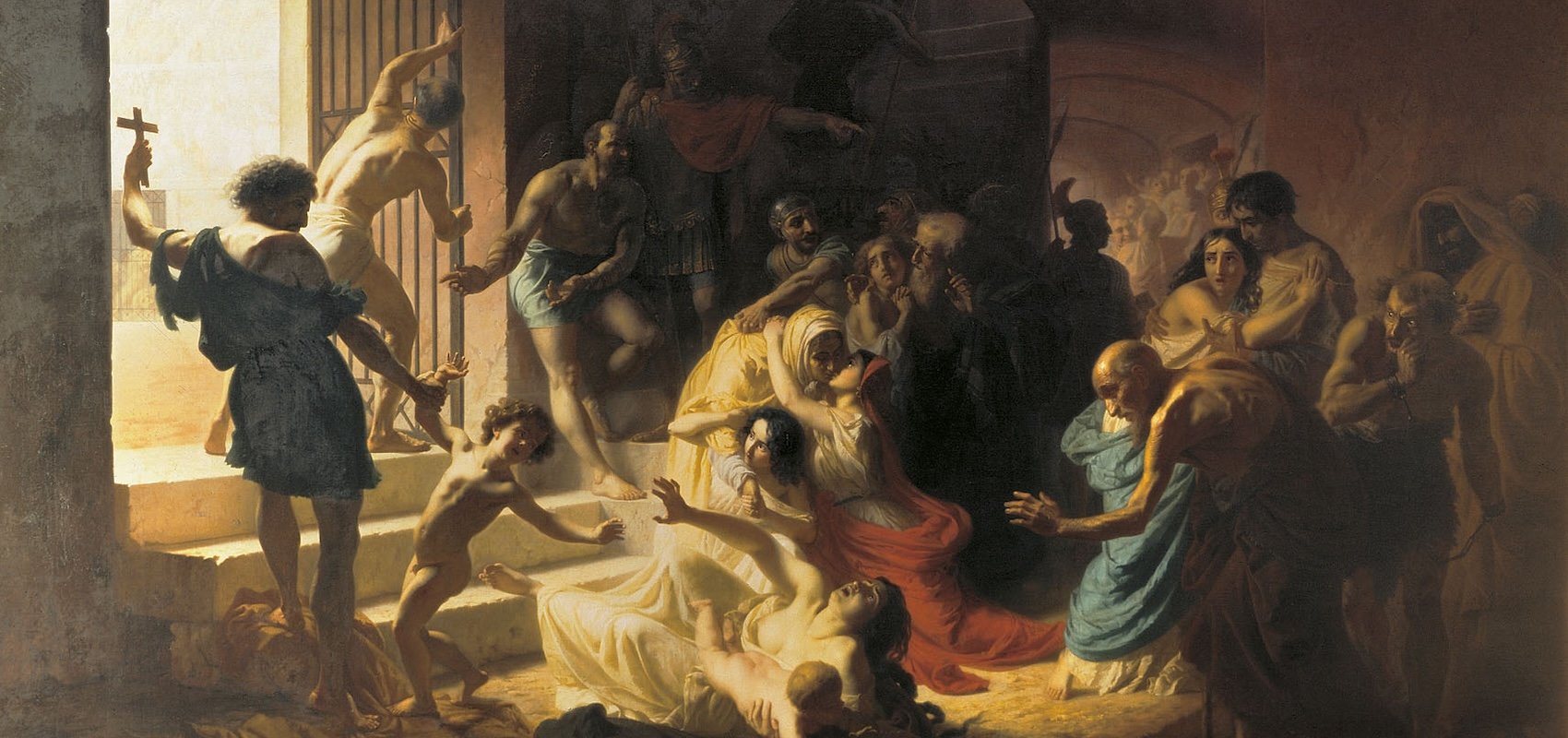
And what about the devolution of life to prudent self-protection, careful calculation of risks, and the pursuit of mere comfort? In the worship of the Catholic Church, believers recite litanies of saints, nearly all of whom were martyred for their faith. Consumed by wild beasts in a Roman arena, SS. Perpetua and Felicity bear witness to a heroic disdain for safety. Moreover, modern objections to Christianity turn on one or another concern that the life of faith is too extreme and “irresponsible.” Belief in miracles—that’s unwarranted. A strict sexual ethic—that’s unrealistic. Wanton charity—that’s imprudent.
We live in an age of small men because a great deal of modern education counsels intellectual safetyism. Our classrooms are devoted to perpetual “critique” that warns us against believing too much and too ardently. Not surprisingly, Christianity is rejected. It is dangerous and authoritarian—unsafe!
And then there’s Nietzsche’s final anathema—indifference. How can we have a culture that encourages heroism when we are catechized to believe that “You have your truth and I have mine”? Today’s soft relativism promises to keep us safe: If nothing is worth sacrificing for, then no one will be bothered to sacrifice. The skeptical tenor promotes quiet self-acceptance. If nothing is worth striving for, then we need do no more than cultivate our private gardens. Again, Christianity is many things, but it is not a party to indifference. To the contrary, liberals and progressives lament Christian intransigence, the Christian refusal to be on the “right side of history.”
I credit Nietzsche with an apt criticism of the drab and dispirited character of modern life. But his animus against Christianity blinded him to the causes of our decidedly unheroic culture. He did not recognize that the enemies of love, especially the enemies of a supernatural love of God, are the enemies of heroism. Worse, Nietzsche’s reductive and anti-metaphysical doctrine of the will to power has become one of the most powerful enemies of love. His prose gains its energy from contempt, the sharp-edged but world-weary emotion he cultivated as a poor surrogate for love, which unlike disdain reaches for great things on the power of wanton affirmation. Truth be told, for all his bluster, Nietzsche was a leading father of the Last Man.
Let me end with a recent experience. I was with a Dominican friar. As always, he was wearing his white habit. It’s an odd outfit. But in Greenwich Village, where we were walking, people often look odder still: men in halter tops and skirts, women in leather fem-dom outfits, people adorned with tattoos and laden with piercings. This strange array is hardly noticed, but the friar’s white habit attracts stares. Passersby recognize that his distinctive garb represents something other than self-expression or a display of identity. It betokens a remarkable commitment and suggests an arduous adventure—spiritual heroism.
You can certainly think that Christianity is false. But it seems far-fetched to claim that Christianity does anything other than inspire heroic ambition.


YOU MIGHT ALSO LIKE
Living with Wittgenstein
In the autumn of 1944, Ludwig Wittgenstein noticed a young doctoral student in attendance at his lectures…
Briefly Noted
Kevin James and Raymond Leo Cardinal Burke rarely appear side by side, even in print—the back-cover endorsements…
How Kanye Went Nazi
Last year, Kanye West—sometimes known as Ye—released a song titled “Nigga Heil Hitler.” The music video featured…
