
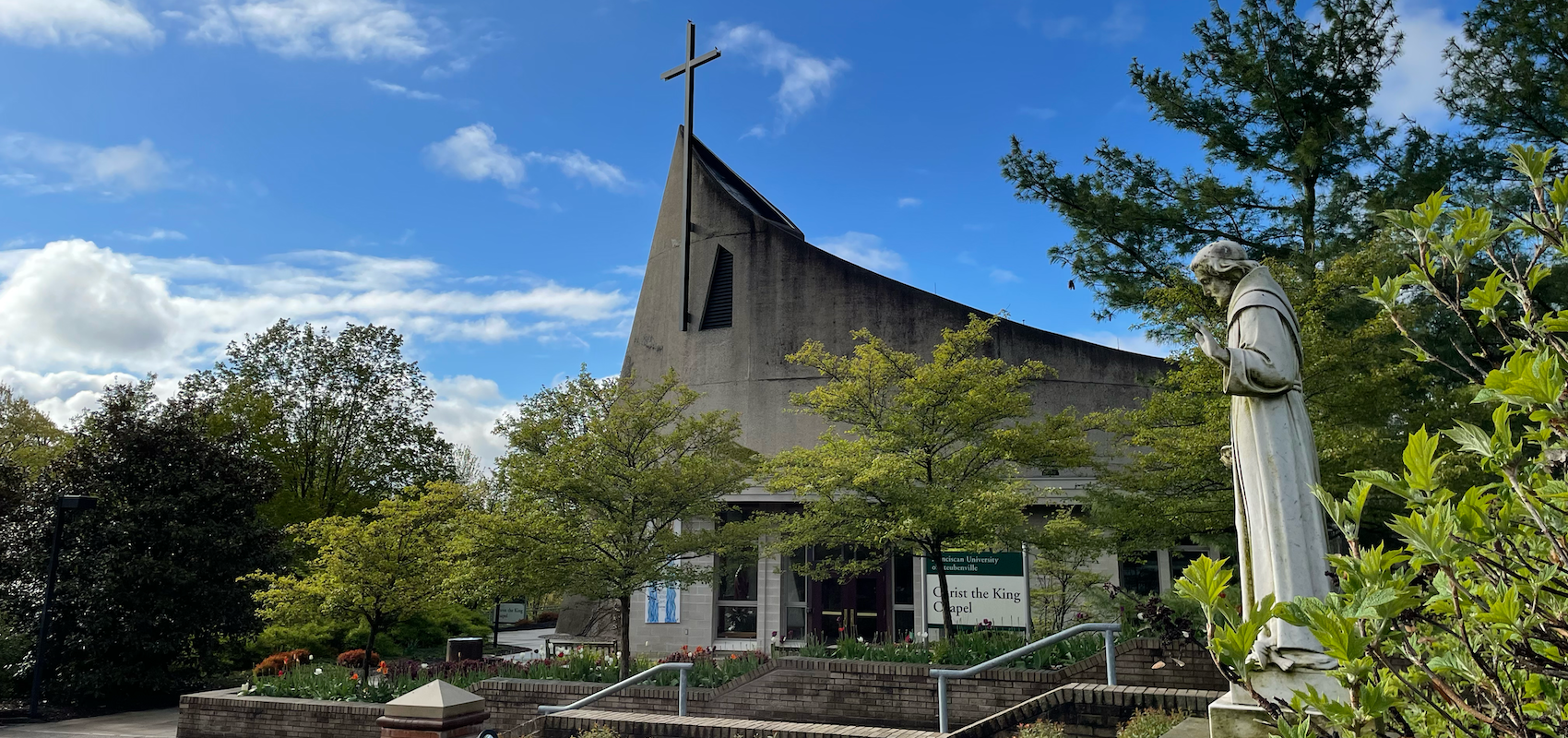
Fr. Dave Pivonka, president of Franciscan University of Steubenville, recalls receiving a recent essay of interest from a prospective student attending a large public school. The student explained that he held traditional beliefs concerning Christian marriage, the sanctity of life, and the creation of man and woman, among other things, that repeatedly put him at odds with his peers. He said in his essay that he’d like to go to a place where he didn’t have to fight all the time, and that he saw Franciscan as a place where he could do just that. Amid a growing interest in faithfully Catholic colleges, this student stands out as one example of a broader trend. “We’re about forming young men and women in the intellectual life, but also in the faith life, where, I think, unfortunately, lots of colleges and universities are really about forming activists,” Fr. Pivonka said.
Estimates say anywhere from one to 1.5 million students have opted out of college after Covid, and 29 percent of Americans say college is simply “not worth it.” For many Gen Zers, the question is no longer which college to attend, but whether to go at all. Amid this national downturn in collegiate interest, Newman Guide–recommended colleges are seeing record enrollment numbers and steadily growing student bodies. And the administrators say their Catholic identity is an integral part of that growth.
The Newman Guide recognizes vetted Catholic colleges that are successfully maintaining a Catholic identity in all areas of campus life. According to its website, the Newman Guide reaches more than 75,000 families each year: parents and students looking for a faithfully Catholic education. It lists “prayer,” “Scripture,” “sacrament,” “Christian worldview,” and “Catholic community” as some of its criteria, and there are currently twenty colleges that make the recommended list, including Belmont Abbey, Benedictine, Christendom, University of Dallas, and Franciscan.
Belmont Abbey in Belmont, North Carolina, has a monastery on campus with fourteen monks living there full-time. It currently has the highest overall enrollment in the college’s history. This year’s freshman class is its second largest ever.
“There is certainly a Catholic piece to our growth. However, I would say the national trend we are seeing with small religious colleges experiencing enrollment growth is tied less to religious denomination than what James Davison Hunter in his highly influential book Culture Wars: The Struggle to Define America pointed to as a divide in our culture between those who hold an orthodox worldview and those who hold a progressive worldview,” Interim President and Provost Joseph Wysocki said. “I believe that in a world that is increasingly characterized by uncertainty, manipulation, and a feeling by students that they are anchorless, that colleges that posit timeless truths worthy of investigation will continue to attract students.”
Benedictine College in Atchison, Kansas, currently has 2,250 undergraduate students, up 22 percent over the last ten years. This fall was only the second time its incoming freshman class exceeded 620, and they report a record number of transfers. On the frontier of making college affordable, Benedictine gave out more scholarship money this year than ever before and launched an initiative to add 250 more scholarships over the next nine months.
Christendom College in Front Royal, Virginia, has grown 18 percent over the past ten years, reaching its enrollment cap of 550 students a couple of years ago. Reaching that enrollment cap has meant administrators like Vice President of Enrollment Tom McFadden are left to wrestle with the question of what the ideal Christendom student is, and how the college will ensure that he is admitted over a “not-so-Christendom-esque student.” Additionally, there has been a dramatic rise in high school students making campus visits throughout the year and attending Christendom’s Best Week Ever summer program.
“Families who are either homeschooling their children, or sending them to private, Catholic, or independent schools, want more for their children,” McFadden said. “They have sacrificed so much to ensure that their children are not affected by today’s toxic culture, and they have sacrificed lots of money to give their children a truly Catholic education. It’s no surprise that when they are looking for colleges to send their children, the Newman Guide colleges are top of the list. As long as the culture continues to decline, Christendom College will continue to be relevant—and necessary.”
A similar sort of wrestling has taken place at the University of Dallas. The university received more than two thousand additional applicants to its undergraduate college this past year. President Jonathan J. Sanford cites the Eucharistic Revival and the growth of classical K–12 education as some of the reasons for this growing interest. “We were not aiming to grow significantly, so what this enabled us to do was to take more care to ensure we pulled in very strong fits who are prepared for our core curriculum, who want to go to our Rome campus their sophomore year, who want to deepen their faith, who want to build character with friends, and who want to be excellent people who also excel professionally,” Sanford said.
Franciscan University of Steubenville in Ohio, however, is looking to grow, reporting increased enrollment numbers for the eleventh year in a row. Franciscan expanded its academic programming to include an engineering major, which just graduated its first class. They wandered campus with the option to attend Mass four times a day alongside over a dozen practicing friars and a practicing priest as the college president.
“St. John Paul would have said that a university should have two communities, an academic community and a faith community, and those two things aren’t opposed to each other. They live vibrantly in a Catholic institution,” Fr. Pivonka said. “That’s what we’re trying to do: What we’re trying to do here stands in contradiction to what’s going on in the culture. And I think more and more young people . . . they see the emptiness. The world that doesn’t stand for anything that’s true, good, or beautiful. And they want to stand in contradiction to that.”

YOU MIGHT ALSO LIKE
James Talarico’s Backward Christianity
James Talarico wants to “reclaim Christianity for the left.” That’s the title of the New York Times…
Redemptor Hominis: More Important than Ever
Forty-seven years ago, Pope John Paul II issued his first encyclical, Redemptor Hominis (The Redeemer of Man).…
Indispensable Plato
Over the past decade, somewhat surprisingly, many people have become born-again defenders of Western civilization...
