
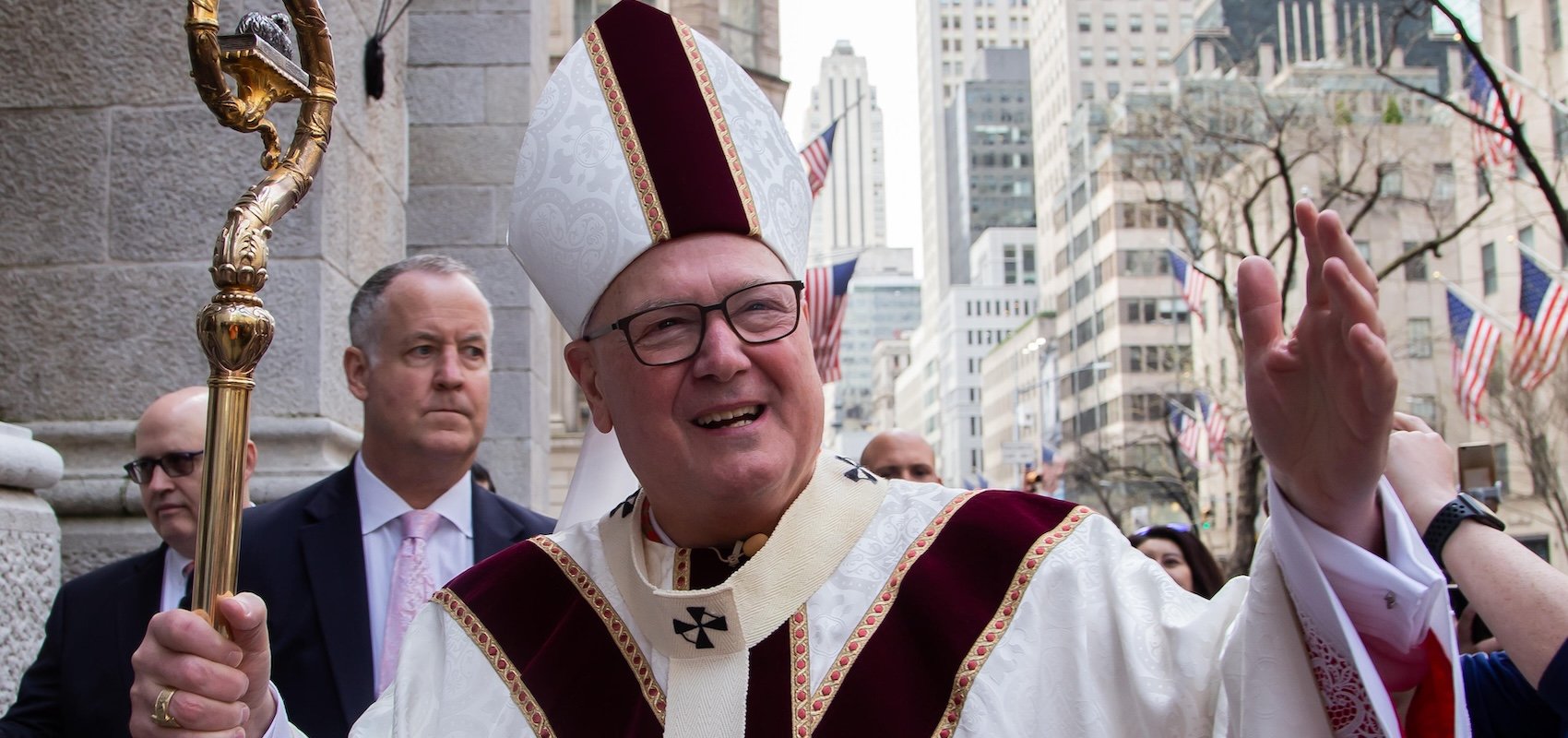
There’s a steakhouse on East 50th Street in midtown Manhattan, to which Cardinal Timothy Dolan and I would sometimes walk for dinner after a preprandial or two in his sitting room. The restaurant was less than a block away from the residence of the archbishops of New York, and the walk would ordinarily take two or three minutes. With Cardinal Dolan, it often took ten minutes, sometimes fifteen, because virtually everyone we passed along the way wanted to greet the archbishop, share a story, thank him for this or that, or just say hello.
I watched this time and again, and it reminded me of something one of Cardinal Dolan’s predecessors, Cardinal John O’Connor, had said when I asked him in 1996 what Pope John Paul meant. “What he means,” Cardinal O’Connor replied, “is that people know they have a pope.” Not abstractly. Not as a historical factoid or “Jeopardy” answer. But as someone in high office with whom people believed they had a personal relationship that made a difference in their lives. Someone they could rely on. Someone they could look up to. Someone who understood them, empathized with them—in fact, loved them.
For the past seventeen years, the people of New York have known that they had an archbishop, and in the same sense in which John Paul II made them know they had a pope.
Since the announcement last December that Pope Leo XIV had accepted the resignation Cardinal Dolan was canonically obliged to offer a year ago on his seventy-fifth birthday, tributes have been paid to Cardinal Dolan’s singular embodiment of Christian joy; to his skills as a homilist who combines accessibility with spiritual depth; to his effective work as a seminary rector forming exceptionally fine priests; to his leadership in the United States Conference of Catholic Bishops; and to his willingness to both work with the powers of this world and speak hard truths to them when necessary. I’d like to focus on three aspects of the man that may not have received sufficient notice thus far.
First, beneath the smiling, gregarious Irish American big brother or uncle that is his public persona, Timothy Michael Dolan is a serious intellectual. He may well be the best-read bishop in the United States; that sitting room where we would sip and talk was overflowing with new books, and they were not there for decoration. They had been read, or were being read, and it was the rare title I’d mention to the cardinal that he hadn’t heard about—and those that were new to him, he ordered. With an earned doctorate in U.S. Catholic history, Cardinal Dolan knew the story of Catholicism in these United States inside and out and had the largest treasure trove of historical anecdotes I’ve ever encountered, many of them gleaned from his mentor, the great John Tracy Ellis.
Second, Cardinal Dolan is a fiercely loyal friend. After he got acquainted with the head of the Ukrainian Greek Catholic Church (UGCC), Major Archbishop Sviatoslav Shevchuk, he became one of the Ukrainian leader’s advocates and defenders. Dolan was sitting next to Shevchuk when the head of the Russian Orthodox Church’s “foreign affairs” department, Metropolitan Hilarion Alfeyev, in a display of grotesquely bad manners and Russian imperial arrogance, befouled his invitation to address a Synod by lambasting the UGCC. The cardinal archbishop of New York turned to the major archbishop of Kyiv-Halych and said, “If you want to walk out, I’ll be right with you.” And in the four years since Russia’s invasion of Ukraine, no American bishop has been more supportive of the UGCC’s head in the U.S., Archbishop Borys Gudziak, than Cardinal Dolan.
Then there is the cardinal’s constant defense of religious freedom, manifest in his creating a small shrine honoring Hong Kong prisoner of conscience Jimmy Lai in St. Patrick’s Cathedral. Regime-friendly (or compromised) Chinese in New York protested; the cardinal paid no heed.
Young Tim Dolan never wanted to be anything but a parish priest, and he’s remained that at heart. When friends are ill, he calls. His parish visits as archbishop in both Milwaukee and New York were his favorite moments as a shepherd. Wherever he has served, virtually everyone regrets his leaving, which cannot be said, alas, of every senior churchman.
As of February 6, he will not be archbishop of New York. But Cardinal Timothy Dolan, in good health and full of energy, is by no means at the end of his ministry or influence. His presence will be felt stateside, and in Rome, for years to come. And we may thank God for it.
George Weigel’s column “The Catholic Difference” is syndicated by the Denver Catholic, the official publication of the Archdiocese of Denver.


YOU MIGHT ALSO LIKE
Turned Away on Palm Sunday
In politics, diplomacy, war, or pretty much any field of human interaction, one must contend not only…
Timothée Chalamet Is Right About Art (ft. Suzy Weiss)
In this episode, co-founder and reporter for the Free Press, Suzy Weiss, joins Virginia and Germán to…
A Medieval Pilgrimage in Modern Assisi
When you go to the hilltop town of Assisi, you’re immediately struck by how medieval it is:…
